Bandhan Nifty Midcap 150 Index Fund: Investing in Category Leaders for Long-Term Capital Appreciation
Why Midcaps?
- Earnings Growth: The year-on-year earnings growth over recent quarters has consistently been stronger in the midcap segment, compared to both large caps and small caps.
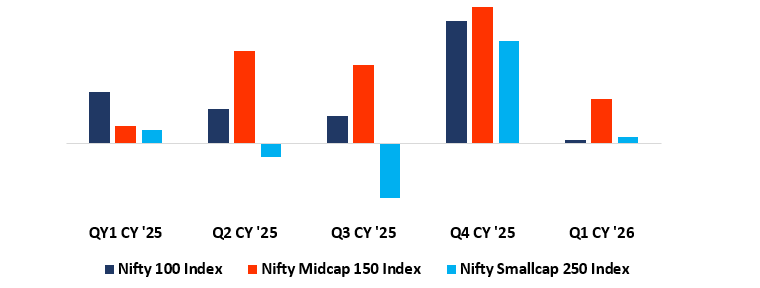
Source/Disclaimer: Data as of 31st March 2026. Bloomberg
- Outperformance: Historically, Mid-Caps have consistently outperformed Large and Small Caps, offering you a powerful tool for potential wealth creation.
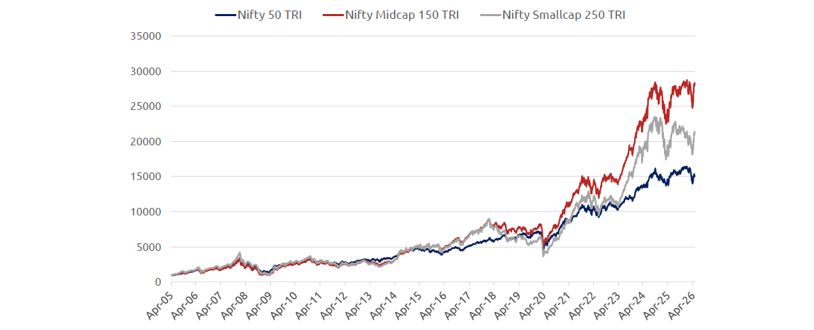
Source/Disclaimer: Nifty indices; Performance as of the close of 30-Apr-2026. Performance results have many inherent limitations, and no representation is being made that any investor will or is likely to achieve. Past performance may or may not be sustained in the future.
- Outperformance on Rolling Return basis: The table below shows the 3- and 5-year rolling return distribution of Nifty Midcap 150 TRI against the Nifty Small cap 250 TRI and Nifty 50 TRI.
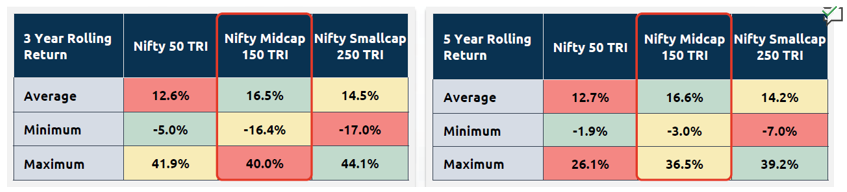
Source/Disclaimer: Nifty indices; Performance as of the close of 30-April-2026. Performance results have many inherent limitations, and no representation is being made that any investor will, or is likely to achieve. Past performance may or may not be sustained in the future. The above graph is used to explain the concept and is for illustration purposes only and should not used for the development or implementation of an investment strategy
- Company Lifecycle Stage: Midcaps are often the sweet spots in a company’s lifecycle. Mid-caps often capture businesses in the life cycle stage where they have a proven business model and a significant runway for potential growth.
- Midcaps have had a striking journey since 2020. After the pandemic crash, the Nifty Midcap 150 rebounded sharply, driven by liquidity and earnings recovery, and by 2021 valuations were running well ahead of fundamentals. That exuberance gave way to a sharp correction in 2022 as global tightening and inflation fears hit sentiment. Midcaps in India are closely tied to the domestic economy rather than global export cycles, offering a degree of insulation. With demand visibility remaining firm, the earnings trajectory lends resilience to the segment, making valuations more balanced than they appear at first glance. While the current trailing P/E of 32.44 is above the five-year average, the forward P/E of 26.94 signals earnings catch-up. This shift from price-led expansion to earnings-backed multiples makes today’s premium more durable than the speculative surge of 2021.
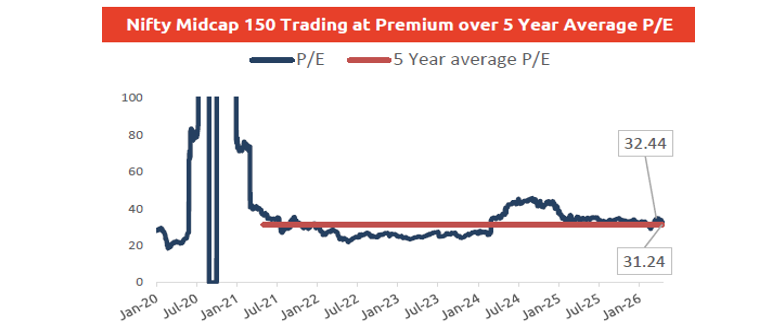
Source: Bandhan AMC. Source- NSE. Data as of 30th April 2026. Performance results may have inherent limitations, and no representation is being made that any investor will or is likely to achieve. Past performance may or may not be sustained in the future.
- Trends in FII and DII investments into mid-cap: Institutional flows show a clear divergence. FIIs have been trimming exposure across segments, with the smallest reduction in midcaps, while DIIs have steadily increased their holdings, most notably in midcaps. Interestingly, while flows diverge, allocations tell a common story - large caps have seen a reduction in ownership, midcaps have witnessed a meaningful and sustained rise, and small caps have remained broadly stable. This alignment in allocations suggests that, despite divergent flows, both FIIs and DIIs are converging on midcaps as the relative area of strength. For investors, this convergence in allocation trends highlights where conviction lies. Domestic institutions are signalling confidence in midcaps, while FIIs, despite cutting back overall, have also reduced exposure least in this segment. This suggests midcaps are emerging as the relative sweet spot in the current cycle.
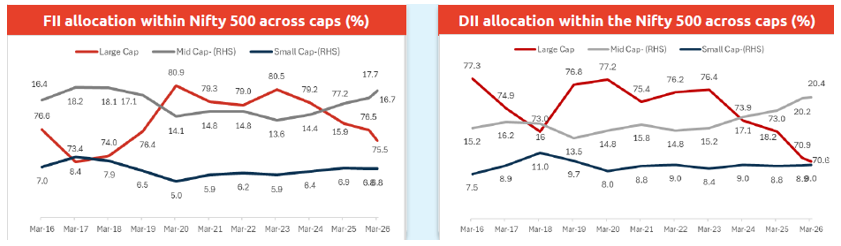
Source: Motilal Oswal India Strategy May 2026. per AMFI data, the market cap of mid-caps has tripled over the last 7 years (as of 30th April 2026, SEBI classified stocks as Large, Mid and Small Cap in 2017 to ensure uniformity; hence, 2017 is taken as the base date for relative comparison).
- From Rs 29,255 Crores in 2017, the AUM of Midcaps has grown to Rs 82,455 Crores in 2024. This shows the immense growth potential of Midcaps over the investment horizon of 5+ years.
- Exposure to Emerging Themes: Mid-Caps are your gateway to benefit from emerging themes (see graphic below).
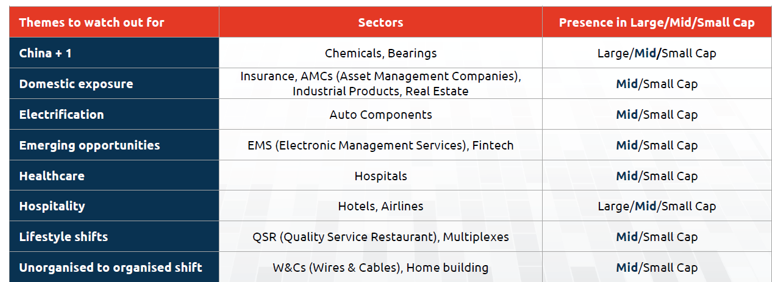
Source/Disclaimer- The sectors/stocks mentioned herein are only for illustrative purposes and should not be construed as a recommendation from Bandhan Mutual Fund or an indicative portfolio of any scheme of Bandhan Mutual Fund. Bandhan Mutual Fund may or may not hold any position in these sectors/stocks.
- Exposure to more sectors and diverse industries.
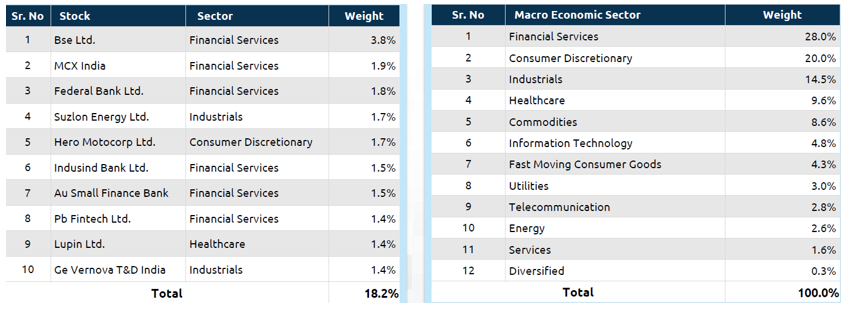
Source/Disclaimer: nifty indices; Data as of 30th April 2026. The sectors/stocks mentioned herein are only for illustrative purposes and should not be construed as a recommendation from Bandhan Mutual Fund or an indicative portfolio of any scheme of Bandhan Mutual Fund. Bandhan Mutual Fund may or may not hold any position in these sectors/stocks.
When is a good time to invest in Midcaps?
It is commonly understood that one should try to capture the markets during corrections to earn returns when they turn bullish. However, what if you were not able to predict the actual low points and were unlucky enough to invest during the market peaks? The graphic below shows that even if you had invested in the peaks, your returns would not have been so miserable. Peak is identified as newer highs. The forward returns are based on historical data and illustrate how performance would have appeared over 1, 3, or 5 years if the investment had been made at a market peak. Peaks beyond July 31, 2023, are not plotted, as forward returns of 3 and 5 years cannot be calculated.
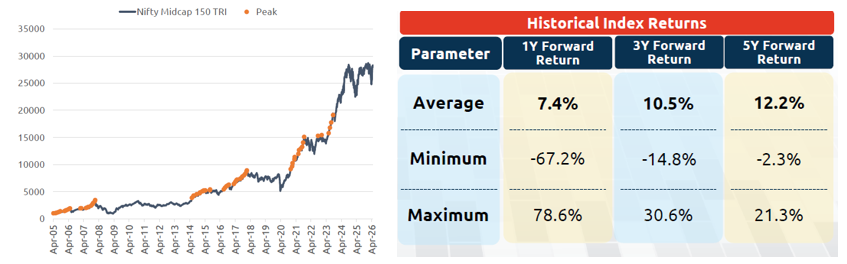
Source/Disclaimer: Nifty indices; Performance as of the close of 01-April-2005 to 30-Apr-2026. Performance results have many inherent limitations, and no representation is being made that any investor will or is likely to achieve. Past performance may or may not be sustained in the future
How to invest in Midcap Funds?
The midcap rally has been broad-based rather than concentrated in a handful of names, with gains spread across a wide set of companies over the past few years. In such an environment, missing even a few key performers can materially drag portfolio returns. For investors seeking to capture the full breadth of this opportunity, passive investing offers a smarter alternative. By tracking the Nifty Midcap 150 Index directly, investors gain exposure to the entire segment and participate in the broader market momentum.
Why Bandhan Nifty Midcap 150 Index Fund?
- The Bandhan Nifty Midcap 150 Index Fund tracks the Nifty Midcap 150 Index and invests in a broad range of mid-sized companies listed on the National Stock Exchange with a weightage based on Free Float Market Capitalisation.
- The fund is rebalanced semi-annually in March and September
- The Bandhan Midcap 150 Index fund has delivered attractive returns despite high market entry points each month.
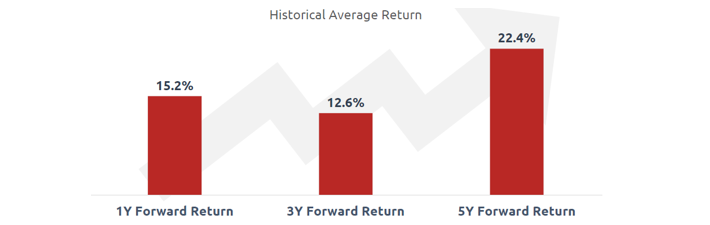
Source/Disclaimer: Nifty indices; Performance as of the close of 01-April-2005 to 30-April-2026. Average 1, 3 & 5 Year forward returns if one were to invest on the day Nifty Midcap 150 TRI was highest in a month. Performance results have many inherent limitations, and no representation is being made that any investor will or is likely to achieve. Past performance may or may not be sustained in the future
Who should invest in the Bandhan Nifty Midcap 150 Index Fund?
- Investors looking for capital appreciation and wealth creation.
- Investors should have at least a 5-year investment horizon in this scheme.
- Investors with a very high risk appetite.
- Investors can invest in this scheme either through a lump sum or SIP, depending on their investment needs.
Contact your financial advisor or mutual fund distributor to understand how the Bandhan Nifty Midcap 150 Index Fund can be a valuable addition to your portfolio.
Mutual Fund Investments are subject to market risk, read all scheme related documents carefully.
Bandhan AMC Limited (formerly IDFC Asset Management Company Limited), established in 2000, is one of India's Top 10 fund houses in terms of Asset Under Management. It has an experienced investment team with an on-the-ground presence in over 60 cities. Bandhan Mutual Fund is focused on helping savers become investors and create wealth. To support this objective, the fund house's equity and fixed-income offerings aim to provide performance consistent with their well-defined objectives. It is having its Registered Office at - Bandhan AMC Limited, One World Center, 6th floor, Jupiter Mills Compound,841, Senapati Bapat Marg, Elphinstone Road, Mumbai: 400 013
Investor Centre
Follow Bandan MF
More About Bandan MF
POST A QUERY