Bank of India Multicap Fund: Power your investments with all market caps

The Bank of India Multicap Fund has recently completed 3 years since launch. As per SEBI guidelines, multicap funds must allocate a minimum of 25% each to large cap mid cap and small cap stocks. This diversification helps spread risk and navigate periods of market volatility more effectively. In this article we will review Bank of India Multicap Fund.
Why Multicap Funds?
- Built-in diversification: Multi cap funds capture the exposure to all market caps, which encapsulates the market's breadth in a single fund.
- Larger universe of stocks: The universe of midcap stocks and small caps is much larger than large cap stocks. Multicap strategy may offer a diversified investment opportunity set compared to large caps.
- Winners rotate across market cap segments: One market cap segment does not outperform always. Winners rotate across market cap segments in different market phases (see the chart below). It is difficult to predict market outcomes for investing and outperforming. Mid and small cap stocks may outperform large caps in bull market and market expansion phases, while large caps may tend to be more resilient in market corrections. Multicap strategy may balance growth across different market cycles. Multicap strategy will enable the investors to capture winners across market segments.
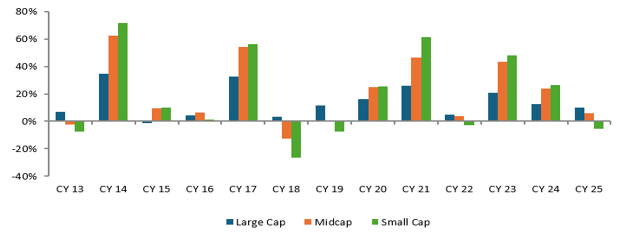
Source: NSE, Advisorkhoj Research, as of 31st December 2025. Large cap is represented by Nifty 100 TRI; Midcap is represented by Nifty Midcap 150 TRI and Small cap is represented by Nifty Small Cap 250 TRI.
- Winners rotate across industry sectors: Sector rotation is an active investment strategy and a characteristic of our equity markets. Midcaps and small caps may provide broader sector exposure than large cap stocks. There are several sectors where large cap stocks have no presence. Multicap funds can add richer diversification to your equity portfolio. The graphic below shows that winners rotate across industry sectors. A portfolio diversified across industry sectors may capture winners.
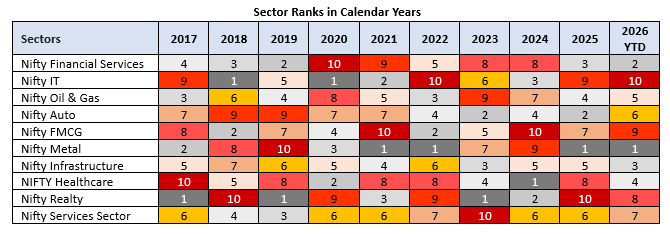
Source: Advisorkhoj Research, NSE, as on 20.02.2026
- Small / midcaps can outperform large caps: The chart below shows the 3-year rolling returns of large caps, midcaps and small caps benchmark indices over the last 20 years. You can see that small cap and midcaps outperform in bull market phases.
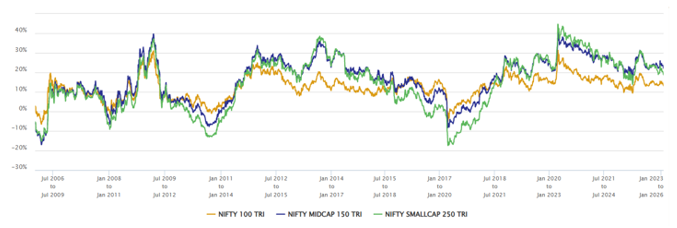
Source: NSE, Advisorkhoj Research, as of 26.02.2026.
- Mid and small caps experience deeper drawdowns compared to large caps: The large cap allocation of Multicap funds can limit downside risk during market corrections The chart below shows the drawdowns of different market cap segments over the last 20 years. You can see that large caps experience smaller drawdowns compared to midcaps and small caps.
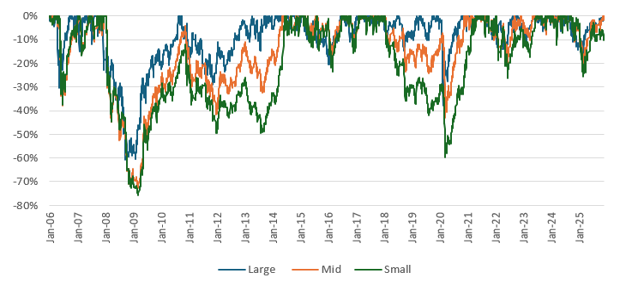
Source: NSE, Advisorkhoj Research, as of 31st December 2025. Large cap is represented by Nifty 100 TRI; Midcap is represented by Nifty Midcap 150 TRI and Small cap is represented by Nifty Small Cap 250 TRI.
- Multicap strategy can tap investment opportunities spread across market cap segments: Multicap strategy
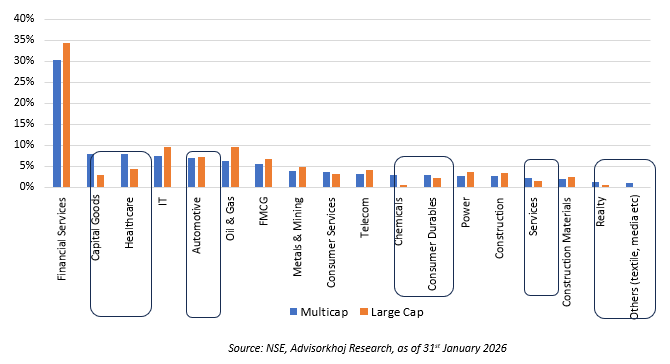
Source: NSE, Advisorkhoj Research, as of 31st December 2025. Multi cap is represented by Nifty 500 Multicap 50: 25:25 TRI and Large cap is represented by Nifty 100 TRI.
- Multicap strategy provides more balanced exposure across market cap segments: The minimum 25% allocation mandate across market caps ensures a more balanced market exposure compared to broader market index (see the charts below).
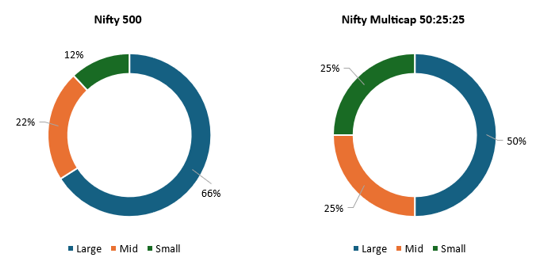
Source: AMFI, NSE, Advisorkhoj Research, as of 31st December 2025.
- Benefit from Government reforms: All three market cap segments can benefit from the structural reforms of the Government namely, formalization (shift from unorganized to organized sectors), digitization, Atmanirbhar Bharat (Make in India / manufacturing), infrastructure development, etc.
- Fund manager's expertise in managing market cap allocations: While SEBI mandates minimum 25% exposure in each market cap segment, the fund managers have the flexibility to allocate the balance 25% to any market cap segment based on their market outlook
Bank of India Multicap Fund
The Bank of India Multicap Fund aims for long-term capital appreciation by allocating 95-100% of assets to domestic equity schemes spanning varied market caps, with minimal debt or cash for liquidity (less than or equal to 25%). Mr. Nitin Gosar manages the fund with an investment strategy that includes a bottom-up and top-down approach for stock selection aiming for long-term growth with higher risk-adjusted returns. The fund is benchmarked against S&P BSE 500 TRI.
Portfolio Construction
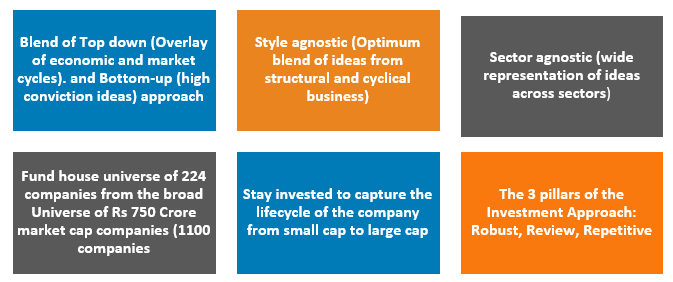
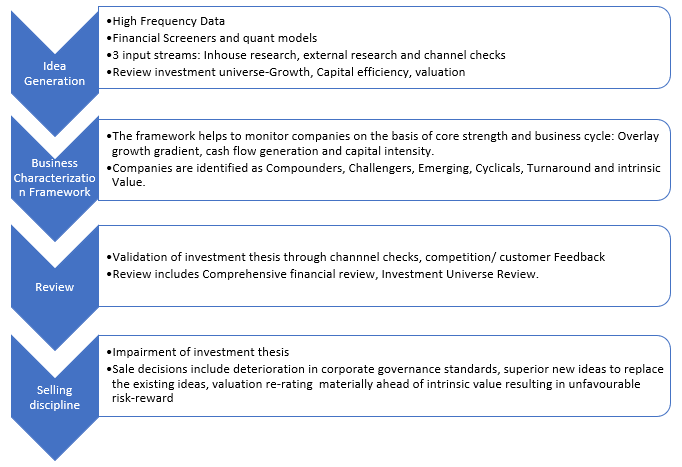
The following 3 acumen is considered in the process of Stock Evaluation:
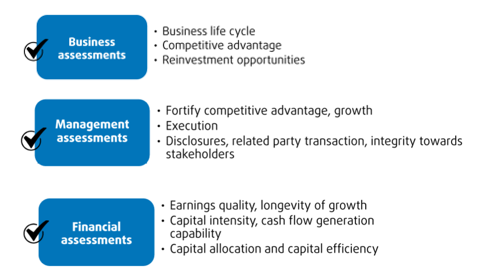
Stock Evaluation Process to create the Fund Universe
Bank of India Multicap Fund outperformed benchmark index
The chart below shows the growth of Rs 10,000 investment in Bank of India Multicap Fund versus the benchmark index since the inception of the scheme. You can see that the fund has outperformed the benchmark and created alphas for investors
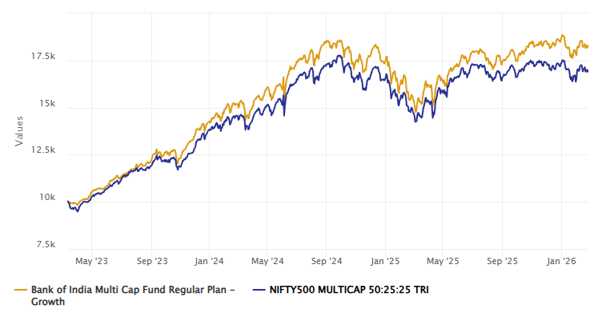
Source: NSE, Advisorkhoj Research, as of 26th February 2026
Bank of India Multicap Fund - Strong consistency performance
The graphic below shows the quartile rankings of quarterly returns Bank of India Multicap Fund for the last 3 quarters. The fund was in top 2 quartiles, 7 times in the last 12 quarters.
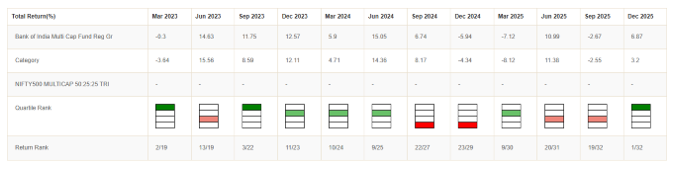
Source: Advisorkhoj Research, as of 31st December 2025
Superior risk adjusted returns
In the last1 years, Bank of India Multicap Fund has beaten the benchmark index in both up markets and down market. The Up Market capture ratio of the fund in the last 1 years was 103%, while the Down Market capture ratio was just 92%.
Why invest in Multicap now?
Sharp correction has brought valuations below peak valuations across all market cap segments.
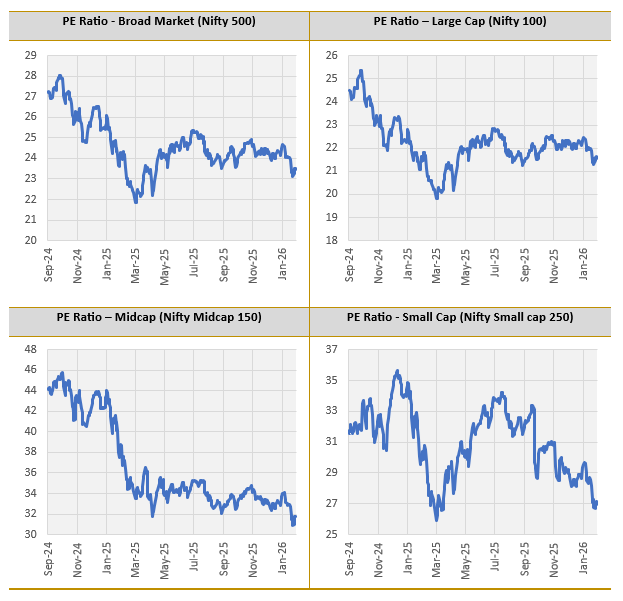
Source NSE, Advisorkhoj Research as on 31st January 2025
Current portfolio positioning
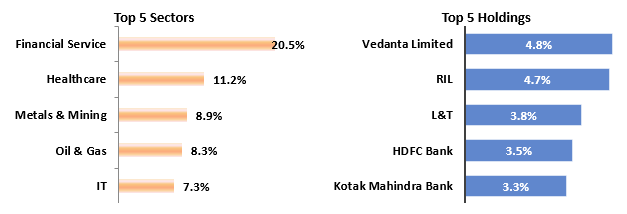
Source: Bank of India MF, Advisorkhoj Research as on 31st January 2025
Who should invest in the Bank of India Multicap fund?
- Investors seeking wealth creation over long investment tenures.
- Investors who want a disciplined structure in market cap allocations and not have over or under exposure to any particular market cap segment.
- Investors who can remain disciplined in face of market volatility. Investors should have long investment tenures of 5-7 years for Multicap funds.
- SIP can be highly effective for Multicap funds. Through SIPs, long term investors can take advantage of market volatility by averaging rupee cost of units acquired across different market cycles.
Consult your mutual fund distributor or your financial advisor to understand how the Bank of India Multicap fund can fit into your investment portfolio.
Mutual Fund Investments are subject to market risk, read all scheme related documents carefully.

Bank of India Investment Managers Private Limited is a wholly owned subsidiary of Bank of India.
Bank of India Investment Managers Pvt. Ltd. has continuously proved to be trustworthy with 15 years of rich experience in fund management and has always catered to the needs of the investors across various objectives, thus leading to a portfolio of 22 varied Mutual Fund Schemes with 8.50 lakhs+ investors and ₹13,424.21 Cr* of assets under management and 15 branches across PAN India as on 31st March, 2026.
Bank of India Investment Managers Pvt. Ltd. offers different types of investment solutions across various different asset classes. It has always planned and achieved delivering to investors with solutions regarding their investments and helped them achieve their investing goals.
Investor Centre
Follow Bank of India Mutual Fund


More About Bank of India Mutual Fund
POST A QUERY