


Bank of India Value Fund NFO: Identifying Value for Wealth Creation

The Bank of India Mutual Fund is set to launch its new fund offer, the Bank of India Value Fund NFO, which opens on 28th August. The NFO will remain open for subscription till 11th September 2026. In this article, we will review the Bank of India Value Fund NFO.
What is value investing?
Fund managers who follow the value style try to identify stocks which are trading at significant discounts to their intrinsic value. The market may over-estimate or under-estimate the intrinsic value of a stock. If the market is under-estimating the intrinsic value of a stock, then the current market price (share price) of the stock will be lower than the intrinsic value. Value fund managers will invest in stocks, where the market price is significantly lower than the intrinsic value as determined by the fund manager.
What is intrinsic value in value investing?
The value of a stock is the present value of the company's future free cash flows. Fund managers estimate the intrinsic value of a stock through fundamental analysis, i.e., analysis of the industry growth potential, the company’s competitive strengths, market share growth, operating margins, working capital and capex growth, and financial projections, including earnings per share (EPS) growth, etc.
The Value Trap
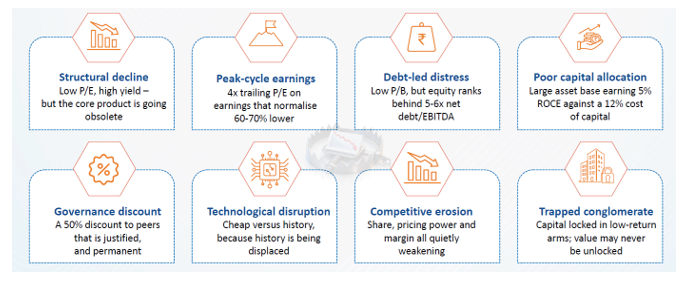
Cheapness without change is a value trap. Eight ways a cheap stock remains cheap:
Value Investing: Debunking Myths
- Cheap does not translate to value: Without improvement in fundamentals, a cheap stock remains cheap. Value is unlocked in a stock through inflexion. (See charts below.)
The illustration below shows how a value business is identified based on various qualitative and quantitative parameters along with inflexion point based on filters and investment approach.
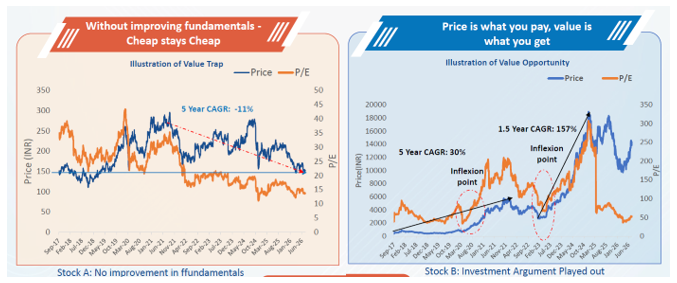
Source: Rupeevest. The above illustration is for illustrative purposes only and not a recommendation to invest in any security/stock/sector. Inflexion point is an indication of identifying value opportunity in any business.
- Value is not intrinsic only in large caps: Value opportunities span across market-cap and sectors. In fact, Small and Mid Caps often show a wider and earlier opportunity set
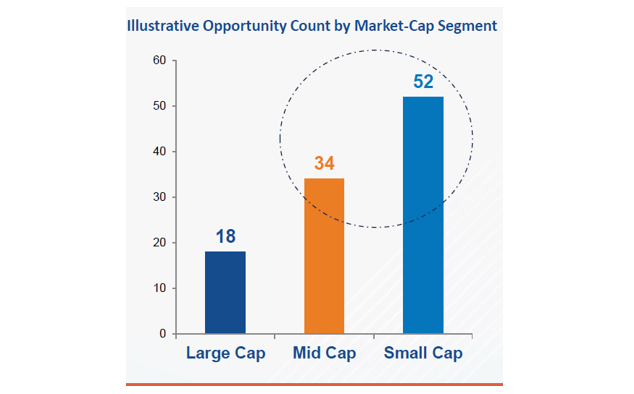
Source: Bank of India product ppt. AMFI, Bloomberg. Above illustration is based on trailing 1Y P/E ratios of the Top 500 companies as on July 31, 2026, using sector-wise average valuations as per AMFI industry classification and market-cap segmentation.
- Value and growth are exclusive: The best value investments often become tomorrow's growth stories. The chart below shows the value and growth phases of a company.
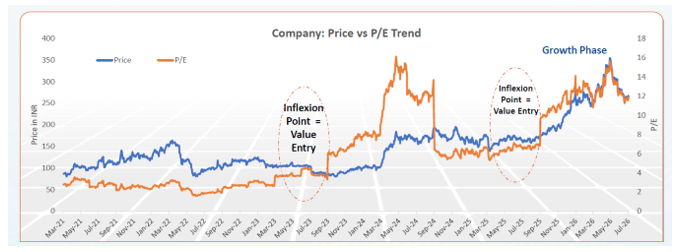
Source: Bank of India product ppt. Bloomberg
Value Vs Growth: A comparison
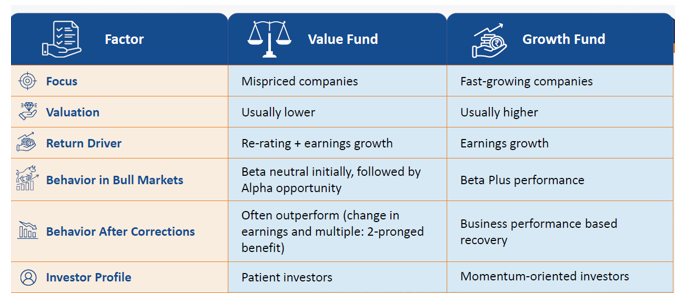
Why should you invest in Value Funds?
- Compounding is amplified in value investing: Value Strategy has generated ~27X Returns over the last 2 decades ( See chart below)
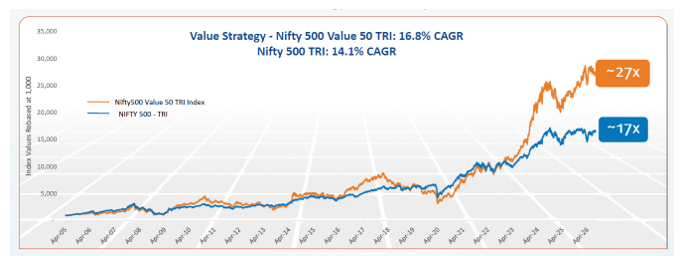
Source: Bank of India Product ppt.
- Value investing wins frequently over other styles. (see illustration below)
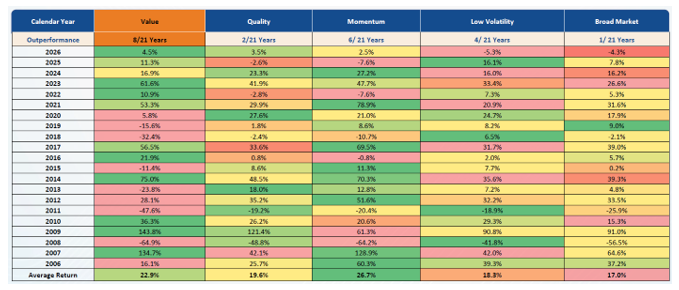
Source: ACEMF: Value: Nifty500 Value 50 TRI; Quality: Nifty500 Quality 50 TRI; Momentum: Nifty500 Momentum 50 TRI; Low Vol: N ifty500 Low Volatility 50 TRI; Broad Market: Nifty 500 TRI. Past performance may or may not be sustained in future. Above data is as on 31 st July, 2026
Bank of India Value Fund NFO: Investment Process
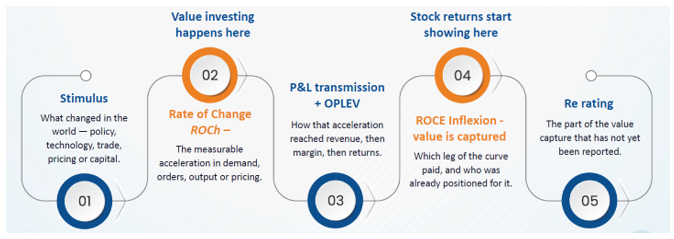
Investment Philosophy
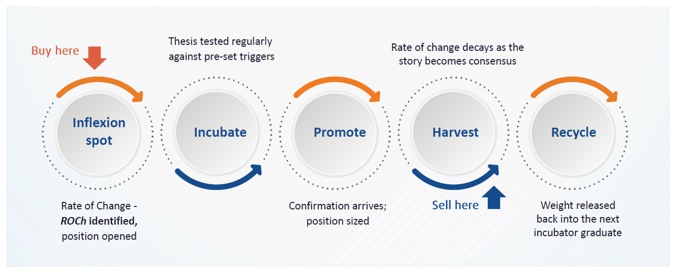
The scheme identifies ROCh as the criterion for investment. ROCh is an acronym for rate of Change that signifies acceleration of the stock rather than the speed or the growth. How fast/slow the growth happens is the ROCh, and is the investment premise in the Bank of India Value Fund, as the philosophy here is that ROCh precedes Value, and Value precedes Growth.
Investment Criteria
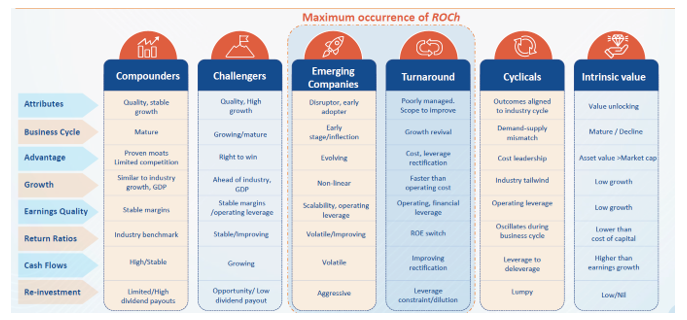
Stocks are run through a 6-badging filter where they are evaluated based on attributes, business cycle, advantages, Growth potential, the quality of earnings, Return ratios, cash flows, and reinvestment opportunities. The companies are assigned six badges, viz. Compounders, Challengers, Emerging Companies, Turnaround, Cyclicals and Intrinsic Value. The Emerging Companies and the Turnarounds are the ones that show the maximum ROCh. The fund manager Mr. Nav Bhardwaj identifies a portfolio of 50-80 stocks using Bottom-up stock selection with macro overlays. The investment is done across market cap and remains sector agnostic
Source: Bank of India product PPT.
5 - filter Portfolio Allocation
Who should invest in the Bank of India Value Fund?
The fund may be suitable for
- Investors looking for capital appreciation over long investment horizon
- Investors looking for value-based investing approach for meeting their long-term financial goals
- Investors willing to invest in undervalued business
- Investor looking for diversified investment in fundamentally strong companies across market cap and sectors
- Investors with a very high-risk appetite
- Investors with an investment tenure of over 5 years
Investors should consult a mutual fund distributor or financial planner to understand if they should invest in the Bank of India Fund NFO.
Mutual Fund Investments are subject to market risk, read all scheme related documents carefully.

Bank of India Investment Managers Private Limited is a wholly owned subsidiary of Bank of India.
Bank of India Investment Managers Pvt. Ltd. has continuously proved to be trustworthy with 15 years of rich experience in fund management and has always catered to the needs of the investors across various objectives, thus leading to a portfolio of 22 varied Mutual Fund Schemes with 8.50 lakhs+ investors and ₹13,424.21 Cr* of assets under management and 15 branches across PAN India as on 31st March, 2026.
Bank of India Investment Managers Pvt. Ltd. offers different types of investment solutions across various different asset classes. It has always planned and achieved delivering to investors with solutions regarding their investments and helped them achieve their investing goals.
Investor Centre
Follow Bank of India Mutual Fund


More About Bank of India Mutual Fund
POST A QUERY




