


HDFC Multi Asset Active FOF: Track record of stability amidst volatility

In the current environment of uncertainty, a multi-asset allocation strategy that provides exposure to three or more asset classes can provide stability to your portfolio and may be suitable for long-term investors. In this article, we will review the HDFC Multi Asset Active FOF which has completed 5 years since its inception and understand how this fund can contribute to your asset allocation requirements.
What is multi-asset allocation?
Traditional asset allocation refers to diversifying your portfolio with allocations to equity and debt based on your risk appetite. However, including other asset classes, e.g., commodities (gold, silver), international equities, etc., can provide richer diversification to your investment portfolio. Multi-asset allocation funds offer exposure to three or more asset classes in a single product. As per SEBI's mandate, multi-asset allocation funds must have a minimum 10% exposure in each asset class, with at least 3 asset classes in the scheme's underlying portfolio.
Benefits of a multi-asset allocation strategy
- Diversifying beyond traditional asset allocation: Traditional asset allocation, i.e., equity and debt, can reduce portfolio risks, but over long investment tenures, multi-asset allocation (three or more asset classes) can harness the potential of other asset classes to enhance portfolio returns. Adding multiple asset classes to your investment portfolio will not just diversify risks, it will also have the potential of generating superior risk-adjusted returns over a long investment horizon.
- Winners rotate across asset classes: One asset class cannot outperform forever. Different asset classes emerge as winners in different years, depending on market and economic conditions (see the chart below). It is difficult to predict the best-performing asset class at any point in time. Exposure to multiple asset classes may bring more consistency to your portfolio performance across market conditions or investment cycles.
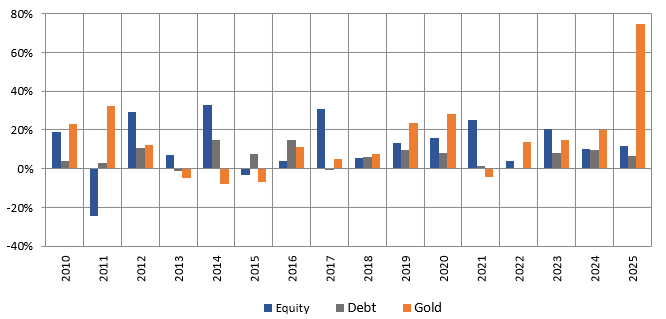
Source: NSE, MCX, Advisorkhoj Research, as on 31st December 2025. Equity is represented by Nifty 50 TRI, Debt by Nifty 10-year Benchmark G-Sec Index, Gold by MCX spot prices.
- Equity and Gold are counter-cyclical: The chart below shows the 1-year rolling returns of Nifty 50 TRI (representing equity) and gold over the last 20 years. You can see that gold outperformed in the periods where equity returns were low/negative. Multi-asset allocation funds can protect downside risks due to gold allocation.
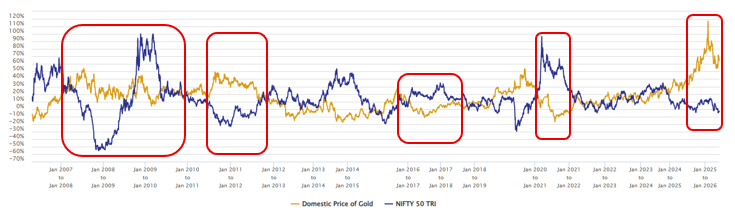
Source: NSE, MCX, Advisorkhoj Research, as on 29th May 2026.
- Why is timing the market difficult: The chart below shows the returns from Nifty 50 in each year since 2000. You will see that the Nifty 50 has given varying returns and even negative returns in various years.
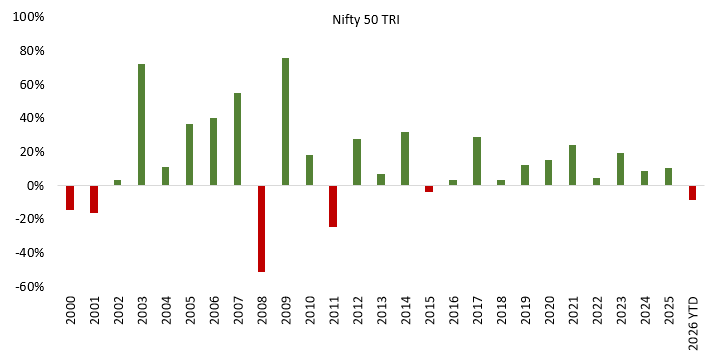
Source: www.niftyindices.com, as on 29th May 2026. Past performance may or may not be sustained in the future and is not a guarantee of any future returns.
Timing the equity markets is difficult. It is difficult to predict the correct entry and exit points consistently in the short term. The key to wealth generation is spending time in the market with downside risk management. Risk management is best done by combining negatively correlated assets.
How to take exposure to different asset classes efficiently?
A Fund of Funds reduces the efforts of making investment decisions for investors by relying on the expertise of Fund Managers to take exposure to multiple mutual fund schemes/asset classes. The fund of funds can help you in managing all the 5 dimensions of investing with an aim to create wealth in the long term. (see graphic below)
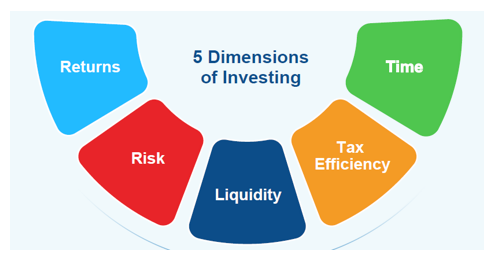
Source: HDFC MF Product presentation
About HDFC Multi Asset Active FOF
Formerly known as the HDFC Asset Allocator Fund of Funds, the name has been changed to HDFC Multi-Asset Active FOF, effective from May 02, 2025, and the Benchmark of the Fund has been changed to 50% NIFTY 50 TRI + 40% NIFTY Composite Debt Index + 10% Gold derived as per regulatory norms. The Fund managers, Mr. Srinivasan Ramamurthy (Equity-oriented Schemes), Mr. Anil Bamboli (Debt-oriented Schemes), and Mr. Bhagyesh Kagalkar (Gold ETFs) seek capital appreciation by managing the asset allocation between Equity-oriented, Debt-oriented, and Gold ETF Schemes.
Why invest in HDFC Multi Asset Active FOF?
- Better risk-adjusted returns compared to Nifty 50: Since its inception, the Fund has been able to perform strongly against NIFTY 50 TRI with lower volatility.
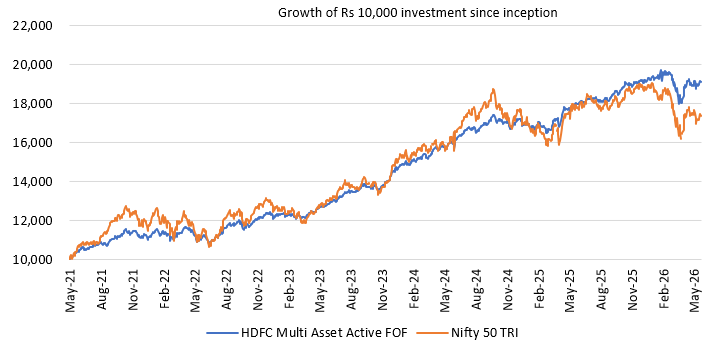
Source: Advisorkhoj Research, as on May 29th, 2026
- Lower downside risks compared to the broad market index: Drawdowns of the fund have been much lower than the broad market index, Nifty 50 TRI (see chart below).
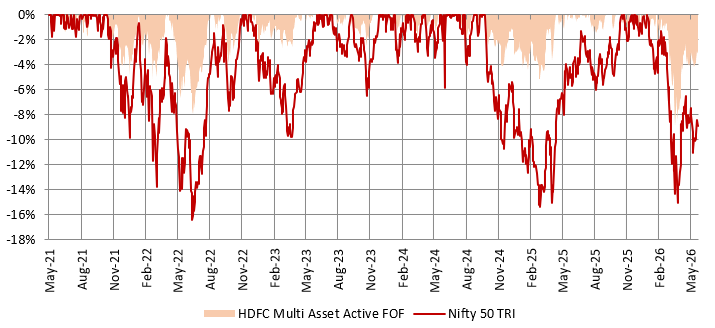
Source: Advisorkhoj Research, as on May 29th, 2026
- Dynamic approach taking care of allocation "horizontally" (Across asset classes) and "vertically" (Across large,mid and small caps for Equity-Oriented Schemes, and across different durations / themes for Debt-Oriented schemes):
- Fund gives exposure to a Multi-Fund Manager expertise
- Aim to generate risk-adjusted returns in a tax efficient manner post latest union budget and subject to conditions
- Over 25 years of proven of HDFC Mutual Fund with an experienced Investment Team
- One-stop solution for meeting asset allocation needs by combining negatively / low correlated assets, bringing diversification to your portfolio
Investment strategy of HDFC Multi Asset Active FOF
- Equity Allocation Strategy (40 - 80%): Allocation to Equity is done on two considerations: Base allocation (50%-100% of Equity allocation into Large Cap, Mid Cap, Small Cap and Flexi Cap categories of MF Schemes) and tactical allocation (0-50% of equity allocation into all other categories of MF Schemes). The factors considered for equity allocation are Trailing 12-month P/E, 1-year forward P/E, Trailing 12-month P/B, Earnings Yield / GSec Yield. The model aiding judicious and dynamic allocation towards equity is done by keeping the above factors in mind. The Model indicating allocation towards Equity is devised on the basis of back-tested results. The Portfolio is rebalanced on a monthly basis. The current positioning is a model aiding judicious and dynamic allocation towards equity by keeping the above factors in mind.
- Debt Allocation Strategy (10 - 50%): The Aim of Debt allocation is to invest, predominantly, in schemes with exposure mostly to issuers with high credit quality and take controlled interest rate risk. There is a duration based allocation (50 - 100% of debt part) e.g. Overnight, Liquid, Ultra Short, Low Duration, Short Duration, Medium Duration, Medium to long Duration, Long Duration categories of MF Schemes and 0 - 50% of the debt part.
- Gold Allocation Strategy (10 - 30%): 10 - 30% is invested in gold ETFs (HDFC Gold ETF).
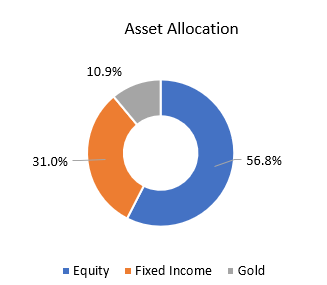
Source: Advisorkhoj Research, HDFC MF, as on 30th April 2026
Current portfolio positioning
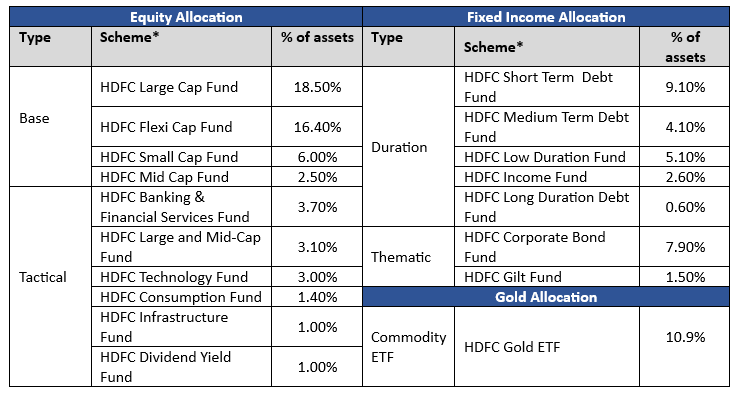
Source: Advisorkhoj Research, HDFC MF, as on 30th April 2026. *The FOF invests in Direct Plan, Growth options of the schemes mentioned below.
Taxation of HDFC Multi-Asset Active FOF
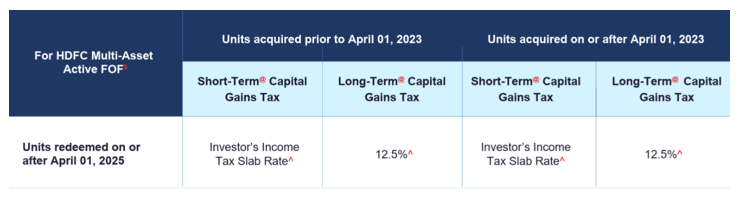
Note: Short-term period: Period of holding less than or equal to 24 months, Long-term period: Period of holding greater than 24 months. ^Surcharge as applicable + Health and Education Cess applicable at 4% on aggregate of base tax + surcharge
Who should invest in the HDFC Multi-Asset Active FOF?
The fund may be suitable for investors who:
- Seek stability in volatile markets
- Aim to generate returns while keeping volatility in check
- Want to diversify across various asset classes
- Look for investment for medium to long-term goals
Contact your Financial Advisor or Mutual Fund distributor to understand if the HDFC Multi-Asset Active FOF is suitable for you.
Mutual Fund Investments are subject to market risk, read all scheme related documents carefully.
RECOMMENDED READS
LATEST ARTICLES

Discipline, good governance, and genuine care for our stakeholders have helped HDFC Asset Management Company Limited build a reputation for trust. Over the last two decades, HDFC AMC has become one of the most prominent mutual fund houses in India. We are committed to our mission of being a wealth creator for every Indian. Here is a brief snapshot of some of HDFC AMC's key milestones.
Investor Centre


About HDFC MF
POST A QUERY




