Stay DiSIPlined: Let Your SIP Do the Heavy Lifting

Discipline is not always exciting. It is waking up when the alarm rings, exercising when the sofa looks more inviting, and saving before spending. Yet, these small, repeated actions often create the biggest results over time. The same principle applies to mutual fund investing. When the word discipline is viewed through the lens of SIP, it becomes DiSIPlined-a reminder that a Systematic Investment Plan can help investors stay consistent, even when markets become noisy. SIP is not merely a way to invest a fixed amount every month. It is a habit that can help investors remain connected to their long-term financial.
Why should investors be DiSIPlined?
Markets rarely move in a straight line. A sharp fall can cause anxiety, while a strong rally can create the fear of missing out. Continuous news updates and market commentary may also make investors question decisions that were originally made with a long-term objective. This is where discipline becomes important. If investors stop their SIPs whenever markets decline, they may miss the opportunity to purchase more units when prices are lower. If they invest aggressively only after markets have risen, they may end up making decisions driven by excitement rather than planning. Staying DiSIPlined does not mean ignoring the market. It means refusing to let short-term movements control a long-term investment plan.
SIP: A small habit with a larger purpose
Imagine an investor starting a monthly SIP of Rs 5,000. The amount may appear modest compared with a large financial goal. However, investing Rs 5,000 every month translates into Rs 60,000 a year and Rs 6 lakh over 10 years, excluding returns. Wealth creation does not always result from one large investment. It can also emerge from regular contributions made over a long period. A SIP helps bring this consistency into an investor's routine. It will help younger investors e.g. Gen Z, Millennials get into early savings habit and begin their investments a long runway to take off for long term financial goals.
The benefit of investing across market cycles
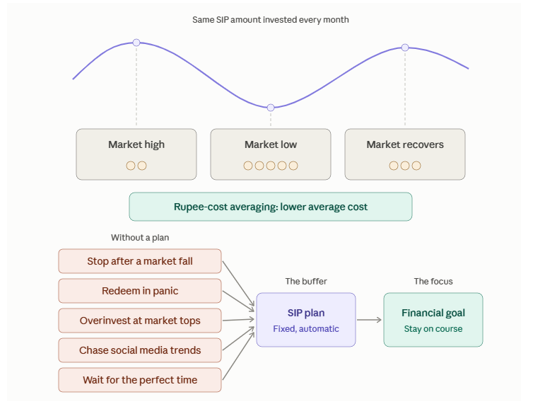
HSBC Mutual Fund's "STAY DISIPLINED" campaign describes SIPs as a disciplined, long-term approach that allows investors to remain invested through market cycles. When markets are high, you will through purchase fewer units, but when markets decline, the same SIP amount may purchase more units. Over time, this can help average the purchase cost of units, a concept commonly known as rupee-cost averaging.
Discipline reduces emotional decisions
One of the biggest advantages of discipline is that it creates a buffer between market events and investor actions. Without a plan, an investor may:
- Stop investing after a market fall.
- Redeem investments in panic.
- Over-invest at market tops.
- Fall prey to temptations and social media trends
- Wait indefinitely for the "perfect" time to invest.
A SIP can help limit these emotional urges or social media and peer group pressures, especially for less experienced investors like Gen Z and Millennials, by enabling them to commit to a plan focused on their financial destination.
Discipline creates financial momentum
A monthly SIP can also encourage better financial habits. Once investing becomes a regular expense, investors may become more conscious of their spending and savings patterns. Over time, investors can consider increasing their SIP contributions as their income grows. Step-up SIP may help their investments keep pace with rising income, inflation, and changing financial goals. For example, an investor may begin with a monthly SIP of Rs 5,000 and increase it periodically as their income grows. Even a gradual increase can strengthen the contribution towards long-term goals.
Staying disciplined does not mean staying careless
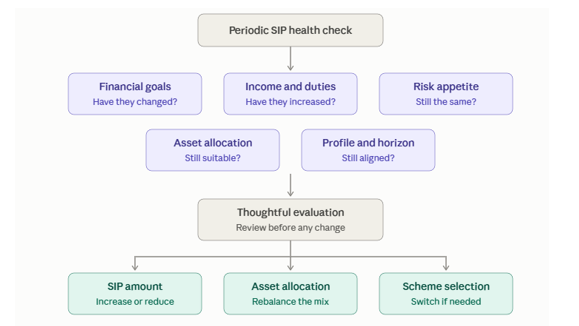
Discipline should not be confused with blindly continuing an investment; you should do a periodic SIP health check:
Let patience join the plan
Discipline works best when combined with patience. A long-term investment goal may take several years to achieve, and the journey may include periods of uncertainty. The important question is not always, "What did the market do today?" It may be more useful to ask, "Am I still following a plan that is suitable for my goal?" That shift in perspective can make investing less stressful. Instead of attempting to predict every market movement, investors can focus on investing in a disciplined way and allowing time to play its role.
Be DiSIPlined, not distracted
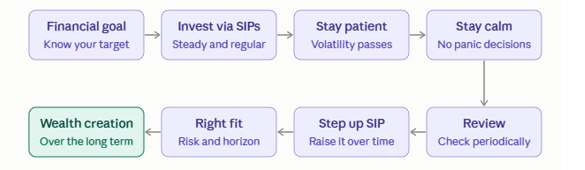
So, the next time market noise makes you question your SIP, remember the wordplay: remain DiSIPlined. Let your plan-not your emotions-guide your investment journey.
An Investor Education and Awareness Initiative by HSBC Mutual Fund
Visit https://www.assetmanagement.hsbc.co.in/en/mutual-funds/investor-resources/information-library/know-your-customer w.r.t. one-time Know Your Customer (KYC) process, complaints redressal process including SEBI SCORES (https://www.scores.gov.in). Investors should only deal with Registered Mutual Funds, to be verified on SEBI website under Intermediaries/Market Infrastructure Institutions (https://www.sebi.gov.in/intermediaries.html). Investors may refer to the section on Investor Education on the website of HSBC Mutual Fund for the details on all Investor Education and Awareness Initiatives undertaken by HSBC Mutual Fund.
Document intended for distribution in Indian jurisdiction only and not for outside India or to NRIs. HSBC MF will not be liable for any breach if accessed by anyone outside India. For more details, Click here / refer website.
Mutual Fund Investments are subject to market risk, read all scheme related documents carefully.
SEBI Registered Name/Number-HSBC Mutual Fund MF/046/02/5
CL 4509

We are a global asset manager with a strong heritage of successfully connecting our clients to global investment opportunities.
Our proven expertise in connecting the developed and developing world allows us to unlock sustainable investment opportunities for investors in all regions. Through a long-term commitment to our clients and a structured and disciplined investment approach, we deliver solutions to support their financial ambitions.
Other Links
POST A QUERY