Volatility in Markets and Your Long-Term Investment

Current Markets
Markets have been more volatile than many investors are comfortable with, and the recent geopolitical shock around the US-Iran conflict has amplified that turbulence by pushing crude higher, pressuring the rupee, and shaking rate-sensitive sectors. Volatility in Indian equities has been driven by a combination of global risk events and FII sell-off, even though domestic investment flows have remained resilient. Rise in crude oil and gas prices have sent prices of many essential commodities increasing and affected domestic market sentiment. Yet this is exactly when disciplined investing matters most. For long-term goals, the best move is usually to keep your SIP running through the noise rather than reacting to market movements.
Serious investors often start their equity investments with an intention of staying invested and building long-term capital. Panic selling in falling markets and indiscriminate profit booking when markets turn bullish are behaviours driven by biases that adversely affect your long-term financial goals. In this article, we will understand the nature of volatility and how to stay a disciplined investor in volatile markets.
Markets move in cycles in the long term
The chart below shows the growth of the Rs 10,000 investment in Nifty 50 TRI over the last 20 years. You can see that the market experienced several corrections over the last 25 years e.g. Global Financial Crisis in 2008, COVID – 19 pandemic in 2020, Russia Ukraine War, US Iran War etc. However, the market always recovered from the lows and went on to make new highs. This is the nature of equity markets. Redeeming your investments in panic when market falls goes against the investment wisdom of buy low, sell high.
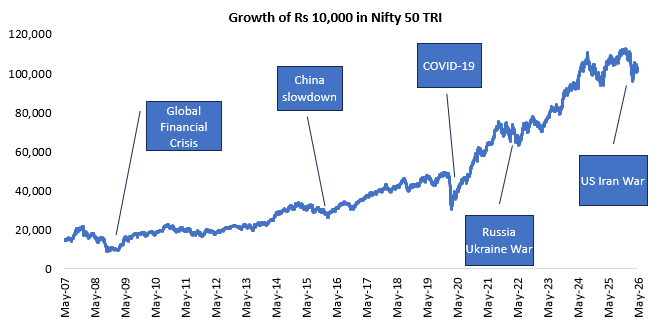
Source: National Stock Exchange, Advisorkhoj Research. Period: 01.06.2006 to 29.05.2026. Disclaimer: Past performance may or may be sustained in the future. Mutual funds are subject to market risks.
Should you stop your SIP in falling markets?
Whilst a correction can trigger all your panic buttons, this is the time to exercise the greatest restraint. Even though your fear of losing more money pushes you to stop any further investment, you should be doing just the opposite. An investor who takes the market correction as an opportunity and continues investing rather than stopping their SIPs in market sell-off, is taking a giant step towards achieving their target corpus.
Why disciplined investors need to be patient?
Every correction and recovery is different. While market recovers faster in some corrections, it takes a longer time to recover in some other corrections. For example, Nifty 50 TRI fell by nearly 60% in the 2008 Global Financial Crisis market crash and took 997 days (nearly 3 years) to recover to the pre-crash level (source: NSE, Advisorkhoj Research). On the other hand, Nifty 50 TRI fell by 37% in the COVID-19 crash and took 259 days (less than 1 year) to recover (source: NSE, Advisorkhoj Research). Long term investors need to be patient and disciplined during market corrections and recoveries, even if the recovery time is long. If you continue your SIP when the market is falling, you will be buying units at lower net asset values. Therefore, for the same amount of investment, you will be able to purchase more units in falling markets. This is known as Rupee Cost Averaging. Let us understand this with the help of a hypothetical example. Suppose you have SIP of Rs 10,000 per month. If the scheme NAV is 100, then you will be accumulate 100 units in a month. However, if the NAV falls to 80, then you will accumulate 125 units. Since you can accumulate higher number of units in falling market, your potential wealth creation is likely to be higher compared to an investor who stops his / her SIP in falling markets.
Conclusion
Rupee cost averaging, the inherent advantage of an SIP, can even out any market volatility over the long term, allowing the investor to gain maximum benefits on his or her investments over time. Investing a fixed amount of money every month towards any scheme allows them to purchase more units of the scheme when the price of the investment is lower. This reduces the average cost of purchasing the financial asset over time. As a footnote, we can say that the market may punish impatience, but it rewards persistence. In that sense, continuing the SIP is not blind optimism; it is a rational response to a market that has historically always recovered after shocks, even when the recovery took longer than anyone expected.
An Investor Education and Awareness Initiative by HSBC Mutual Fund
Visit https://www.assetmanagement.hsbc.co.in/en/mutual-funds/investor-resources/information-library/know-your-customer w.r.t. one-time Know Your Customer (KYC) process, complaints redressal process including SEBI SCORES (https://www.scores.gov.in). Investors should only deal with Registered Mutual Funds, to be verified on SEBI website under Intermediaries/Market Infrastructure Institutions (https://www.sebi.gov.in/intermediaries.html). Investors may refer to the section on Investor Education on the website of HSBC Mutual Fund for the details on all Investor Education and Awareness Initiatives undertaken by HSBC Mutual Fund.
Document intended for distribution in Indian jurisdiction only and not for outside India or to NRIs. HSBC MF will not be liable for any breach if accessed by anyone outside India. For more details, Click here / refer website.
Mutual Fund Investments are subject to market risk, read all scheme related documents carefully.
SEBI Registered Name/Number-HSBC Mutual Fund MF/046/02/5
CL 4174

We are a global asset manager with a strong heritage of successfully connecting our clients to global investment opportunities.
Our proven expertise in connecting the developed and developing world allows us to unlock sustainable investment opportunities for investors in all regions. Through a long-term commitment to our clients and a structured and disciplined investment approach, we deliver solutions to support their financial ambitions.
Other Links
POST A QUERY