PGIM India Healthcare Fund: The health of your wealth

In the short time since its inception in December 2024, the PGIM India Healthcare Fund has shown promise of being a good opportunity for long-term investment. In this article, we will review the fund in light of the opportunities presented by the Healthcare sector in India.
Healthcare Industry: More than just pharmaceuticals
There are many misconceptions about the healthcare sector, with some believing it is highly concentrated or limited to just pharmaceuticals. In reality, healthcare is a diverse and expansive theme that encompasses various sub-segments, including hospitals, diagnostics, medical devices, discovery, and pharmaceuticals. Each sub-segment in healthcare features distinct business models with unique economic characteristics
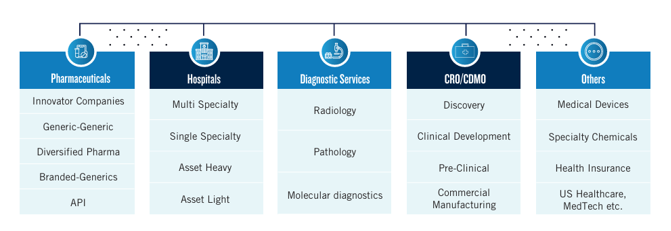
Source: PGIM product leaflet. CRO - Contract Research Organization, CDMO - Contract Development and Manufacturing Organization
Why invest in a dedicated healthcare fund?
Healthcare is a complex and under-represented sector within broader indices, necessitating a specialized, active approach. Bottom-up stock picking is of paramount importance in this segment as winners keep rotating between subsegments as shown in the table:
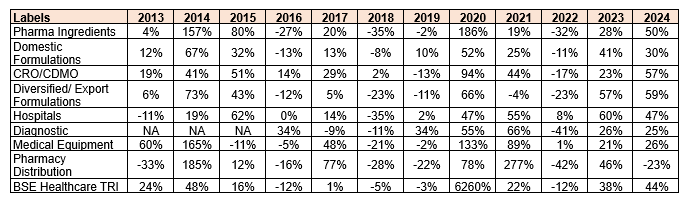
Source- Factset, PGIM India Internal Analysis. For understanding purposes only. The sub-segments are the internal bifurcation of PGIM India AMC. Past performance may or may not be sustained in the future and is not a guarantee of any future returns. Index performance does not signify scheme performance. CDMOs- Contract development and manufacturing organizations, CRO- Contract research organizations.
Drivers of long-term growth in the Indian healthcare sector
Under-penetration of health insurance in India results in significantly higher out-of-pocket expenses compared to developed economies. There is huge growth potential for healthcare and allied sectors in India. The drivers of long-term growth of the healthcare industry in the Indian context are:
- Life expectancy is increasing in India. Average life expectancy at birth in 2000 was 63 years, which is expected to increase to 84 years by 2048. Longer life spans fuel healthcare sectors.
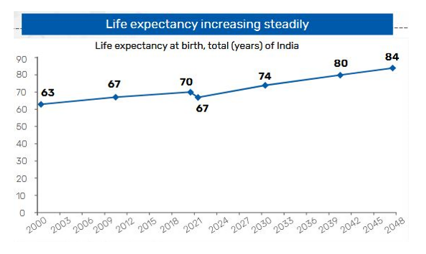
Source: PHD Research Bureau projections for the years 2030, 2040 and 2047
- The ageing population over time is a natural phenomenon in a young country with improving healthcare facilities. India has seen an increase in the median age since the 1950's. The median age is further expected to increase by 1.3X (2025-2050). An aging population boosts demand for age-related healthcare services.
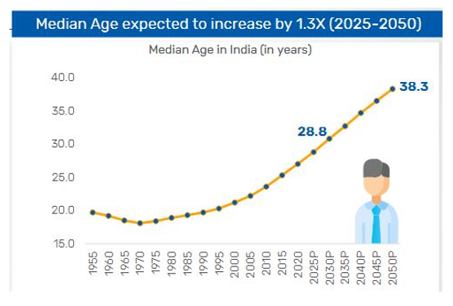
Source: UN WPP 2024
- Private healthcare expenditure outstrips Government spending on healthcare in India. Growing per capita income will drive personal healthcare investment.
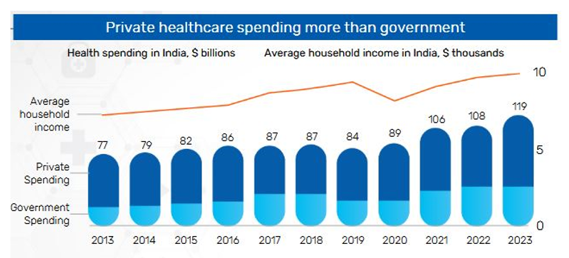
Source: S&P Household Income Projections; Fitch Solutions Health Expenditure
- India spends less on health than other EMs & DMs (see the chart below). There is scope for significant growth in healthcare expenditure in India compared to other major economies.
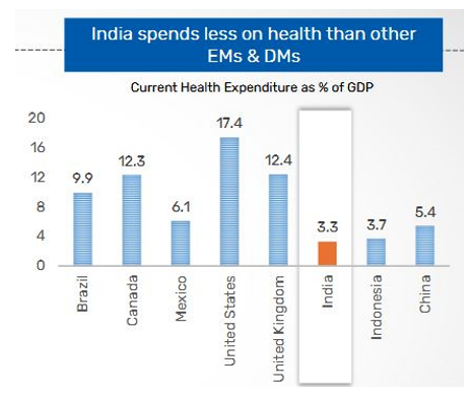
Source: WHO, Data as of 2021. DM – Developed Market and EM – Emerging Market
- Healthcare infrastructure needs to improve rapidly if India aspires to be developed economy in the next two decades. Hospital beds expected to increase 12X by 2048 (see the chart below) to be comparable with the healthcare standards of developed countries. Number of Doctors increased 1.1X in 4 years. No of medical colleges in India increased by 1.8X to 758 in FY 24 (in 8 years). Healthcare infrastructure is expanding with growing investments in Tier 2-6 cities for multispecialty hospitals, diagnostics, specialty clinics etc.
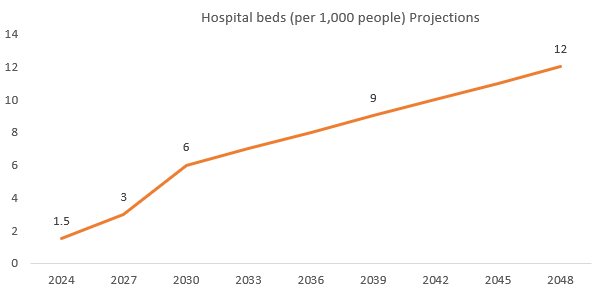
Source: IBEF, PHD Research Bureau projections for the years 2030, 2040 and 2047. Disclaimer: The projections have been made to meet the aspirational target of developed economy healthcare levels by 2047
Why should you invest in the Healthcare sector?
- Wealth Creation with lower corelation: Lower correlation may help investors reap the benefits of diversification and risk management (see chart below)
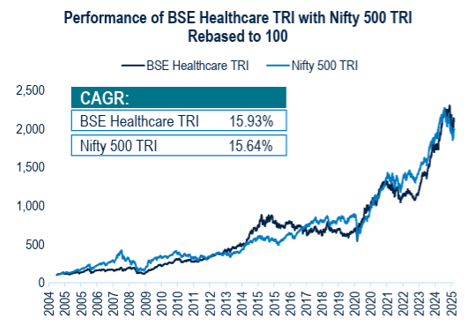
Source: MFI ICRA. Data from 31st August 2004 to 31st April 2025 & 30th April 2007 to 30th April 2025. BSE Healthcare TRI is the benchmark for this fund and Nifty 500 TRI represents the broader market.
- Superior performance consistency: The table below shows the rolling returns distribution of the healthcare index versus the broad market index (Nifty 500 TRI) for different investment tenures over the last 20 years. You can see that the healthcare index consistently had higher % instances of 15%+ CAGR returns compared to the broad market index, across most investment tenures.
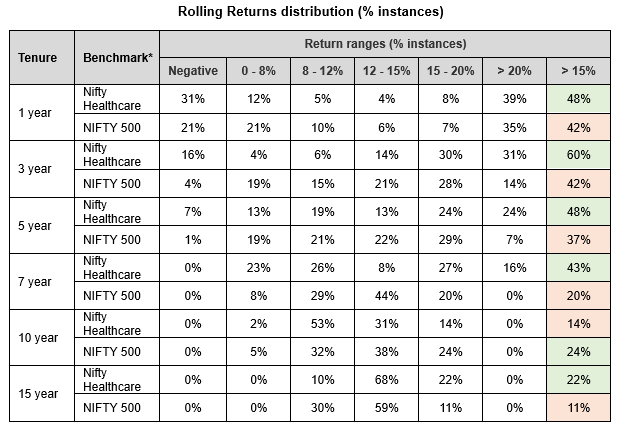
Source: Advisorkhoj Research, as on 19th June 2026 * Both benchmark indices are total return indices
- Diverse opportunities across various sub-segments within Healthcare: Investment in the Healthcare sector gives investors the exposure to the entire gamut of the sub-segments in the healthcare industry; each sub-segment features distinct business models with unique economic characteristics.
PGIM India Healthcare Fund
The PGIM India Healthcare Fund is an open-ended equity scheme investing in healthcare and pharmaceutical sector, with an objective to seek to generate consistent returns by predominantly investing in equity and equity-related securities of pharmaceutical and healthcare companies. The fund is managed by fund manager A Anandha Padmanabhan, who also manages multiple PGIM India MF schemes and has been tracking the Healthcare domain of Indian equities for over 15 years.
The fund has demonstrated promise since its inception in December 2024. The fund has outperformed its peers (category average) over different investment tenures in the last 1 years (see the chart below).
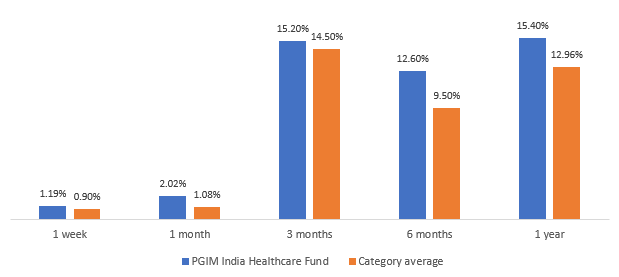
Source: Advisorkhoj Research as on 19th June 2026
Upper Quartiles Performance
The charts below show that the fund has featured in the top quartile in the two years since its launch. Also, the fund has featured in the top two quartiles in 4 quarters out of the 5 completed quarters since its launch.
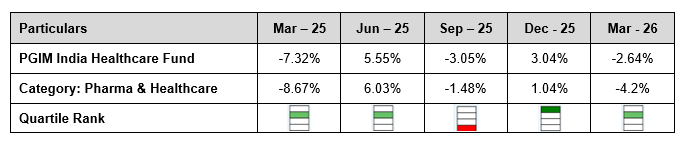
Source: Advisorkhoj Research as of 31st March 2026
Investment Approach of PGIM India Healthcare Fund
- Combination of top-down and bottom-up portfolio construction.
- Growth at a reasonable price (GARP) style.
- Flexibility to adjust allocations across different sub-segments within the healthcare theme based on the market outlook.
- The fund managers use three-pronged criteria based on Quality, Growth and Management to choose about 180-200 stocks from a universe of all companies with a market cap greater than Rs.1,000 crores (including any IPOs).
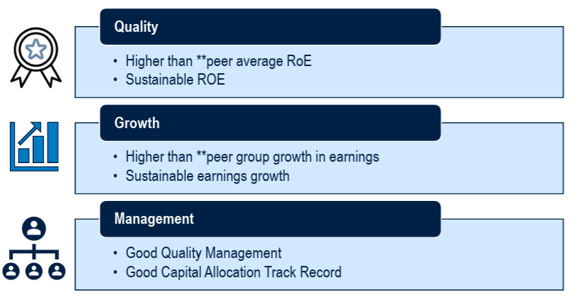
Source: PGIM India Healthcare Fund product presentation
- From the fund house universe of 180-200 stocks so chosen, an optimal portfolio is constructed (see graphic), keeping in view the mandate of diversification and high active share while maintaining lower portfolio turnover. Factors considered include valuation, market cap, liquidity, and macro-outlook.
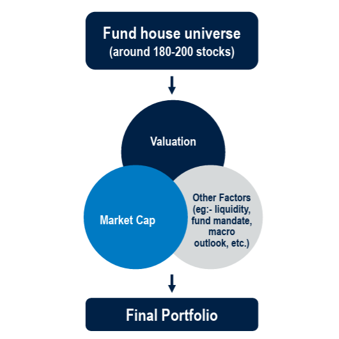
Source: PGIM India Healthcare Fund product presentation
Portfolio Construct
The current portfolio construction is leaning towards small caps with 46.31% allocation; Large cap allocation is 33.34%, while Midcap stocks are at 18.24%, besides 2.1% of cash for liquidity purposes. The chart below shows the top 5sector allocation as well as the top 5 stocks in the portfolio.
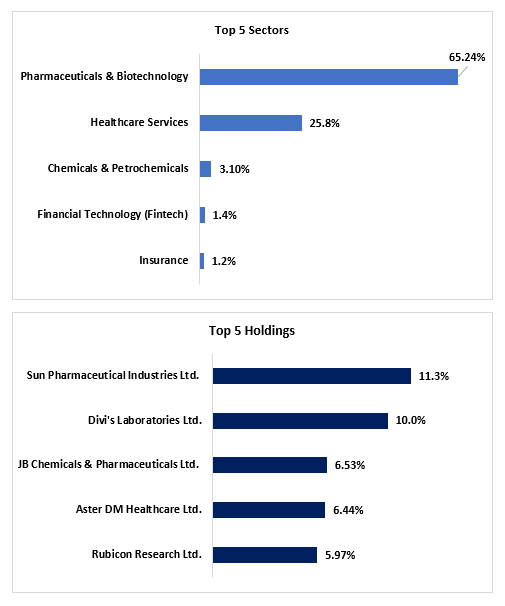
Source: Fund factsheet as of 31st May 2026
Why invest in PGIM India Healthcare Fund?
- Pricing Power: Healthcare is one of the few sectors that demonstrates strong pricing power, driven by its essential, non-discretionary nature, which supports long-term growth
- Active Management: In a sector where winners rotate across sub-segments, an actively managed fund is positioned to strategically navigate opportunities, optimizing exposure to sub-themes based on their relative risk and return potential.
- Emerging Opportunities: Capitalize on domestic growth and global export potential, driven by evolving geopolitical dynamics and India’s strong manufacturing capabilities.
- Risk/Return Potential: Focus on relative risk/return potential, management quality, and revenue growth consistency.
- Key Drivers: Key drivers for various segments include therapy mix, field force productivity, and brand strength in hospitals and diagnostics.
Who should invest in the PGIM India Healthcare Fund?
The fund is suitable for:
- Investors looking for long term capital growth,
- Investors who have a long-term investment horizon of more than 5 years
- Investors who have a high to very high-risk appetite.
- Investors who would want exposure to the healthcare sector.
Investors should consult their financial advisers or mutual fund distributors to understand if the PGIM India Healthcare Fund is suitable for them.
Mutual Fund Investments are subject to market risk, read all scheme related documents carefully.

PGIM is the global investment management business of Prudential Financial, Inc. (PFI) USA, with USD 1.5 trillion in assets under management. We offer a broad range of investment capabilities through our multi-manager model along with experienced investment teams that assist you in achieving your financial goals. With a shared legacy of more than 150 years, PGIM is built on the strength, stability and deep expertise in managing money. We offer you a long-term perspective, having weathered multiple market cycles, and see opportunity in periods of disruption.
Investor Centre
Follow PGIM India MF


More About PGIM India MF
POST A QUERY