PGIM India Small Cap Fund: Promising fund in current market conditions for long term investors

Current market context
The outbreak of the Iran War led to sharp decline in major equity markets globally. The Nifty 50 fell by 11% on a month on month basis in March hitting 52 week low. Closure of the Strait of Hormuz and the damage to the energy infrastructure in middle east led to Brent crude oil price shooting up to $109 per barrel. The market has rebounded strongly after 15 day ceasefire between US and Iran was agreed on 8th April 2026. The Nifty has rebounded from 52 week low of 22,331 to 24,040 (as on 10th April 2025). Small cap (Nifty Small Cap 250 TRI) recovery was higher in the last 10 days at 8.5% compared to Nifty, which recovered by 6.5% (source: NSE, as on 9th April 2026). In this article, we will review PGIM India Small Cap Fund which has beaten its benchmark index in the last one year.
Why invest in small caps?
- Wealth creation potential over long investment horizon: Historical data shows that small cap stocks have outperformed large cap stocks over the last 20 years ending 31st March 2026 (see the chart below).
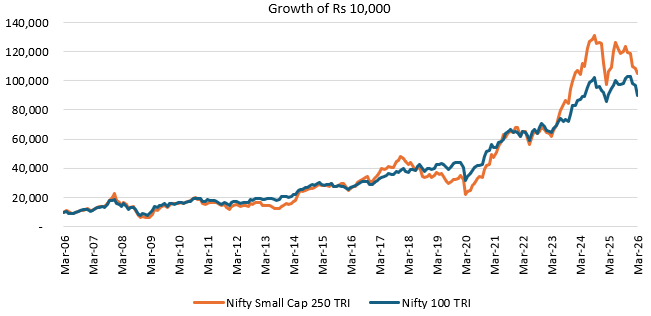
Source: NSE, as on 31st March 2026
- Suitable for SIPs: Small caps are more volatile than midcaps and large caps. Investors can take advantage of market volatility by rupee cost averaging through SIP. Rupee cost averaging can enable to accumulate more units and get higher potential returns (see the chart below).
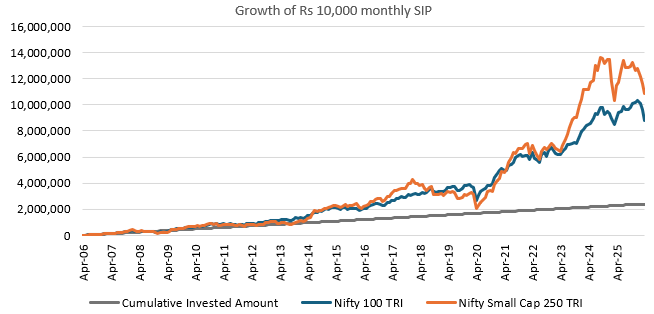
Source: NSE, as on 31st March 2026
- Exposure to a broader universe of stocks: Top 100 stocks by market capitalization are large cap stocks. 250th and lower stocks by market capitalization are small cap stocks. The universe of small cap stocks is much larger than large caps
- Add richer sector diversification to your portfolio: Small cap index has higher weights in sectors where to large caps have relatively lower weights e.g. healthcare, capital goods, chemicals etc (see the chart below). Adding small cap funds to your portfolio can increase portfolio diversification across sectors.
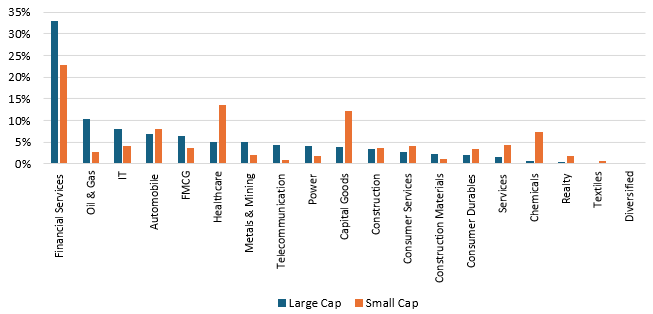
Source: NSE, as on 31st March 2026. Large cap is represented by Nifty 100 and small cap is represented by Nifty Small Cap 250
- Value discovery potential: Small cap stocks are lower percentage of institutional ownership compared to large cap stocks. As a result, they are usually under researched compared to large caps and therefore, price discovery in small cap stocks tend to less efficient than large caps. Fund managers have the opportunity to identify small cap stocks that are trading at discounts to their intrinsic valuations. These stocks may experience valuation rerating when the market discovers their value.
- Valuations have moderated: Valuations of small cap stocks have moderated over the last 6 months (see the chart below).
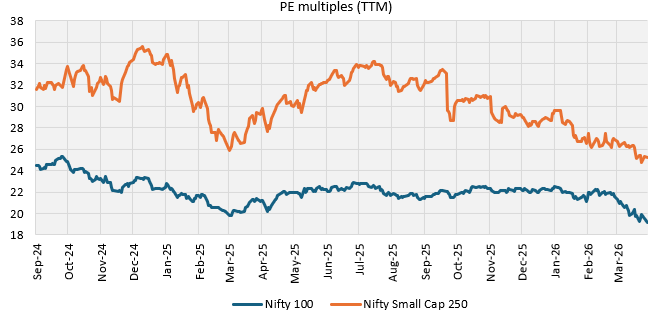
Source: NSE, as on 31st March 2026. Large cap is represented by Nifty 100 and small cap is represented by Nifty Small Cap 250
About PGIM India Small Cap Fund
The fund was launched in 2021 and has around Rs 1,353 crores of assets under management (as on 31st March 2026). The fund has underperformed for some time, but it has started outperforming the benchmark index over the last 1 year or so.
Outperformed the benchmark index in the last 1 year
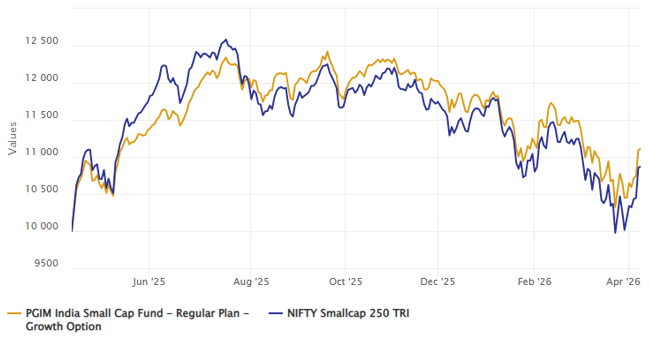
Source: Advisorkhoj Research. Period: 9th April 2025 to 9th April 2026.
Limited downside risks for investors
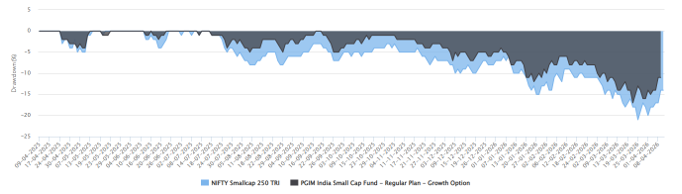
Source: Advisorkhoj Research. Period: 9th April 2025 to 9th April 2026.
Investment Approach
- Stock selection and portfolio construction on the basis of:
- Growth at Reasonable Price (GARP) Principle
- Fundamentals driven, bottom-up stock picking approach
- Focus on Return on Equity (ROE), Growth, Free Cash Flow generation and Leverage ratios
- Focus on fundamentals: Stock price over the medium to long term, tends to track the fundamentals of the company
- Focus on corporate governance: Companies which are backed by good management and demonstrate the ability to scale-up are generally rewarded by investors
- Focus on re-rating: Investors are likely to pay a higher multiple for higher expected growth in the future, leading to re-rating of the stock.

Current portfolio positioning
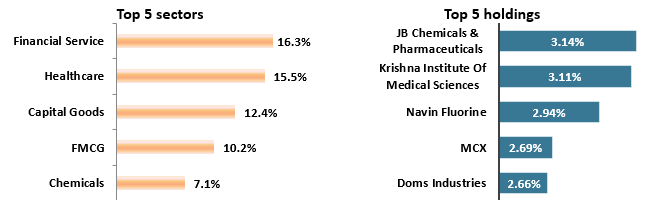
Source: PGIM India Mutual Fund, as on 31st March 2026.
Why invest in PGIM India Small Cap Fund?
- The scheme's investment strategy is to capture opportunities available in the small cap segment.
- The portfolio is built utilizing a combination of the top-down and bottom-up portfolio construction process, focusing on the fundamentals of each stock, including quality of management.
- The fund has a diversified portfolio with exposure across sectors, given the fact that small cap stocks present a wider investment universe.
Who can find PGIM India Small Cap Fund suitable?
- Investors with an investment horizon of at least 5 years or more
- Investors having a commensurate risk appetite associated with small cap segment
- The fund is suitable for investment through SIP
Investors should consult with their financial advisors or mutual fund distributors if PGIM India Small Cap is suitable for their investment needs.
Mutual Fund Investments are subject to market risk, read all scheme related documents carefully.

PGIM is the global investment management business of Prudential Financial, Inc. (PFI) USA, with USD 1.5 trillion in assets under management. We offer a broad range of investment capabilities through our multi-manager model along with experienced investment teams that assist you in achieving your financial goals. With a shared legacy of more than 150 years, PGIM is built on the strength, stability and deep expertise in managing money. We offer you a long-term perspective, having weathered multiple market cycles, and see opportunity in periods of disruption.
Investor Centre
Follow PGIM India MF


More About PGIM India MF
POST A QUERY