PGIM Multi Asset Allocation Fund: Diversification for stability in volatile markets

Current Market Scenario
Headwinds caused by the ongoing conflict in the Persian Gulf and prolonged disruption to energy supplies has caused volatility in the equity markets, though the market has remained broadly rangebound. With the Strait of Hormuz remaining virtually shut, crude oil prices remain high, with Brent crude at around $110 per barrel (as on 15th May 2026, Source: Bloomberg). The Indian Rupee has depreciated to around ₹95.7 to the dollar (as on 15th May 2026, Source: Bloomberg). FII flows were negative in March and April, and FII outflows have continued into May so far. Precious metal prices declined in March when US Treasury Bond yields rose (see the graphic below). Following the US-Iran ceasefire in early April, the dollar weakened and precious metal prices resumed its uptrend. A weakening INR has also helped gold and silver prices in India to go up. That said, precious metals could face near-term headwinds if US Treasury Bond yields rise further.
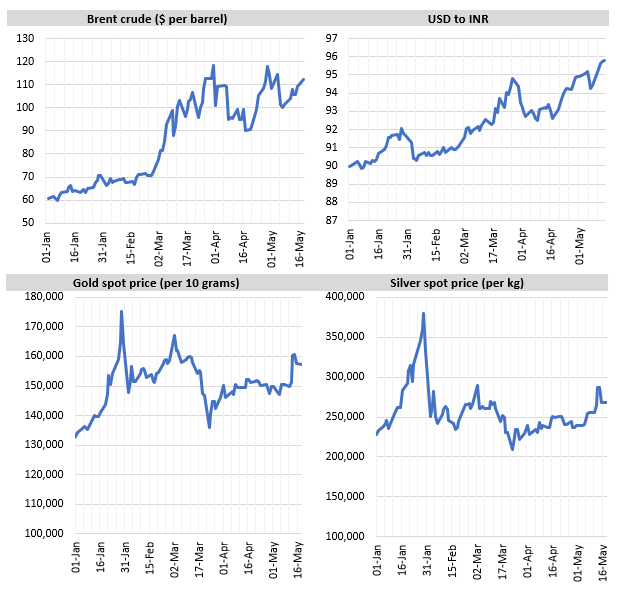
Source: MCX spot prices, Bloomberg, Advisorkhoj Research, as on 15th May 2026
In current environment of uncertainty, a multi-asset allocation strategy that provides exposure to three or more asset classes can provide stability to your portfolio and may be suitable for long-term investors. In this article, we will review the PGIM Multi-Asset Allocation Fund, which has been able to provide stability to investors in current market conditions.
What is multi-asset allocation?
Traditional asset allocation refers to diversifying your portfolio with allocations to equity and debt based on your risk appetite. However, including other asset classes, e.g., commodities (gold, silver), international equities, etc., can provide richer diversification to your investment portfolio. Multi-asset allocation funds offer exposure to three or more asset classes in a single product. As per SEBI's mandate, multi-asset allocation funds must have a minimum 10% exposure in each asset class, with at least 3 asset classes in the scheme's underlying portfolio.
Benefits of a multi-asset allocation strategy
Winners rotate across asset classes (see the chart below). It is difficult to predict the best-performing asset class at any point in time. Exposure to multiple asset classes may bring more consistency to your portfolio performance across market conditions or investment cycles.
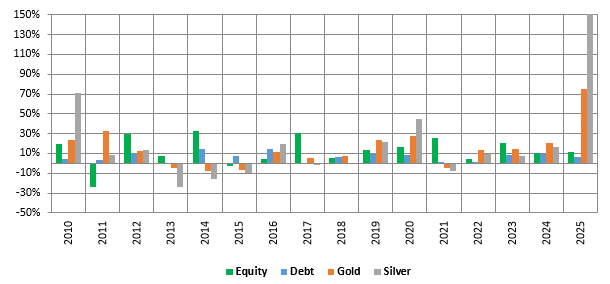
Source: MCX spot prices, NSE, Advisorkhoj Research, as on 31st December 2025. Equity is represented by Nifty 50 TRI, debt by Nifty 10 year Benchmark G-Sec Index, Gold and Silver by MCX spot prices of respective commodities
- Improve portfolio risk return trade-off: The charts below show the median and standard deviation of 1-year rolling returns for different tenures over the last 20 years. You can see that different asset classes have different risk / return profiles. A mix of asset classes (3 or more) can balance risk and returns, more optimally.
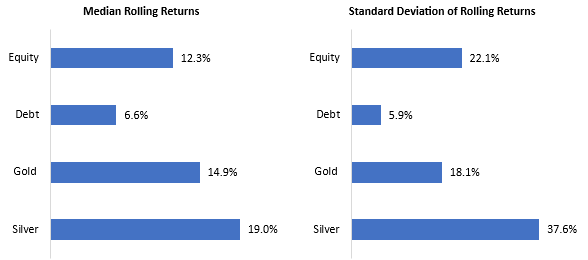
Source: MCX spot prices, NSE, Advisorkhoj Research, as on 15th May 2026. Equity is represented by Nifty 50 TRI, Debt by Nifty 10 year Benchmark G-Sec Index, Gold and Silver by MCX spot prices.
- Silver has growing industrial applications: Silver's industrial use, especially in new age technologies like artificial intelligence infrastructure, quantum computing, and advanced battery systems, may support demand over time. The recent government restrictions on silver imports could potentially impact silver supply dynamics in the domestic market.
- Equity and Gold are counter-cyclical: The chart below shows the 1-year rolling returns of Nifty 50 TRI (representing equity) and gold over the last 20 years. You can see that gold outperformed in the periods where equity returns were low/negative. Multi-asset allocation funds can protect against downside risks due to gold allocation.
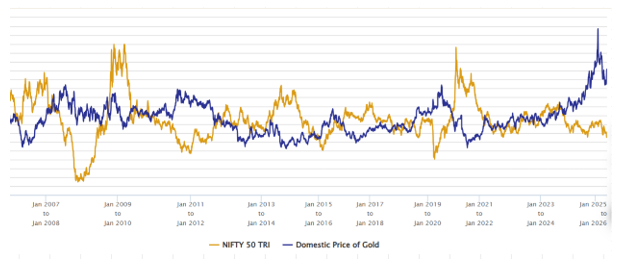
Source: Advisorkhoj Research as on 15th May 2026
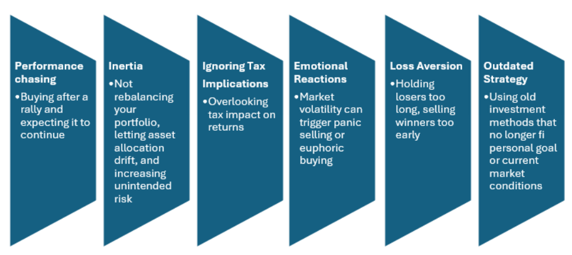
- Avoid behavioural pitfalls
About PGIM Multi-Asset Allocation Fund
The investment objective of the Scheme is to seek to generate long-term capital appreciation by investing in multiple asset classes, including equity and equity-related securities, debt and money market instruments, Gold ETFs & Silver ETFs. The fund is managed by fund managers Mr. Utsav Mehta, Mr. Anandha Padmanabhan Anjeneyan, and Mr. Vivek Sharma for the Equity Portion, and Mr. Puneet Pal for the Debt Portion.
Provided stability in volatile market
The chart below shows the growth of Rs 10,000 investment in PGIM India Multi Asset Allocation Fund versus the broad market index, Nifty 50 TRI since the inception of the scheme. You can see that the multi asset allocation fund was able to outperform Nifty 50 TRI during this period. Please note that past performance is not indicator of future returns and a hybrid fund may not always be able to outperform equity as an asset class. multi asset allocation fund may help bring stability.
[Note: The fund's SEBI-mandated benchmark is 60% Nifty 500 TRI + 20% CRISIL Short Term Bond Index + 10% Gold + 10% Silver. Nifty 50 TRI is shown here as a broad market reference index, not as the fund's benchmark.]
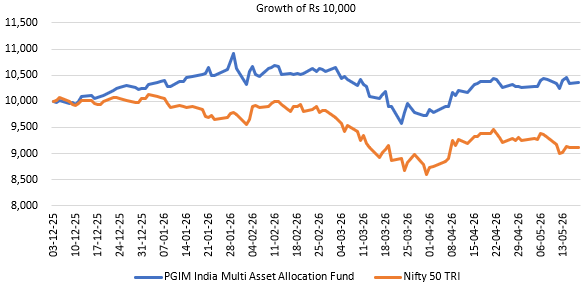
Advisorkhoj Research as of 15th May 2026
Limited downside risks
The chart below shows the drawdowns of PGIM India Multi Asset Allocation Fund versus the broad market index, Nifty 50 TRI since the inception of the scheme. You can see that in this difficult period, PGIM India Multi Asset Allocation Fund was able to limit downside risks for investors.
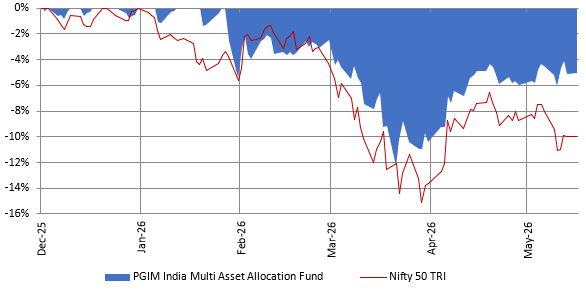
Advisorkhoj Research as of 15th May 2026
Asset allocation of PGIM India Multi Asset Allocation Fund
- Equity: 30-70% (including Derivatives)
- Precious Metals: 10-25% (Gold ETFs & Silver ETFs)
- Debt & Money Market: 10-35%
- REITs & InvITs: 0-10%
Asset allocation strategy
- Active multi-asset allocation framework to capture upcycle during various market cycles with a minimum 65% gross equity allocation to maintain equity taxation.
- 10-25% exposure to Gold ETFs & Silver ETFs to take advantage of diversification to provide a stable growth experience for the investor across tenor of investment
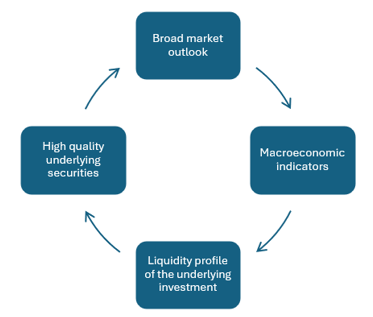
- Asset allocation will depend on:-
- High Quality and High Growth framework for stock selection.
Equity strategy

Current asset allocation and portfolio positioning
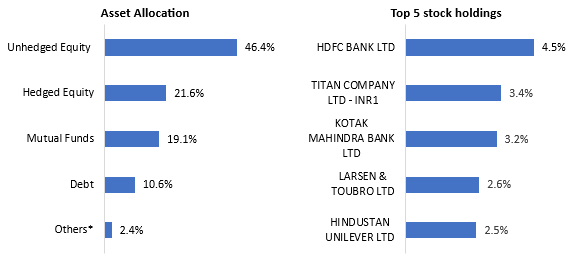
Source: PGIM India Fund Factsheet as on 30th April 2026. *Others include cash and cash equivalents
Who should invest in PGIM India Multi Asset Allocation Fund?
- Investors looking for capital appreciation and stability over long investment tenures
- Investors looking to diversify across multiple asset classes
- Investors with high-risk appetites
- Investors with a minimum 3-year investment horizon
Investors should consult their financial advisors or mutual fund distributors if PGIM India Multi Asset Allocation Fund is suitable for their investment needs.
Mutual Fund Investments are subject to market risk, read all scheme related documents carefully.

PGIM is the global investment management business of Prudential Financial, Inc. (PFI) USA, with USD 1.5 trillion in assets under management. We offer a broad range of investment capabilities through our multi-manager model along with experienced investment teams that assist you in achieving your financial goals. With a shared legacy of more than 150 years, PGIM is built on the strength, stability and deep expertise in managing money. We offer you a long-term perspective, having weathered multiple market cycles, and see opportunity in periods of disruption.
Investor Centre
Follow PGIM India MF


More About PGIM India MF
POST A QUERY