Tukka Nahi, Tareeka Chahiye: Why Multi-Asset Allocation Deserves a Place in Your Portfolio

Investing in India has never been more accessible. A few taps can open a demat account, start a SIP, track a stock, or follow a market influencer. Yet, easier access has not always meant better decisions. In a market full of tips, trends, hot stocks, and "sure-shot" ideas, many investors still confuse information with insight.
Union Mutual Fund's campaign, "Tukka Nahi, Tareeka Chahiye," captures this gap well. Tukka is a guess; tareeka is a method. The campaign encourages investors to move beyond instinct-led decisions and adopt planning, asset allocation, and diversification as the foundation of long-term investing.
The Problem With the ‘Tukka' Mindset
Every market cycle produces its own version of the tukka: a friend's stock tip, a viral video claiming a sector will multiply, a social-media post about gold, or a sudden rush into the latest investment theme. These ideas may sometimes work, but they are not a strategy.
A tukka-driven investor often enters late, exits early, and reacts to headlines rather than goals. The result is a portfolio that changes with every market mood-too much equity during bull runs, too little during corrections, and little thought given to what happens when different assets move in different directions.
The real issue is not that investors lack information. It is that information arrives faster than understanding. A chart, a return number, or a tip tells you very little unless you also know the risk, time horizon, liquidity needs, and role that investment plays in your overall plan.
Information Is Not Understanding
Today's investor has unprecedented access to market data. But access alone can create overconfidence. Knowing that equity has delivered strong long-term returns does not mean one should put every rupee into equity. Similarly, knowing that gold is considered a haven does not mean it should dominate a portfolio.
True investment understanding answers simpler, more useful questions:
- What am I investing for, and over what period?
- How much volatility can I genuinely tolerate?
- Which asset classes should I own, and in what proportion?
- What will I do when markets fall instead of reacting emotionally?
This is where investor education must become relatable. Financial jargon often creates distance; stories, humour and everyday examples make concepts stick. Union MF's campaign uses exactly this approach-contrasting a guess with a method through simple, recognisable narratives rather than complex theory.
Why One Asset Class Is Not Enough
Recency bias attracts investors to asset classes that are currently outperforming. However, historical data shows that winners have rotated across asset classes. In the last 15 years, equity was the top performer in 6 years, debt was in the top performer in 2 years, and gold was the top performer in 7 years.
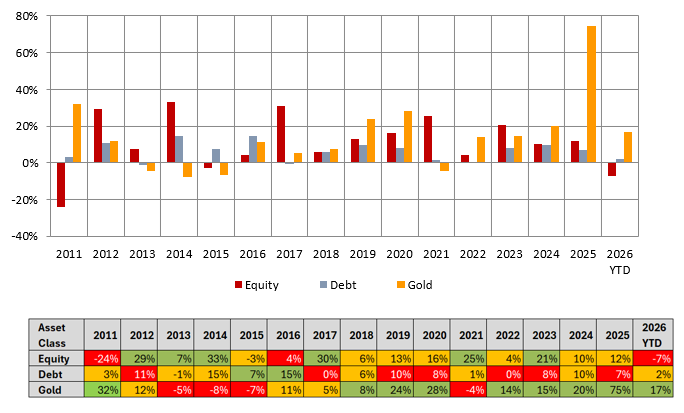
Source: NSE, Advisorkhoj Research, as on 31st August 2026. Equity is represented by Nifty 50 TRI, Debt by Nifty 10 year Benchmark G-Sec Index and Gold by MCX spot prices.
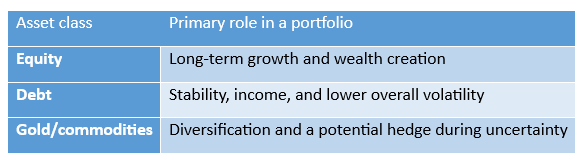
A strong portfolio is like a well-balanced meal. Equity may provide growth, debt may add stability and income, while gold and other assets can offer diversification and act as a hedge during uncertain periods. No single asset performs best in every market environment.
Multi-asset allocation brings these building blocks together. A Multi-Asset Allocation Fund invests across at least three asset classes, with a minimum allocation of 10% in each, as per the category mandate. These may include equity, debt, gold and other permitted asset classes.
The objective is not to predict which asset will win next year. It is to ensure that the portfolio does not depend entirely on one outcome. Diversification cannot eliminate risk or guarantee returns, but it can reduce concentration risk and help smooth the journey across market cycles.
The ‘Tareeka': Allocation, Discipline and Review
A method-based investor does not chase every trend. They follow a process:
- Define the goal: Retirement, a child's education, a home purchase or long-term wealth creation.
- Assess risk capacity: Not just willingness to take risk, but the ability to stay invested through downturns.
- Allocate across assets: Choose a mix of equity, debt, and gold or other assets suited to the goal and horizon.
- Invest regularly: SIPs can bring discipline and help average the cost of investment over time.
- Review periodically: Rebalance when allocations drift materially, rather than reacting to short-term noise.
This approach turns investing from a series of reactions into a repeatable habit. It also makes it easier to stay invested when markets are volatile-often the difference between long-term success and short-term regret.
Making Awareness Participative
Investor awareness cannot remain limited to disclaimers, brochures or technical presentations. It needs to enter everyday conversations-in a manner that is simple, engaging and memorable.
Union MF's campaign extends beyond advertising into participative education. Its original jingle and employee-led video use music and storytelling to make the message easier to recall: do not rely on a tukka; follow a tareeka. By featuring employees rather than only experts, the campaign makes investor education feel human. It signals that informed investing is not reserved for market professionals-it is a skill every investor can build.
The Role of AMCs and MFDs
Asset management companies as well as MFDs have a responsibility that goes beyond managing schemes and promoting a particular asset class. As mutual fund participation widens, AMCs, along with the MFDs, must also help investors understand why they are investing, not merely where.
That means communicating in plain language, using relatable formats, explaining risk honestly, and promoting principles such as goal-based investing, diversification and long-term discipline. The "Tukka Nahi, Tareeka Chahiye" campaign matters because it shifts the conversation from selling products to building behaviour.
Multi-asset allocation offers a practical starting point. It encourages investors to look beyond a single asset class, respect diversification, and build portfolios that can withstand changing market conditions. Because in investing, luck may occasionally reward a tukka. But a tareeka rewards patience, discipline, and informed decision-making-qualities that matter far more over the long run.
Jingle: https://www.youtube.com/watch?v=9lEZx4XIkxE
Brand Film: https://www.youtube.com/watch?v=Gp8f3cgqCE0
Mutual Fund Investments are subject to market risk, read all scheme related documents carefully.
RECOMMENDED READS
- Union Income Plus Arbitrage Active FOF: Jugal Bandi of stability and tax efficiency
- Union Small Cap Fund: On an improving performance trajectory versus benchmark and peers
- Union Diversified Equity All Cap Active FOF
- Union Childrens Fund: Investment for your childrens future
- Union Innovations and Opportunities Fund: Strong outperformance
LATEST ARTICLES
- Union Multi Asset Allocation Fund: Stability in volatile market
- Union Active Momentum Fund: Long term wealth creation using momentum investing
- Union Small Cap Fund: Outperforming benchmark and peers
- Arthaya Equity Long Short SIF: Potential to exploit opportunities across market conditions
- Union Small Cap Fund: On an improving performance trajectory versus benchmark and peers

Union Mutual Fund, sponsored by Union Bank of India and Dai-ichi Life Holdings, Inc., aims to be a reliable and trusted partner to investors and distributors through responsible investing. With a focus on long-term wealth creation, the fund house seeks to support investors across towns and cities in their journey towards financial freedom. Its investment approach emphasizes managing credit risk through careful selection of securities and maintaining portfolios that are true to mandate. The core values of Trust, Transparency, and Consistency of Performance guide its overall philosophy.
Investor Centre


About Union MF
POST A QUERY