The Wealth Company Gold ETF: Turning tradition into smart investing

The Wealth Company has launched a New Fund Offer (NFO), The Wealth Company Gold ETF. Gold has been an important asset class since time immemorial. Gold not only has enormous cultural significance as an auspicious metal, it is has tremendous economic importance as a store of value. Under the Gold Standard system, central banks used to back their currency with gold reserves. With rise in geopolitical risks, central banks have again started buying gold to strengthen financial stability. This has resulted in surge in demand for gold. In the last 2 years, gold prices have surged by more than 100%. Though traditional way of investing in gold was in form of physical, gold ETFs is the modern way of investing in gold offering much more cost efficiency, safety and liquidity. The Wealth Company Gold ETF will open for subscription on 16th December 2025 and will close on 22nd December 2025.
Why is Importance of gold as an asset class
- Winners rotate across asset classes: One asset class cannot outperform forever. Different asset classes outperform in different years (see the chart below). Gold outperfomed equity and debt, 9 times in the last 16 years.
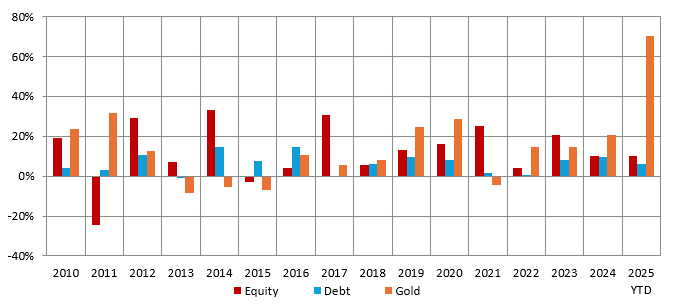
Source: Advisorkhoj Research, NSE, MCX. Equity is represented by Nifty 50 TRI, Debt by Nifty 10 year Benchmark G-Sec Index, Gold by MCX spot prices, as on 30th November 2025. These figures pertain to performance of the index and do not in any manner indicate the returns/performance of the Scheme. It is not possible to invest directly in an index. There is no assurance of any returns/capital protection/capital guarantee to the investors in the Scheme. Past performance may or may not sustain in future
- Gold and equity have given similar returns: Historical data shows that, gold and equity have given similar returns, even if we exclude the recent gold outperformance (see the chart below).
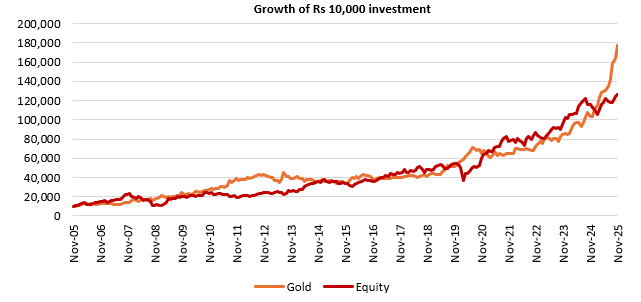
Source: Advisorkhoj Research, NSE, MCX. Equity is represented by Nifty 50 TRI, Gold by MCX spot prices, as on 30th November 2025. These figures pertain to performance of the index and do not in any manner indicate the returns/performance of the Scheme. It is not possible to invest directly in an index. There is no assurance of any returns/capital protection/capital guarantee to the investors in the Scheme. Past performance may or may not sustain in future
- Gold is less volatile: Despite giving similar returns, gold is less volatile equity and has experienced much smaller drawdowns compared to equity (see the chart below)
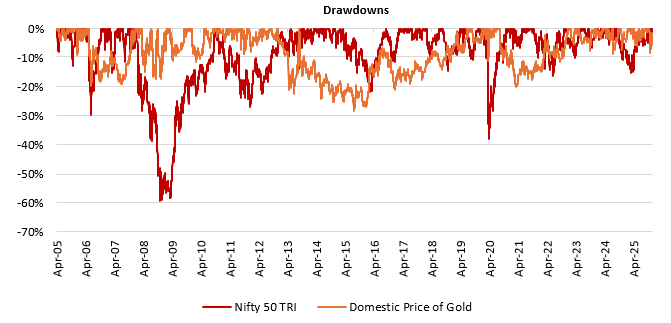
Source: Advisorkhoj Research, NSE, MCX. Equity is represented by Nifty 50 TRI, Gold by MCX spot prices, as on 30th November 2025. These figures pertain to performance of the index and do not in any manner indicate the returns/performance of the Scheme. It is not possible to invest directly in an index. There is no assurance of any returns/capital protection/capital guarantee to the investors in the Scheme. Past performance may or may not sustain in future
- Low correlation with other asset classes: Gold has low or even negative correlations with equity and debt (see the table below). Low correlation with other asset classes makes gold a highly suitable for asset allocation.

Source: Advisorkhoj Research, Bloomberg, MCX. Equity is represented by Nifty 50 TRI, Debt by CRISIL Short Term Bond Index, Gold by MCX spot prices, as on 30th September 2025. These figures pertain to performance of the index and do not in any manner indicate the returns/performance of the Scheme. It is not possible to invest directly in an index. There is no assurance of any returns/capital protection/capital guarantee to the investors in the Scheme. Past performance may or may not sustain in future
- Gold can provide stability in uncertain or volatile market: Markets may turn without warning. Historical data shows that gold held strong, even when other asset classes, especially equity underperforms or goes through deep corrections (see the graphic below).
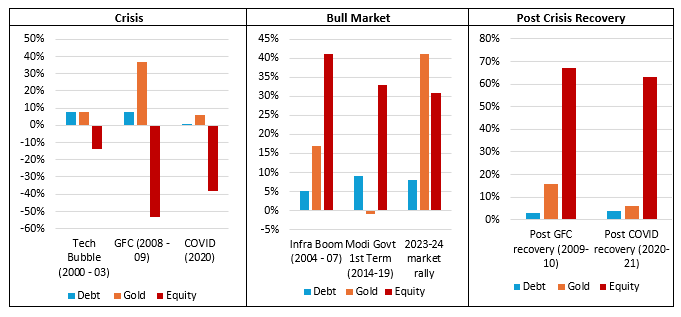
Source: Advisorkhoj Research, Bloomberg, MCX. Equity is represented by Nifty 50 TRI, Debt by CRISIL 1 year T Bill Index, Gold by MCX spot prices. These figures pertain to performance of the index and do not in any manner indicate the returns/performance of the Scheme. It is not possible to invest directly in an index. There is no assurance of any returns/capital protection/capital guarantee to the investors in the Scheme. Past performance may or may not sustain in future
Gold: 3 – 5 year outlook
- Gold a timeless pillar of asset allocation: Gold is not just a store of wealth and hedge against inflation; it is also a safe haven asset which provides security in times of uncertainty. Gold is Essential component in modern asset allocation, offering both stability and diversification.
- Global Interest Rate Peak & Monetary Easing Cycle: Central banks, including the U.S. Fed, are nearing the end of their tightening cycle. Real yields are flattening or declining. Historical data shows that gold has an inverse relationship with US interest rates. When US interest rates fall, US Treasury bonds become less attractive as safe haven asset, and gold becomes more attractive for risk averse investors.
- Weakening USD and reserve diversification: The U.S. dollar’s strength has likely peaked. Historical data shows an inverse correlation between dollar and gold. Any depreciation enhances gold prices in other currencies. Emerging markets are diversifying reserves away from dollar assets. This trend increases gold’s strategic relevance.
- Central Bank buying gold: Central banks have accumulated over 1,000 tonnes of gold annually for the past three years. Purchases are led by China, India, and Turkey. This reflects diversification away from the U.S. dollar. Continued central bank buying will provide support to gold prices even if there is a short term correction.
- Safe haven asset in environment of geo-political risks: Geo-political risks have increased significantly in recent years with several countries turning to protectionism, increasing the possibility of trade wars. Geo-political risks support gold’s safe-haven appeal.
Demand supply imbalance
Gold supply is limited. Gold mine production is plateauing. There have very few discoveries of new gold ore deposits in the past decade. Furthermore, there is a long lead time (10 – 15 years) for gold mine to become operational for gold production. Central banks are sucking up gold supply. On the other hand, investment demand for gold is rising. Gold jewellery demand remains strong globally. Gold’s industrial use in electronics, semiconductors and medical devices is growing.
Gold ETFs – A smart way of investing in Gold
Though buying physical gold is the traditional way of investing in gold, ETFs offer several benefits compared to physical gold. Gold ETFs are exchange-traded funds that track the domestic price of gold. Gold ETFs are highly liquid since they are traded in the stock exchange, just like shares of listed companies. ETFs provide a way to invest in Gold without the need for physical storage of the precious metal. They are backed by physical Gold of 99.5% purity (as specified by SEBI regulations).
What are advantages of Gold ETFs compared to physical gold?
- Liquidity: You can buy or sell units of your Gold ETFs anytime on stock exchanges. There is no need to visit a jeweller to buy or sell physical gold. If you are selling gold jewellery to a jeweller, the jeweller will first verify the purity of gold, which takes time and may involve some deductions in resale value.
- Cost efficiency: Gold ETFs are much more cost efficient than physical gold. Cost of gold jewellery includes making charges, GST etc. You may also have to incur bank locker charges if you want to store your gold jewellery safely. There are no making or storage charges in gold ETFs.
- Highest purity: Purity of gold jewellery can vary from one jeweller to another. It is hard for an average retail buyer to verify purity. Gold ETFs, on the other hand, are backed by gold of 99.5% purity since ETFs have to comply with SEBI regulations.
- Safety: Unlike gold jewellery, there is no risk of theft in gold ETFs. ETFs units are stored digitally in your demat account.
- Convenience: You can buy or sell gold ETFs online or through your mobile app. There is no need to visit a jeweller.
- Transparency: Gold ETF prices are linked to real-time gold rates. On the other hand, physical gold prices may vary by jeweller and may involve hidden charges.
- Ease of investing: You can invest in small amounts in gold ETFs, to gradually accumulate gold ETF units over investment horizon. Physical gold is less suitable for gradual investing.
Investors should consult with their financial advisors if The Wealth Company Gold ETF is suitable for their investment needs.
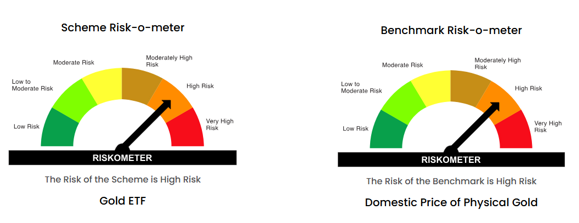
Disclaimer:
The information on this document is provided for information purpose only. It does not constitute any offer, recommendation or solicitation to any person to enter into any transaction or adopt any hedging, trading or investment strategy, nor does it constitute any prediction of likely future movement in rates or prices or any representation that any such future movements will not exceed those shown in any illustration. Users of this document should seek advice regarding the appropriateness of investing in any securities, financial instruments or investment strategies referred to on this document and should understand that statements regarding future prospects may not be realised. Opinion, Projections and estimates are subject to change without notice.
Wealth Company Asset Management Holdings Private Limited or The Wealth Company Mutual Fund (acting through Pantomath Trustee Private Limited) accepts no liability and will not be liable for any loss or damage arising directly or indirectly (including special, incidental or consequential loss or damage) from your use of this document, howsoever arising, and including any loss, damage or expense arising from, but not limited to, any defect, error, imperfection, fault, mistake or inaccuracy with this document, its contents or associated services, or due to any unavailability of the document or any thereof or due to any contents or associated services.
NSE Disclaimer: It is to be distinctly understood that the permission given by NSE should not in any way be deemed or construed that the Scheme Information Document has been cleared or approved by NSE nor does it certify the correctness or completeness of any of the contents of the Scheme Information Document. The investors are advised to refer to the Scheme Information Document for the full text of the ‘Disclaimer Clause of NSE’.
BSE Disclaimer: It is to be distinctly understood that the permission given by BSE Limited should not in any way be deemed or construed that the SID has been cleared or approved by BSE Limited nor does it certify the correctness or completeness of any of the contents of the SID. The investors are advised to refer to the SID for the full text of the Disclaimer clause of the BSE Limited.
Mutual Fund Investments are subject to market risk, read all scheme related documents carefully.
RECOMMENDED READS
- Optimizing performance across market cycles through long short strategy
- The Wealth Company Balanced Advantage Fund: A true to label BAF aligned with current market structure
- WSIF Equity Ex Top 100 Long Short Fund: potential of mid and small caps in different market conditions
- The Wealth Company Flexi Cap Fund NFO: A promising fund for long term investors
- Wealth Company Gold ETF FOF NFO: Adding the glitter of gold for a diversified portfolio
LATEST ARTICLES
- WSIF Equity Long Short Fund: Strategizing positions for volatile markets
- The Wealth Company Multi Cap Fund NFO: Power of all caps in a single fund
- The Wealth Company Gold ETF FoF Golden Passbook: Units Tell One Story, Grams Tell Another
- Wealth Company Midcap Fund: Investment for long term risk adjusted capital appreciation
- The Wealth Company Large and Midcap Fund NFO: Potential Growth and relative stability in a single investment
Investing, the Way It Should Be
At The Wealth Company Mutual Fund, we're building the fund we wish existed. One that puts thinking before scale. Clarity before clutter; and aligns every move with long-term value creation. Backed by years of investing experience, we've created a mutual fund house that believes in going deeper - in thought, structure, and responsibility.
We are part of The Wealth Company - the asset management arm of the Pantomath Group, a name trusted for its depth in investment banking, private equity, and capital markets. Our roots shape the way we invest: with precision, discipline, and an eye for potential long before it's widely recognized.
Follow Wealth Company MF


Distributor First
POST A QUERY