Wealth Company Midcap Fund: Investment for long-term risk-adjusted capital appreciation

The Wealth Company is launching its NFO, The Wealth Company Midcap Fund NFO. As per AMFI Dec 2025 data, midcap funds as a category have the second-highest assets under management (Rs 4.6 trillion) among all actively managed diversified equity funds. In this article, we will review the fund and understand why Midcap funds are a good addition to your investment portfolio.
Why Midcap Funds?
- Greater wealth creation potential: The chart below shows the growth of Rs 10,000 investment in Nifty Midcap 150 TRI, the benchmark index of midcap stocks, versus the Nifty 100 TRI, the benchmark index of large cap stocks over the last 20 years. You can see that, based on historical data, midcaps created significantly higher wealth compared to large caps.
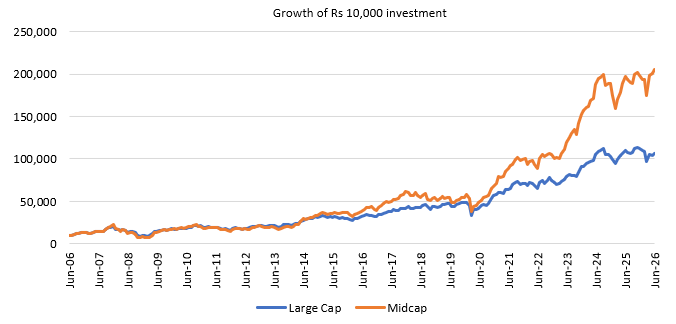
Source: NSE, Advisorkhoj Research, as on 30th June 2026. Nifty 100 TRI represents large caps. Midcaps are represented by Nifty Midcap 150 TRI; Past performance may or may not be sustained in the future. These are index returns. One cannot directly invest in index. Performance results have many inherent limitations and no representation is being made that any investor will, or is likely to achieve. Past performance may or may not be sustained in the future. The above graph is used to explain the concept and is for illustration purposes only and should not used for the development or implementation of an investment strategy.
- Less researched stocks: Midcaps are relatively less researched compared to large cap stocks. Price discovery in midcaps is less efficient to large cap stocks. With significantly fewer companies receiving extensive analyst coverage, midcaps offer greater scope for research-led discovery and alpha creation. Fund managers can identify midcap stocks trading at discounts to their intrinsic valuations. These stocks can create alphas for your portfolios through value discovery or valuation rerating.
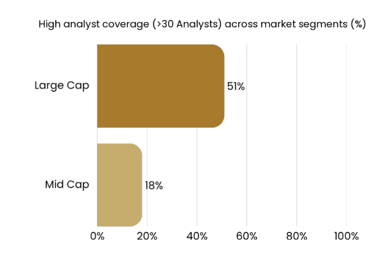
Source : https://www.alfaccurate.com/indias-most-misunderstood-asset-class-the-real-mid-small-cap-story; Data as on 04 Dec 2025
- Lesser drawdowns compared to small caps: The chart below shows the drawdowns of Nifty Midcap 150 TRI, the benchmark index of midcap stocks, versus the Nifty Small Cap 250 TRI, the benchmark index of small cap stocks over the last 20 years. You can see that midcaps had smaller drawdowns compared to small caps.
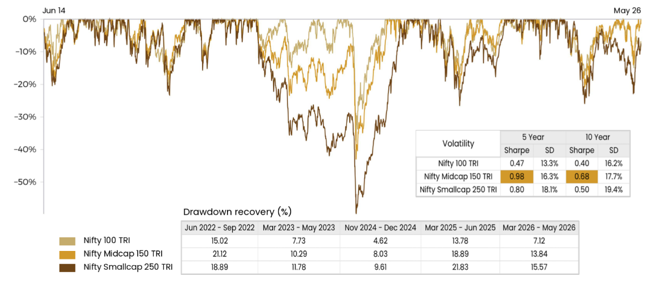
Source: Bloomberg. Performance results have many inherent limitations, and no representation is being made that any investor will, or is likely to achieve. Data as on 29 May 2026; Past performance may or may not be sustained in the future. Performance results have many inherent limitations and no representation is being made that any investor will, or is likely to achieve. Past performance may or may not be sustained in the future. The above graph is used to explain the concept and is for illustration purposes only and should not used for the development or implementation of an investment strategy.
- Nifty Midcap 150 TRI has historically delivered higher returns compared to Nifty 100 TRI across rolling investment periods. The chart below shows that Midcaps delivered stronger outcomes, with 91% of 5-year and 100% of 7-year periods generating >10% returns.
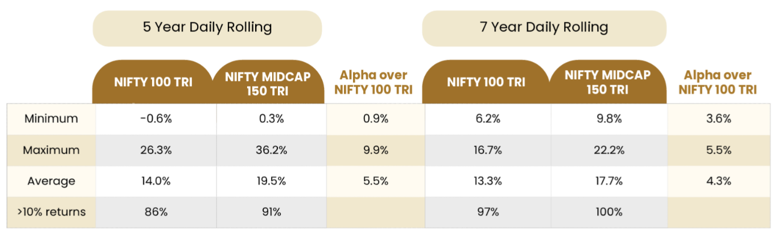
Source: Wealth Company product ppt. Data as on 12 June 2026; Source: Bloomberg. Performance results have many inherent limitations, and no representation is being made that any investor will, or is likely to achieve. Past performance may or may not be sustained in the future. Performance results have many inherent limitations and no representation is being made that any investor will, or is likely to achieve. Past performance may or may not be sustained in the future. The above graph is used to explain the concept and is for illustration purposes only and should not used for the development or implementation of an investment strategy.
- More diversified sector exposure: Midcaps can provide greater exposure in compared to large cap index with a higher capital goods and consumption tilt in comparison to large caps. The table below shows the sector weights of consumption segments in Nifty 100 vs Nifty Midcap 150
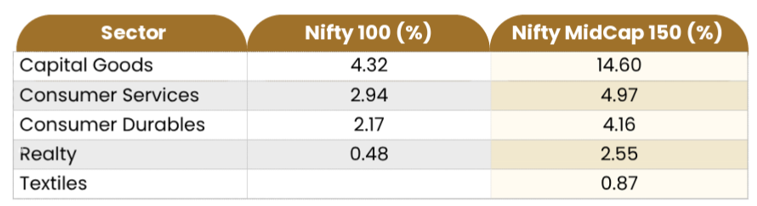
NSE Indices, As on 29 May, 2026.; https://www.bain.com/globalassets/noindex/2026/bain_report_how_india_shops_online_2026.pdf; https://www.fortuneindia.com/business-news/private-capex-jumps-67-to-77-lakh-crore-in-sept-2025-as-cii-flags-investment-revival/136867#google_vignette; Higher investments The above-mentioned Industry and weightage are for illustration purpose only and as per AMFI Market Capitalization classification for six months ending December 2025
- Favourable policy interventions: Favourable policy interventions have given a boost to Consumption and discretionary & capex spending in 2025.

- Favourable risk-return trade-off for long term investors: The table below shows the rolling returns distribution of large cap, midcap and small caps for different investment tenures over the past 20 years. You can see that Mid Cap has lesser percentage instances of negative returns compared to small cap the percentage instances of 15%+ CAGR returns were significantly higher for midcaps compared to both large caps and small caps.
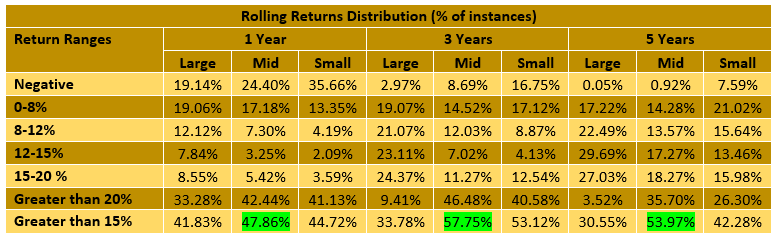
Source: NSE, Advisorkhoj Research, as on 30th June 2026. Nifty 100 TRI represents large caps. Nifty Midcap 150 TRI represents midcaps. Small caps are represented by the Nifty Small Cap 250 TRI. One cannot directly invest in index. Performance results have many inherent limitations and no representation is being made that any investor will, or is likely to achieve. Past performance may or may not be sustained in the future. The above graph is used to explain the concept and is for illustration purposes only and should not used for the development or implementation of an investment strategy.
Why invest in Midcaps now?
In current markets, midcaps are gaining depth and momentum. Relatively Stronger earnings potential, broader opportunities, and growing liquidity are driving midcap growth.
- Midcaps are likely to be better placed for India's domestic capex and consumption cycle. Large caps are concentrated in banks, IT, energy, and FMCG, while midcaps offer higher emerging exposure themes, such as manufacturing, defence, EMS, healthcare, financial services, real estate, and utilities.
- Midcaps now have institutional relevance and liquidity. This is no longer a tiny, illiquid segment. The Nifty Midcap 150 represents ~18% of NSE's total market cap, with index constituents accounting for ~24% of total traded value. That supports the idea that large institutional capital can participate more meaningfully in midcaps. (Source: Bloomberg; *NSE Indices - Nifty Midcap 150 Index; Data as on 30 Mar 2026)
Why should you invest in The Wealth Company Midcap Fund?
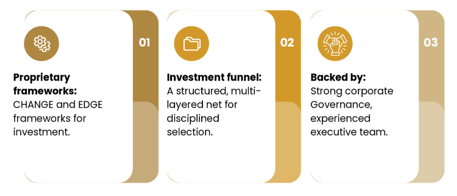
The Wealth Company Midcap Fund
Stock selection: CHANGE and EDGE framework
- CHANGE is a disciplined framework employed by the fund managers to identify scalable, resilient, and high-quality businesses where each letter of the acronym stands for:
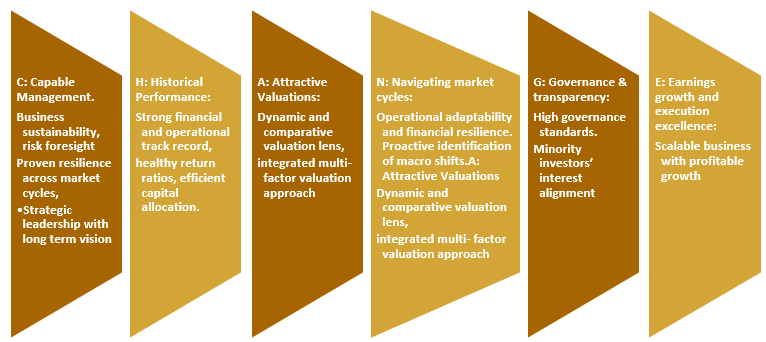
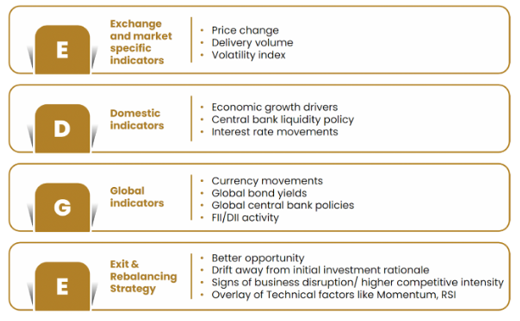
- Framework for stock-selection: EDGE
The fund managers also employ EDGE, a multi-dimensional lens to assess market direction and positioning.
Unique Investment Funnel:
A portfolio of 40-50 stocks (tentative) may be created with a private equity-type deep dive into due diligence of the stocks filtered from the universe of 5500 listed stocks. The filtration process takes place over several stages, which ensures a safety net for the final stocks selected. The number of stocks mentioned are tentative and for understanding purposes only. However, final portfolio can have a higher or lower number of stocks as well, depending on prevailing market conditions. Portfolio will be managed as per the stated Investment objective.
- Listed Stock Universe (5500 stocks): Proprietary scientific filters based on the following parameters is engaged to select about 400 stocks (the potential capital multiplier universe) from the total universe.
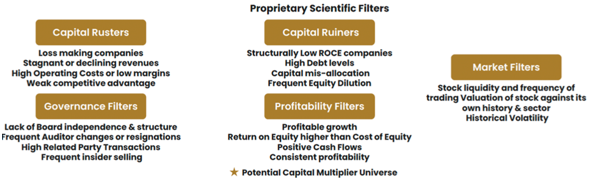
- The stocks undergo several more stages of filtration based on the parameters like ROCE, past growth, prospects, and earnings momentum, etc.

- Stock portfolio: The stocks so selected will be tested on promoter behaviour, succession visibility, strategic intent, financial, legal, and forensic due diligence, and any red flags, and channel checks.
Who should invest in the Wealth Company Midcap Fund?
The fund may be suitable for:
- Investors seeking capital appreciation or wealth creation over long investment tenures
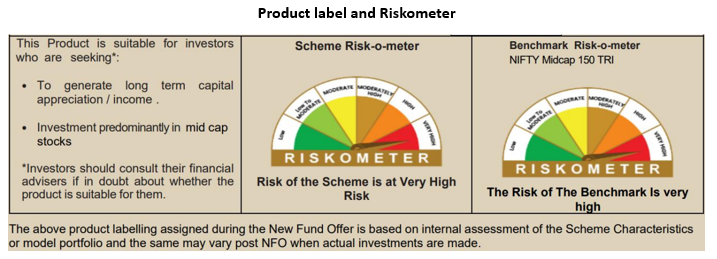
- Investors with very high risk appetites
- Investors with a long (minimum 5 years) investment horizon
- The fund is suitable for SIP investors
- Lump sum investors can also invest in the fund if they have a minimum 5-year investment horizon
Investors should consult their financial advisors or mutual fund distributors if the Wealth Company Midcap Fund is suitable for their investment needs.
The Wealth Company Mutual Fund - SEBI Regn. No: MF/086/25/12
Mutual Fund Investments are subject to market risk, read all scheme related documents carefully.
RECOMMENDED READS
- Optimizing performance across market cycles through long short strategy
- The Wealth Company Gold ETF: Turning tradition into smart investing
- The Wealth Company Balanced Advantage Fund: A true to label BAF aligned with current market structure
- WSIF Equity Ex Top 100 Long Short Fund: potential of mid and small caps in different market conditions
- The Wealth Company Flexi Cap Fund NFO: A promising fund for long term investors
LATEST ARTICLES
- WSIF Equity Long Short Fund: Strategizing positions for volatile markets
- The Wealth Company Multi Cap Fund NFO: Power of all caps in a single fund
- The Wealth Company Gold ETF FoF Golden Passbook: Units Tell One Story, Grams Tell Another
- The Wealth Company Large and Midcap Fund NFO: Potential Growth and relative stability in a single investment
- The Wealth Company MF Didi and MF Dost: Aap ke Bharose ke Saathi

Investing, the Way It Should Be
At The Wealth Company Mutual Fund, we're building the fund we wish existed. One that puts thinking before scale. Clarity before clutter; and aligns every move with long-term value creation. Backed by years of investing experience, we've created a mutual fund house that believes in going deeper - in thought, structure, and responsibility.
We are part of The Wealth Company - the asset management arm of the Pantomath Group, a name trusted for its depth in investment banking, private equity, and capital markets. Our roots shape the way we invest: with precision, discipline, and an eye for potential long before it's widely recognized.
Follow Wealth Company MF


Distributor First
POST A QUERY