Passive funds can play an important role in your investment portfolio

The popularity of passive funds is growing globally. According to a Price Waterhouse Coopers study, passive funds will account for 58% of the US mutual fund industry assets under management (AUM) by 2030 (source: PWC). Passive funds AUM have been growing rapidly in India as well. AUM of exchange traded funds (ETFs) increased by 6.9X in the last 5 years (see the chart below). Number of ETF folios have grown from 24.3 lakhs in March 2020 to 4.03 crores in March 2026, showing increasing retail participation (source: AMFI, as on 31st March 2026).
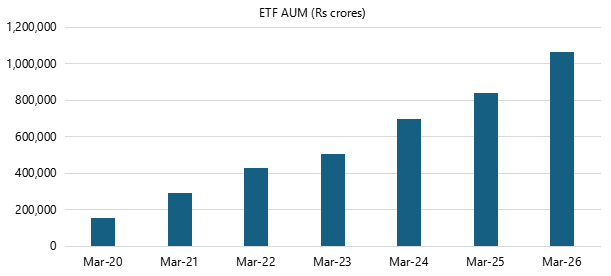
Source: AMFI, as on 31st March 2026
Along ETFs, popularity of index funds which preferred by retail investors, who do not have demat accounts, have also grown rapidly over the last few years, especially after the COVID-19 pandemic. AUM of exchange traded funds (ETFs) increased nearly 38X in the last 6 years (see the chart below). Number of index fund folios have grown from just over 5 lakh folios in 2020 to around 1.5 crore folios in 2026. (source: AMFI, as on 31st March 2026).
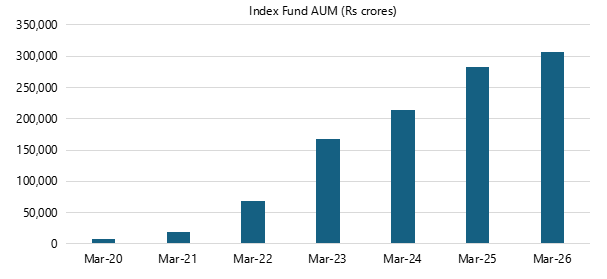
Source: AMFI, as on 31st March 2026
As passive funds have grown in popularity, the product offerings have also increased. In March 2020, there only 32 index fund schemes and as of March 2026, we have of 360 index fund schemes (see the chart below). Today we have passive schemes for different asset classes e.g. equity, debt, commodities etc, international equities etc. In this article, we will delve into passive funds, advantages of investing in passive funds, different types of passive funds, how passive funds can fulfil investment needs for different risk appetites and financial goals.
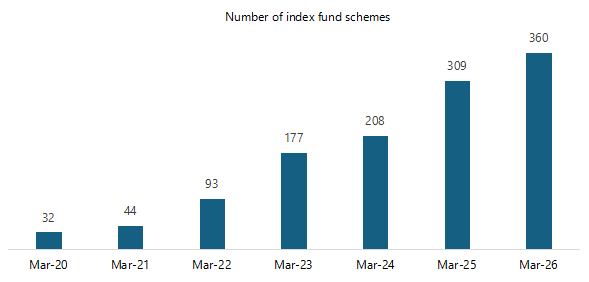
Source: AMFI, as on 31st March 2026
Why invest in passive funds?
- No unsystematic risks: Passive funds do not aim to beat the benchmark index; they simply track the index by investing in a portfolio of securities that replicate the index composition. Actively managed equity funds, on the other hand, are overweight / underweight on certain stocks, with the aim to beat the benchmark index. This is known as unsystematic risks. While unsystematic risks arising out of stock selection can create alphas, it can also lead to underperformance versus the benchmark
- Lower TER compared to active funds: Expense ratio of passive funds is much lower than expense ratios of active funds. Unless an active fund is able create sufficient alphas, the lower expense ratio of passive funds works to its advantage especially over long investment tenures
- No human / fund manager bias: Fund managers may have biases like most human beings which may impact investment decisions and outcomes. There is no human bias in passive funds.
Equity passive funds
Equity passive funds (ETFs and index) track equity benchmark indices. There are different type of equity passives based on broad market capitalization segments, industry sectors and strategies or factors.
- Broad market passive funds: These schemes track different market cap indices e.g. frontline indices like Nifty 50 or Sensex, large cap stocks, midcap stocks, small cap stocks etc. Some funds track benchmark which track combinations of different market cap segments like large and midcap, multicap etc. Different market cap segments have different risk / volatility profiles and outperform / underperform each other in different market conditions (see the table below). You can select schemes based on your risk appetites. Broad market passive funds should be part of your core portfolio. You should have long investment horizons for broad market passive funds.
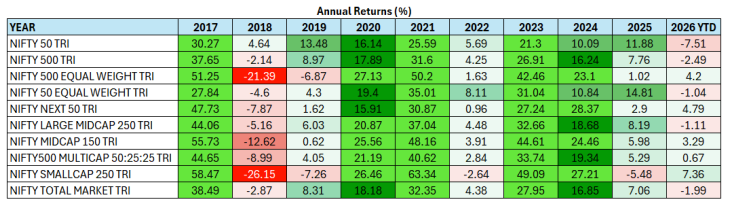
Source: National Stock Exchange, Advisorkhoj Research, as on 31st July 2026. Past Performance may or may not sustain in future, The data shown above pertains to the index and does not in manner indicate performance of any scheme of the Fund
- Sectoral / thematic passive funds: These schemes track different sectoral / thematic benchmark index. Different industry sectors outperform the broad market benchmark e.g. Nifty 50 TRI in different market conditions or investment cycles. Adding sectoral / thematic passive funds can help you create potential alphas in your equity portfolio.
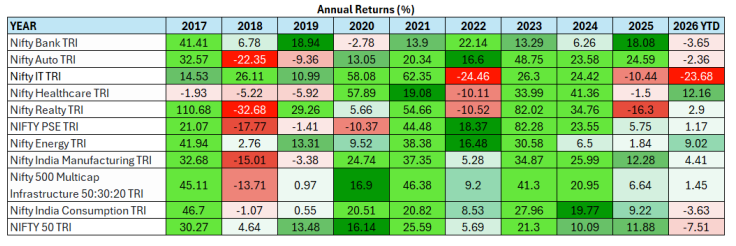
Source: National Stock Exchange, Advisorkhoj Research, as on 31st July 2026. Past Performance may or may not sustain in future, The data shown above pertains to the index and does not in manner indicate performance of any scheme of the Fund
Investors should understand that a particular industry sector or theme may not outperform forever. Performance rotates across sectors (see the chart below). You can tactically add sectoral / thematic passives in your satellite portfolio to boost portfolio returns.
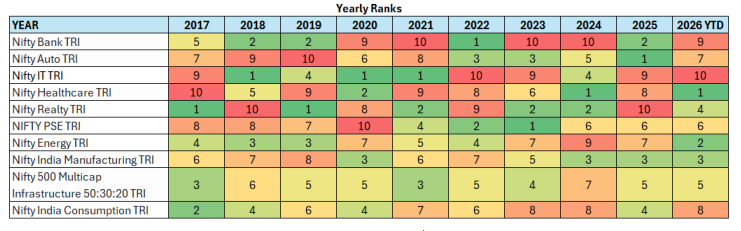
Source: National Stock Exchange, Advisorkhoj Research, as on 31st July 2026. Past Performance may or may not sustain in future.
- Smart beta or factor based passive funds: ETFs or index funds tracking factor indices provide low cost investment opportunities to different investment strategies that are based on quantitative model, free from human biases. Smart beta investing is increasingly becoming popular in developed markets like the US. They are also becoming popular in India. Smart beta funds combine characteristics of active and passive investments at low cost, devoid of human biases, since factor indices are constructed based on quantitative, rule based investment strategies. Smart beta funds can be single factor (e.g. momentum, value, low volatility, quality etc) or multi-factor (e.g. Quality and low volatility, alpha and low volatility etc). Smart beta funds have the potential to beat broad market benchmark returns and create alphas in your equity portfolio or limit downside risks in drawdowns phases (see the chart below).
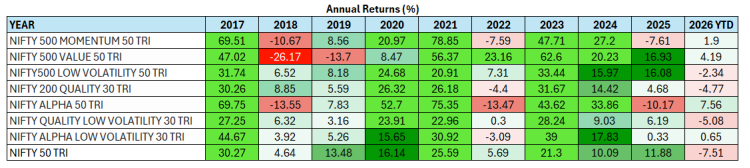
Source: National Stock Exchange, Advisorkhoj Research, as on 31st July 2026. Past Performance may or may not sustain in future, The data shown above pertains to the index and does not in manner indicate performance of any scheme of the Fund
Just like in the case of industry sectors, performance rotate across different factors / strategies. It may be prudent to diversify across different factors. Smart beta funds may be part of your core investment portfolio. You should always have long investment horizon for smart beta funds.
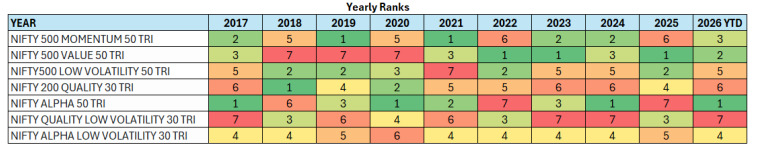
Source: National Stock Exchange, Advisorkhoj Research, as on 31st July 2026. Past Performance may or may not sustain in future, The data shown above pertains to the index and does not in manner indicate performance of any scheme of the Fund
Commodity passive funds
Commodity ETFs track the market price of commodities e.g. gold, silver. Though gold ETFs have been around for fairly long time, its popularity has jumped in recent years. From just Rs 8,000 crores of AUM in March 2020, gold ETF AUM increased in the last six years to Rs 1.71 lakh crores (see the chart below).
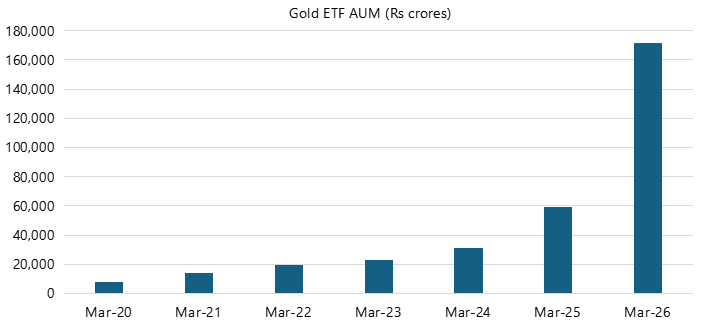
Source: AMFI, as on 31st March 2026
Gold as a hedge against inflation
Historical data shows that gold is a hedge against inflation in the long term - gold returns go up when inflation is rising (see the chart below).
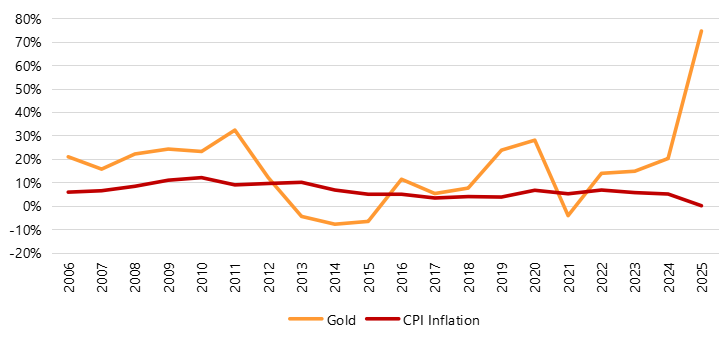
Source: MCX (year-end spot prices), World Bank (for CPI inflation), as on 31st December 2025
Commodities (precious metals) and equity are counter-cyclical
Historical data shows that precious metals (e.g. gold, silver) and equity are counter-cyclical i.e. precious metals outperforms when equity underperforms and vice versa (see the chart below). Adding precious metals to your asset allocation can provide stability to your investment portfolio.

Source: NSE, MCX, Advisorkhoj Research, as on 31st July 2026. Equity is represented by Nifty 50 TRI and gold, silver by MCX spot prices
Silver can add richer diversification to your asset allocation
Though both gold and silver are precious metals and show high correlation, silver outperforms gold in certain economic phases e.g. economic recovery, growth etc (see the chart below). In addition to its status as a safe haven asset, the industrial use of silver is grown especially in new age technologies, like renewable energy, advanced electronics etc.
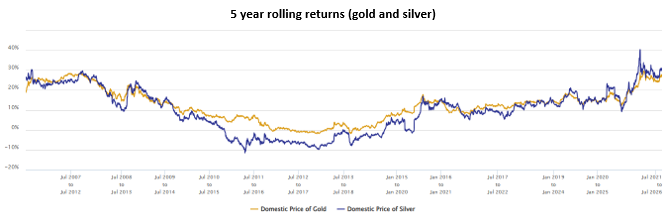
Source: MCX spot prices, Advisorkhoj Research, as on 31st July 2026.
You can get cost efficient (e.g. no impurities, jewellery making charges, storage costs etc) exposure to gold and silver through ETFs. If you do not have demat accounts, then you can invest in gold and silver fund of funds (FOFs). These FOFs invest in gold or silver ETFs in their underlying portfolios. If you want exposure to both the precious metals in a single scheme, you can invest in Gold and Silver FOFs.
Debt passive funds
The most popular schemes under passive debt funds are target maturity funds. These are open ended funds with a maturity data. You can select target maturity funds based on investment horizon. One benefit of investing is target maturity fund is that you may be able lock in the current yield to maturity fund if you hold the fund till maturity date. Secondly, you can also benefit from potential price appreciation if interest rate falls. Finally, these funds invest in Government Securities (G-Secs) and State Development Loans (SDLs); credit quality is very high – sovereign quality. Other than target maturity funds, you can get exposure to G-Secs and SDLs of different maturities through passive debt funds.
International passive funds
International passive funds track international benchmark indices e.g. S&P 500, NASDAQ 100, Hang Seng etc. There is low correlation of returns between Indian and international equities (see the chart below). Adding international passive funds may add more diversification to your portfolio. Investment in international equities may provide exposure to global megatrends or themes (e.g. artificial intelligence) for which there are limited investment opportunities in domestic equity market. You may also benefit for currency depreciation. However, you should not invest in international ETFs or international FOFs just to benefit from potential currency depreciation because market specific risks may outweigh benefits from currency from currency depreciation. You should consult with your financial advisor of mutual fund distributor, if you need help in understanding risk profile of international funds.
While your core portfolio should comprise of domestic equity and fixed income funds, you can add international funds to your satellite portfolio for the purpose of asset class diversification and provide stability to your portfolio across different market conditions and investment cycles.
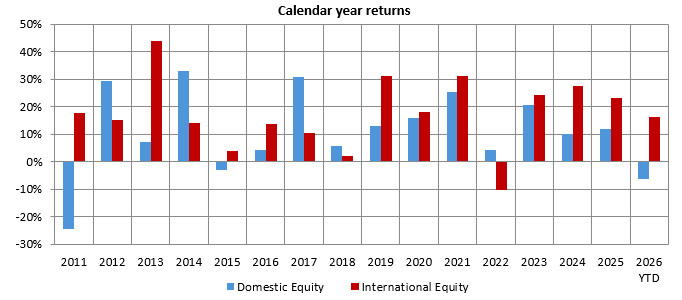
Source: NSE, Yahoo Finance, Advisorkhoj Research, as on 31st July 2026. Domestic Equity is represented by Nifty 50 TRI and Internation Equity is represented by S&P 500 (in INR)
Factors to consider in selection of passive schemes
- Asset class and sub-category: Decide on the asset class and sub-category based on your asset allocation needs. Your asset allocation will depend on your risk appetite, short and long term financial goals.
- Low tracking error: Tracking error is the deviation of the fund’s returns from the benchmark index return. This should be one of the most important factors in selecting passive funds because a passive fund aims to track benchmark index. SEBI requires passive funds to disclose their tracking errors as part of statutory disclosures. You should select funds with low tracking errors
- Low TER: Since passive funds do not aim to create alphas, TER is an important factor in passive scheme selection. Higher TER is a source of tracking error. You should select schemes with lower TERs.
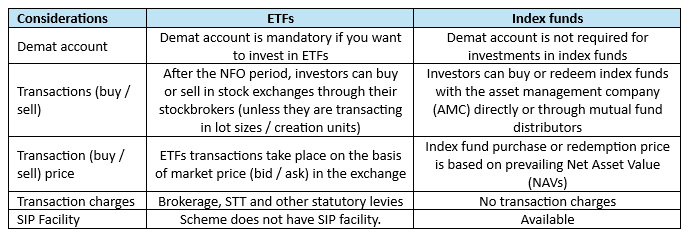
- Liquidity: Since you can sell ETF units in stock exchanges only (unless transacting in creation units), liquidity should be an important consideration when you are investing in ETFs. You can check average daily volumes of ETFs in stock exchanges to get a sense of liquidity.
ETFs or Index Fund?
You can decide between ETFs and index funds based on the following considerations. You should consult with your financial advisor, if you need help in deciding whether ETFs or index funds may be more suitable for you.
Conclusion
In this article, we discussed about how passive funds are increasingly becoming popular in India. Passive funds offer a wide variety of cost efficient investment options for different asset classes and sub-categories. Passive funds can provide investment solutions for different risk appetites and financial goals. While passive funds may gain more popularity with retail investors in coming years, active funds will continue to have an importance place in investor’s portfolio. Active funds have the potential to create alphas as shown earlier in the article. The question is really about, how to build a resilient, diversified and growth oriented investment portfolio with both active and passive funds. Investors should consult with their financial advisors or mutual fund distributors to discuss how to build a well-rounded portfolio that helps you achieve your financial goals with active and passive funds.
Disclaimer:
The investors will bear the recurring expenses of the Fund of Fund (‘FoF’) scheme in addition to the expenses of the Underlying Schemes in which Investments are made by the FoF scheme
Past performance may or may not be sustained in future and is not a guarantee of any future returns
The information herein is meant only for general reading purposes, and the views being expressed only constitute opinions and therefore cannot be considered as guidelines, recommendations or a professional guide for the readers. The document has been prepared on the basis of publicly available information, internally developed data, and other sources believed to be reliable. Recipients of this information are advised to rely on their own analysis, interpretations & investigations. Readers are also advised to seek independent professional advice in order to arrive at an informed investment decision
An Investor education and Awareness initiative of Aditya Birla Sun Life Mutual Fund.
All investors have to go through a one-time KYC (Know Your Customer) process. Investors to invest only with SEBI registered Mutual Funds. For further information on KYC, list of SEBI registered Mutual Fund, and redressal of complaints including details about SEBI SCORES portal, visit link:https://mutualfund.adityabirlacapital.com/Investor-Education/education/kyc-and-redressal for further details. Investors may lodge their complaints with SEBI through the SCORES portal (SEBI Complaints Redressal System) at https://scores.sebi.gov.in/.
Mutual Fund Investments are subject to market risk, read all scheme related documents carefully.
RECOMMENDED READS
LATEST ARTICLES
- GenAI for Business Expansion: MFD Module by Aditya Birla Sun Life MF NIPUN
- Aditya Birla Sun Life Quant Fund: One of the best performing quant funds
- Nomination Transmission and Gifting in Mutual Funds
- Investor Rights in Mutual Funds
- Responsibilities of Regulators and Key Constituents of the Mutual Fund Industry

An investor education initiative by Aditya Birla Sun Life Mutual Fund
Follow Birla Sun Life MF
More About ABSL MF
POST A QUERY