Responsibilities of Regulators & Key Constituents of the Mutual Fund Industry

The mutual fund industry in India operates within a tightly regulated, multi-layered framework where each constituent like SEBI, AMFI, Trustees, AMCs, Fund Managers, and Custodians plays a distinct yet interlinked role to safeguard investors and maintain market integrity. Together, they create checks and balances that promote investor protection, good governance, and transparency across the entire value chain, from product design and portfolio management to distribution, disclosure, and grievance redressal. (See the flowchart below)
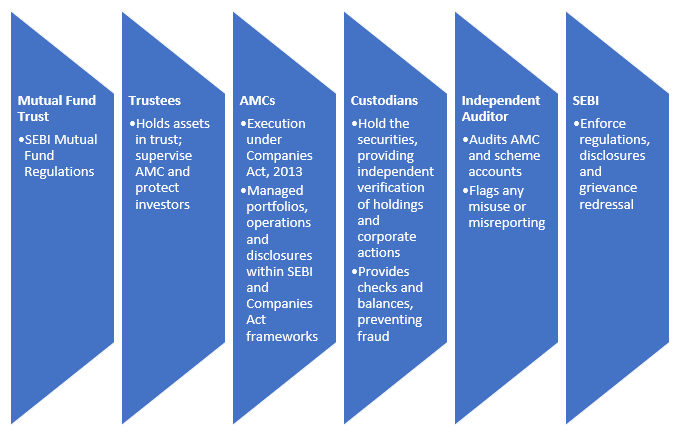
Mutual Funds as a trust
Their operational arms structured as companies registered under the Companies Act, 2013 and subject to independent audit. Together, this legal and oversight architecture creates a multi-layered safety net for investors that complements SEBI's regulations. Trustees hold scheme assets in fiduciary capacity for unitholders and must ensure that AMC decisions adhere to the trust deed, SEBI (Mutual Funds) Regulations, and investors' best interests, effectively becoming the first legal line of defence for investors in case of any dispute
Trustees: First line of defence for investors
Every mutual fund has a board of trustees or a trustee company that holds the property of the mutual fund in trust for the benefit of the unitholders. Trustees do not run the schemes day-to-day but are vested with broad powers of supervision and direction over the AMC, and they must ensure that the AMC operates strictly within SEBI regulations and guidelines and the interests of investors.
In practice, trustees review compliance reports, monitor risk and operations, oversee adherence to investment objectives, and step in when conflicts of interest or red flags arise. Recent regulatory focus has further strengthened trustees' duties by emphasising independent oversight, early warning systems for irregularities, and the ability to question, escalate, or intervene if the AMC's actions may harm unitholders, reinforcing trustees as a crucial governance checkpoint.
AMC: The execution arm of mutual fund
The Asset Management Company (AMC) is appointed by the trustees to design, manage, and operate mutual fund schemes, acting as the professional investment and operations arm. AMCs are responsible for research, portfolio construction, risk management, compliance, product development, operations, and investor servicing, and they must follow SEBI's regulations, AMFIguidelines, and the directions of the trustees
From a governance and transparency perspective, AMCs must publish scheme-wise portfolios, NAVs, performance data, and expense ratios at prescribed intervals, while ensuring that all marketing materials are fair, balanced, and not misleading. Boards of Directors of AMCs are increasingly required to set up dedicated unitholder protection committees and to conduct independent evaluations of how decisions impact investors, strengthening internal accountability beyond purely commercial objectives.
Fund Managers: Fiduciaries of Investor Capital
Fund managers are the individuals or teams within the AMC who take daily investment decisions, including stock and bond selection, asset allocation, and risk management within each scheme. They must operate strictly within the mandate stated in the scheme documents, adhere to SEBI and internal risk limits, and ensure that trading and allocation practices are fair to all unitholders.
Because they directly influence portfolio outcomes, fund managers carry a fiduciary responsibility: they must prioritise investor interest over short-term gains or any conflicts involving group entities or distributors. Their performance is subject to regular review by the AMC's investment committees and trustees, and their decisions are made transparent to investors through periodic portfolio disclosures, commentary, and mandatory risk and performance reporting.
Role of the Companies Act
The AMC that manages investors' money is incorporated as a company under the Companies Act, 2013, which brings in corporate governance requirements such as a board of directors, audit committees, and oversight of financial reporting. Changes in control, board composition, and key governance actions of the AMC must comply not only with SEBI rules but also with Companies Act processes.
Custodians: Safekeeping and settlement backbone
Custodians are SEBI-registered entities appointed to hold the securities and other assets of mutual fund schemes in safe custody. They handle settlement of trades executed by the fund manager, maintain accurate records of holdings, and ensure that assets are segregated scheme-wise so that investor property is clearly identifiable and protected from misuse or commingling.
Custodians provide independent verification of holdings and corporate actions, which feeds into valuation, NAV calculation, and audit, strengthening transparency and reducing operational and settlement risk. Their role as an external, regulated entity distinct from the AMC adds another layer of checks and balances, especially important in preventing fraud, unauthorised transactions, or misappropriation of securities.
Independent auditor as a safety layer
Independent auditors, appointed in line with Companies Act provisions and SEBI regulations, examine both the AMC's books and scheme-wise financial statements, ensuring segregation of scheme assets and flagging off misstatement or misuse of funds. Their reports feed into trustees' and SEBI's oversight, adding an external, unbiased check on NAV computation, expense charging, and overall financial integrity of the mutual funds.
SEBI: The central regulator
The Securities and Exchange Board of India (SEBI) is the primary regulator for mutual funds and lays down the core legal framework through the SEBI (Mutual Funds) Regulations, 1996 and subsequent circulars and master directions. SEBI's key responsibilities include granting registration to mutual funds and AMCs, prescribing norms on scheme categorisation, risk management, valuation, disclosure standards, fees, and advertising, and ensuring that fund houses adhere to high standards of integrity and fairness.
From an investor protection standpoint, SEBI mandates detailed scheme documents, standardised risk-o-meters, periodic portfolio disclosures, and clear communication of investment objectives so that investors know what they are buying and at what risk. SEBI also provides a structured grievance redressal mechanism and has powers to investigate, penalise, or restrict intermediaries in case of mis-selling, misuse of investor money, or governance failures, thereby acting as the ultimate guardian of unitholder interest.
AMFI: Self-regulatory body and industry voice
The Association of Mutual Funds in India (AMFI) functions as a self-regulatory and representative body of mutual fund houses, working under the broad oversight of SEBI. Its responsibilities include issuing and enforcing a code of conduct for AMCs and distributors, standardising operational practices and terminology across the industry, and serving as a liaison between the industry, SEBI, and the government on policy matters.
AMFI is a key driver of investor awareness and financial literacy through initiatives such as mass media campaigns, workshops, educational tools, and its website resources, which explain products, risks, and rights in simple language. It also provides framework for distributors pertaining to guidelines for AMFI Registration Number (ARN) , helping ensure that only qualified and accountable intermediaries sell mutual fund products, thereby reducing mis-selling and improving overall market conduct.
A collaborative ecosystem for investor protection
The mutual fund ecosystem in India operates as a collaborative network rather than isolated silos: SEBI sets the rules, AMFI shapes industry standards and awareness, trustees supervise, AMCs execute, fund managers invest, and custodians safeguard assets. Each participant has clearly demarcated responsibilities, yet they interact continuously through regulations, reporting, oversight, and feedback loops to maintain a robust governance architecture.
For investors, this layered structure translates into multiple lines of defence: regulatory oversight, self-regulation, fiduciary supervision, independent safekeeping, and transparent information flow; all aimed at building trust, protecting rights, and ensuring that mutual funds remain a transparent and well-governed vehicle for long-term wealth creation.
Disclaimer: An Investor education and Awareness initiative of Aditya Birla Sun Life Mutual Fund
All investors have to go through a one-time KYC (Know Your Customer) process. Investors to invest only with SEBI registered Mutual Funds. For further information on KYC, list of SEBI registered Mutual Funds and redressal of complaints including details about SEBI SCORES portal, visit link :https://mutualfund.adityabirlacapital.com/Investor-Education/education/kyc-and-redressal for further details.
Mutual Fund Investments are subject to market risk, read all scheme related documents carefully.
RECOMMENDED READS
LATEST ARTICLES
- Passive funds can play an important role in your investment portfolio
- GenAI for Business Expansion: MFD Module by Aditya Birla Sun Life MF NIPUN
- Aditya Birla Sun Life Quant Fund: One of the best performing quant funds
- Nomination Transmission and Gifting in Mutual Funds
- Investor Rights in Mutual Funds

An investor education initiative by Aditya Birla Sun Life Mutual Fund
Follow Birla Sun Life MF
More About ABSL MF
POST A QUERY