Role of asset allocation in achieving your financial goals

What is asset allocation?
Asset allocation is diversifying your investments across different asset classes. Different asset classes have different risk / return profiles. By diversifying across asset classes, you can balance risks and returns. Though asset allocation is one of the most important concepts in investing, it is often ignored by many investors. Many investors do not rebalance their portfolios till they reach retirement age. This can expose their corpus to unwarranted volatility and put their financial goals at risk. In this article, we will discuss how asset allocation can help you navigate through volatility and help you achieve your financial goals.
Why is asset allocation important?
The table below shows some of the biggest drawdowns in the last 25 years and how long it took the market to recover from trough to previous peak. If your portfolio was pure equity, it may have fallen by 15 to 60% in major drawdowns and recovery from peak to trough to peak may have taken 10 months to 4 years. What if you had a major life stage goal coming up, when market had crashed or in early stages of recovery?
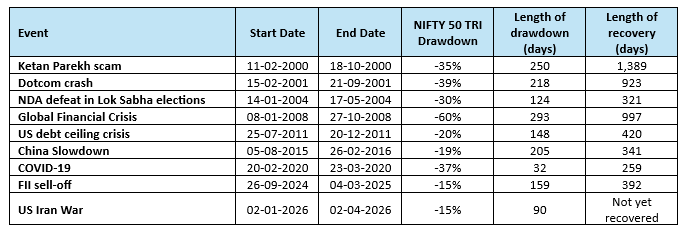
Source: NSE, Advisorkhoj Research, as on 30th June 2026. Disclaimer: Past performance may or may not be sustained in the future
How can asset allocation reduce risks?
The table below shows the drawdowns for different asset allocations compared to pure equity. You can see that asset allocation considerably reduces downside risks in your portfolio.
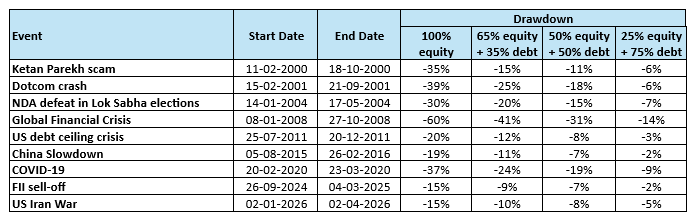
Source: NSE, Advisorkhoj Research, as on 30th June 2026. Equity is represented by Nifty 50 TRI and debt by Nifty 10-year benchmark G-Sec Index. Disclaimer: Past performance may or may not be sustained in the future
How to determine your optimal asset allocation?
Your asset allocation depends on your risk appetite, investment horizon and financial goals. One of the popular thumb rules of asset allocation suggests equity allocation to be 100 minus your age. If your age is 35 years, then your equity allocation should be 65% and debt allocation should be 35%. If you are 50 years old, then your equity and debt allocation should be 50% each. Please note that this is only a thumb rule. Please consult with your financial advisor to determine your target asset allocation.
Why you need to rebalance your asset allocation?
- Let us assume your target asset allocation is 50% equity and 50% debt. Let us assume equity CAGR return of 12% and debt return of 6%. If you do not rebalance your portfolio, in 10 years your asset allocation will become skewed to 63% equity and 37% debt. In other words, your portfolio risk will be higher than what your risk profile and target asset allocation would have.
- Your risk appetite will change as you approach different life stage goals. If you do not rebalance your asset allocation from time to time, then you might be exposing your financial goals to risks. Right asset allocation at right life stage and goals make investing meaningful.
- Rebalancing your portfolio optimizes risk / returns. For example, when you are rebalancing from equity to debt when market is high, you are selling high. Similarly, when you are rebalancing from debt to equity when market has fallen, you are buying low.
Various factors e.g. taxation, costs, sharp market movements, life stage goals, goal horizon etc, should be considered to determine when to the rebalance your portfolio. Hybrid mutual funds provide the benefit of auto rebalancing without any taxation incident in hands of the investors.
Beyond traditional asset allocation
- Equity and debt are the two most popular asset classes for asset allocation. However, other asset classes like commodities and international equities can add richer diversification to your portfolio.
- There is low correlation of returns between different asset classes. See the chart below.
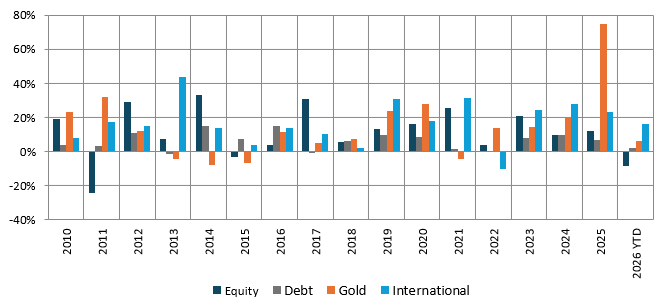
Source: NSE, MCX, Bloomberg, Advisorkhoj Research, as on 30th June 2026. Equity is represented by Nifty 50 TRI, debt by Nifty 10 year benchmark G-Sec Index, Gold by MCX Spot Prices and International by S&P 500 in INR. Disclaimer: Past performance may or may not be sustained in the future
- The chart below shows the 5-year rolling returns of Nifty 50 TRI and Gold over the last 20 years. You can see that equity and gold are counter-cyclical.
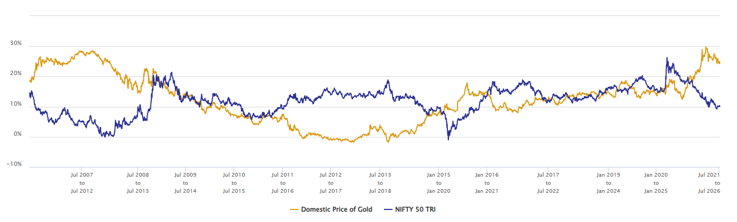
Source: NSE, MCX, Advisorkhoj Research, as on 10th July 2026.
- The chart below shows that the 5-year rolling returns of Nifty 50 TRI and S&P 500 TRI (in INR) over the last 20 years. You can see that domestic and international equities outperform / underperform each other in different periods.
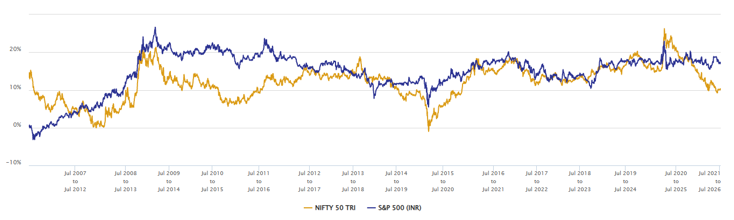
Source: NSE, Bloomberg, Advisorkhoj Research, as on 10th July 2026.
- The chart below shows that the 5-year rolling returns of Gold and S&P 500 TRI (in INR) over the last 20 years. You can see that gold and international equities are counter-cyclical.
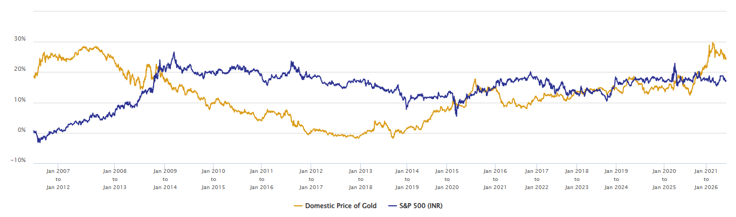
Source: MCX, Bloomberg, Advisorkhoj Research, as on 10th July 2026.
How to get exposure to multiple asset classes?
Multi Asset Allocation Funds are hybrid mutual fund schemes which invest in at least 3 asset classes. Minimum investment in each asset class is 10%. Apart from Multi Asset Allocation Funds, you can also get exposure to multiple asset classes through Multi Asset Fund of Funds (FOFs). These fund of funds invest in mutual funds / ETFs of different asset classes. Multi Asset Allocation Funds and Multi Asset FOFs offer taxation benefits, rebalancing and convenience of getting exposure to multiple asset classes in a single scheme.
Conclusion
In this article, we have discussed the importance of asset allocation, rebalancing and exposure to multiple asset classes beyond the traditional equity and debt asset allocation. Multi Asset Allocation Funds and Multi Asset FOFs offer tax efficient, convenient investment options for getting exposure to multiple asset classes. Different multi asset allocation funds and multi asset FOFs have different asset allocation profiles and tax treatment. Investors should consult with their financial advisors or mutual fund distributors to select a fund which can be suitable for their risk profile and investment needs.
Mutual Fund Investments are subject to market risk, read all scheme related documents carefully.
RECOMMENDED READS
LATEST ARTICLES
- Why you need to focus on asset allocation in current market conditions
- How a fund of funds with 65 percentage allocation to debt can be of use for risk averse investors
- Why having large and midcap funds in the portfolio matters now
- Role of index funds in portfolio construction
- Large and Midcap Funds: Mix of growth and stability

The information being provided under this section 'Investor Education' is for the sole purpose of creating awareness about Mutual Funds and for their understanding, in general. The views being expressed only constitute opinions and therefore cannot be considered as guidelines, recommendations or as a professional guide for the readers. Before making any investments, the readers are advised to seek independent professional advice, verify the contents in order to arrive at an informed investment decision.
Mutual Fund investments are subject to market risks, read all scheme related documents carefully.
Quick Links
Follow Nippon India MF
More About Nippon India MF
POST A QUERY