

Term Insurance for Women (2026): A Simple, Practical Guide

Term insurance is often seen as something only the "main earner" needs. But real families don't work that way. Women today may be earning, running a business, supporting parents, taking career breaks, raising children, or managing the household full time. In every one of these roles, a woman's absence can create a real financial shock for the family.
So the right question isn't "Do I earn?"
It's: "If something happens to me, will my family's finances take a hit?"
If you're still shortlisting options and want a quick sense of what's available in the market, you can refer to a comparison style guide on Best Term Insurance Plans 2026 and then choose a plan based on your life stage and responsibilities.
What term insurance actually does
Term insurance is a life cover. You pay a premium for a chosen term, like 20 or 30 years. If the insured person passes away during the policy term, the insurer pays a payout (sum assured) to the nominee. The family can use this money for anything that keeps life stable, like monthly household expenses, rent or EMIs, children's education, medical costs, and long term support for dependents.
This is exactly why term insurance matters for women. The payout is not meant to replace emotions. It's meant to protect the family from financial instability at a time when they are least prepared to handle it.
The biggest myth: "My husband has term insurance, so I don't need it"
This is one of the most common assumptions, and it creates a gap that families realise only when it's too late.
Even if your spouse has a strong term plan, your family may still struggle if something happens to you. If you earn, your income may be paying for EMIs, school fees, or everyday expenses. Losing that income can force families to dip into savings or stop investments. If you don't earn, your role may still need replacement support, like childcare, home help, or elder care. Either way, the family can face a combination of higher expenses and lower earning capacity, especially when children are young.
So, your spouse's cover is important, but it does not automatically replace the need for your own cover.
Why term insurance matters for women across life stages
Women's financial responsibilities often change sharply across life stages. A single woman may be supporting her parents or paying off a loan. A working woman may be contributing significantly to the household budget. A new mother may be planning long term expenses for children and may also take a career break. A woman managing the household full time may not have a salary, but she often handles the daily systems that keep family life running.
In all these situations, term insurance is not about gender. It's about responsibility and dependency.
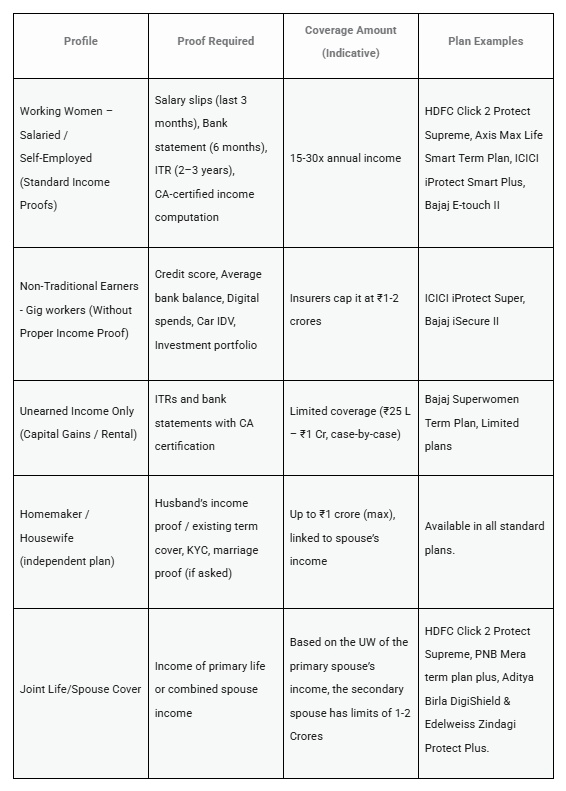
Term Insurance For Housewife: why homemakers should not ignore life cover
Many people assume insurance is only for salaried individuals. But a homemaker's contribution has real economic value. If she is not around, families often need paid support to replace what she handled daily. That can mean childcare support, help with cooking and cleaning, school runs, or elder care support if parents are dependent. These are not one time expenses. They can become long term monthly costs.
This is why Term Insurance For Housewife planning makes sense. It is not about replacing "income." It is about protecting the household from the cost of replacement support and the disruption that follows.
A simple way to think about the cover amount is to estimate what it would cost per year to replace key household support and multiply it by 10 to 15 years, depending on children's age and responsibilities. Then add a buffer for emergencies. Many families, even with conservative estimates, end up needing a meaningful cover because replacement costs add up quickly over time.
How much term cover should a woman take?
If you are working, a practical starting point is to look at 10 to 20 times your annual income and add any outstanding loans. Then adjust based on your family's goals, such as children's education or dependent parents' support. If you are a homemaker, the replacement cost method is usually more sensible than income based methods. The right cover is the one that prevents your family from making panic financial decisions later.
One important point here is that the cheapest premium should not be the goal. The goal should be adequate protection with a premium that you can comfortably pay every year.
What impacts the premium?
Term insurance premiums usually depend on age, cover amount, policy term, health history, BMI, and tobacco use. Younger applicants typically get lower premiums. Tobacco use, even occasional, usually increases premiums significantly. Add ons (riders) and payout options can also affect pricing.
Instead of trying to optimise only for price, focus on getting a plan with clean conditions and honest disclosures. A slightly higher premium for a well disclosed policy is often better than a cheaper policy built on incomplete information.
How to shortlist a plan without confusion
Most people compare plans only on premium, which is a mistake. A better approach is to first decide the cover amount based on responsibilities, then decide the policy term based on the years your family will depend on you most. After that, choose a payout style your family can manage, like lump sum or lump sum plus monthly income.
Disclosures: the one thing you must do right
Many claim problems start at the buying stage because of incomplete or incorrect disclosures. Always disclose tobacco use, existing medical conditions like thyroid issues, diabetes, BP, asthma, or PCOS/PCOD if diagnosed, along with any ongoing medication. Also disclose past surgeries, hospitalisations, or abnormal test results.
If you're unsure whether something matters, disclose it anyway. Term insurance works best when the policy is clean and transparent from day one.
Final takeaway
Term insurance for women is a practical financial decision, not a gender specific trend. Whether you are earning or managing the household full time, your absence can create a financial gap that the family may struggle to fill. This is especially true in Term Insurance For Housewife scenarios, where the cost of replacement support can be substantial over many years.
If your family would face financial stress without you, term insurance is one of the simplest ways to protect them.
Data sources: This article uses market research and consumer behavior data compiled by Ditto Insurance, an online insurance advisory platform, as well as publicly available industry statistics from the Insurance Regulatory and Development Authority of India (IRDAI).
Mutual Fund Investments are subject to market risk, read all scheme related documents carefully.





Queries
-
What is the benefit of mutual fund STP
Aug 29, 2019
-
How much to invest to meet target amount of Rs 2 Crores
Aug 26, 2019
-
Can I achieve my financial goals with my current mutual fund investments
Aug 24, 2019
-
Can you tell me return of various indices
Aug 19, 2019
-
What would be the post tax return on different investments
Aug 18, 2019
-
Which Principal Mutual Fund scheme will be suitable for my retirement corpus
Aug 16, 2019
-
What is the minimum holding period for availing NCD interest
Aug 4, 2019
Top Performing Mutual Funds

Recommended Reading




Fund News
-
Mirae Asset Mutual Fund launches Mirae Asset Fixed Maturity Plan Series VI 3 to 6 Months
Oct 23, 2026 by Advisorkhoj Team
-
Sundaram Mutual Enters SIF Products with Select Equity Ex-Top 100 Long Short Fund
Oct 22, 2026 by Sundaram Mutual Fund
-
UTI Mutual Fund launches UTI Nifty India New Age Consumption Index Fund
Oct 22, 2026 by Advisorkhoj Team
-
Aditya Birla Sun Life Mutual Fund launches Aditya Birla Sun Life Fixed Maturity Plan Series VB 136 Days
Oct 22, 2026 by Advisorkhoj Team
-
Sundaram Mutual Fund SIF launches Select Equity Ex Top 100 Long Short Fund
Oct 21, 2026 by Advisorkhoj Team




