

UTI Banking and Financial Services Fund: Strong performance recovery

The UTI Banking and Financial Services Fund has completed a little more than 20 years since its inception. It is a sectoral fund which primarily invests in companies from the Banking, Financial Services and Insurance sector. The fund has made a strong recovery in performance post COVID, and has outperformed the benchmark index, creating alphas for investors. As far as, banking and financial services sector is concerned, it is the engine of growth of modern economies and has long been favoured by investors for long term wealth creation. In this article we will review the fund in the light of the reasons why investors may add this fund to their portfolio.
Banking sector and financial services in India
The BFSI sector in India has experienced substantial growth, with a market cap increase of over 50 times in 20 years. India is projected to become the world's third-largest economy by 2030, with a GDP of $7.3 trillion (source: PIB, GOI) and the BFSI sector will be pivotal in the India growth story. The financial assets-to-GDP ratio of some of the major economies is 4-5X (source: US Federal Reserve, World Bank). If India is to become a $30 Trillion economy by 2047 (source: Economic Diplomacy Division, MEA, GOI) then its household financial assets has the potential to grow from $4.1 trillion (source: RBI Household Financial Savings) to $120 - 150 trillion in the next two decades.
Why Banking and Financial Services?
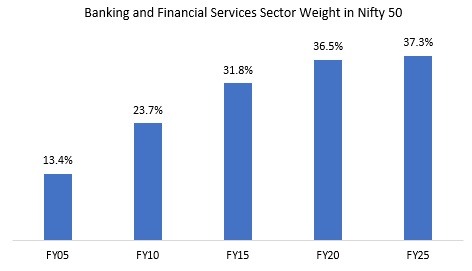
- BFSI share in Nifty 50 has increased multi-fold from ~13% in 2005 to ~37% in 2025.
Source: Bloomberg. Data for the financial year end of respective years, Advisorkhoj Research
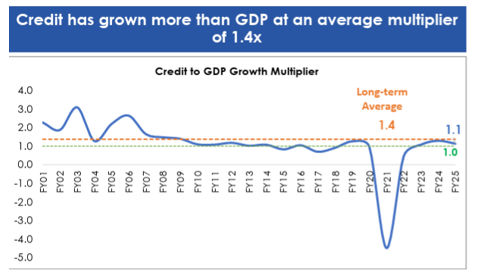
- Credit is a key propellant of economic growth to fuel India's ambitions of $ 5 trillion economy. Credit growth has historically outpaced GDP growth, indicating a robust lending environment. Credit has grown at 1.4x GDP over a two-decade period (see chart). Lenders are key beneficiaries from low household credit penetration at <40% to GDP and corporate recovery. Banks' profitability is best in a decade with sufficient capital to support growth. Key credit drivers are domestic/export manufacturing capex by public/private sector and retail consumption driven loans. Household credit & Industrial capex constitute >50% of overall credit. SME is an emerging growth engine for the sector as GST has enabled better underwriting for the lenders. Higher household income and consumerism are set to drive credit demand in mortgages and personal loans. The sector is characterized by low household credit penetration and strong profitability among banks, presenting significant investment opportunities
Source: Bloomberg, Antique Research, RBI; SME - Small and Medium Enterprises
- Investing in the BFSI sector provides an opportunity to participate beyond lending. Many investors associate financial services primarily with banks. Though banks are a very important part of financial services, the financial services sector is much broader than purely the banking sector. The financial services sector includes the following sub-sectors: - Term lending institutions, Housing finance companies, Leasing and hire purchase companies, Life insurance companies, General insurance companies, Capital markets (asset management companies, stock broking, stock exchanges, depositories, distribution companies) etc.
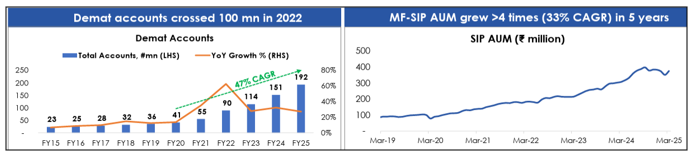
- Financialization of savings from physical assets (real estate and gold) and shift of traditional savings (fixed deposits, government schemes) to capital markets like stock markets, mutual funds, etc. has also given impetus to the BFSI sector.
Source: Jefferies, NSDL, CDSL, AMFI
- Sector valuations have been reasonable, and below long-term average with superior return metrics compared to history. BFSI sector has outperformed Nifty 50 Index by over 300 bps on a 20 year CAGR basis. Banks (~75% of the benchmark) trade at multiples that are below average. This makes a strong investment case, given visibility of mid-teens book value compounding with an ROE of 15%+. Select private banks trade at a discount and PSUs at a premium to 10-year averages highlighting dispersion within the sector and provides opportunities for mean reversion plays.

Source: Bloomberg; SD - Standard Deviation; PB - Price to Book Ratio. Data as of 30/Nov/2025
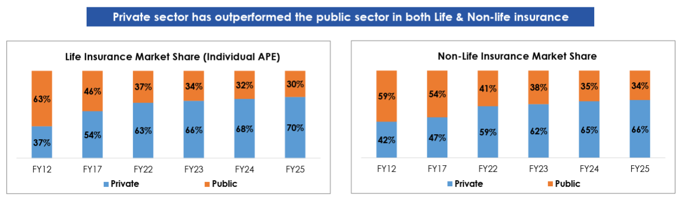
- The insurance sector is also a growth area, with a significant protection gap in retail segments. Accelerated shift in market share, product-mix driven profitability and reasonable valuations bode well for the sector.
Source: IRDA, Company Reports; APE - Annual Premium Equivalent
- BFSI's faster growth showcases sectoral leverage to GDP expansion over the last 2 decades.
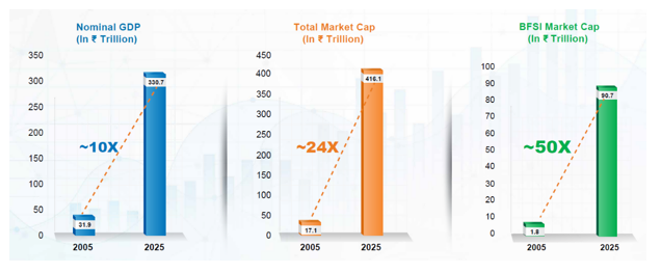
Source: Bloomberg. Data for the financial year end of respective years, Motilal Oswal Institutional Research
Financial Services have outperformed the broad market
Nifty Financial Services Index which comprises of the 20 largest financial services companies by market cap in the NSE has outperformed the leading broad market benchmark index (Nifty 50) over long investment horizons. The chart below shows the growth of Rs 10,000 in Nifty Financial Services Index and Nifty 50 TRI over the last 20 years (ending 30th January 2026).
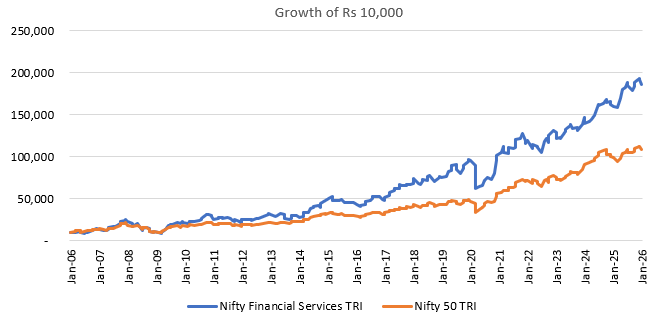
Source: National Stock Exchange, Advisorkhoj Research, as on 30th January
Financial Services performance in economic cycles
Financial Services sector is closely related to the overall economy. The sector does well when demand is increasing (economic expansion) and underperforms when demand slows down or contracts (economic slowdown). The charts below show the returns of Nifty Financial Services TRI over the last 10 years (ending 30th September 2025) in relation to India's real GDP growth rate over the same period. You can see that returns of financial services were lower when the GDP growth rate slowed down. With acceleration of GDP growth rate in the medium to long term, we can expect the financial services to do well as an investment theme.
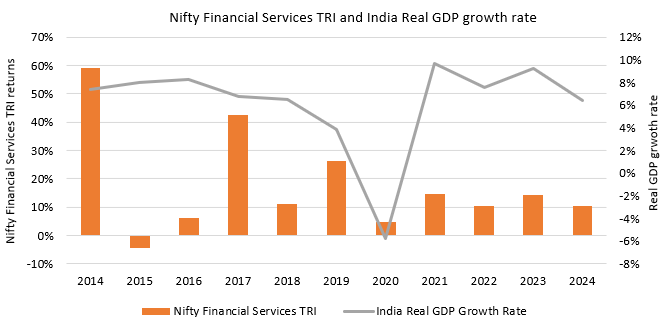
Source: Nifty Financial Services TRI data from National Stock Exchange (as on 31st December 2024), GDP growth data from World Bank (2014 to 2024).
UTI Banking and Financial Services Fund Growth option
The UTI Banking and Financial Services fund is a Sectoral equity fund managed by fund managers Amit Premchandani and Mr. Bhavesh Kanani. Started in April 2004, the objective of the UTI Banking and Financial Services Fund is to generate long term capital appreciation by investing predominantly in equity and equity related securities of companies/institutions engaged in the banking, insurance and financial services related activities of the Indian economy.
Wealth Creation with UTI Banking and Financial Services Fund
A lumpsum of Rs 1 lakh invested into the fund at its inception would have grown to Rs 13.36 lakhs as on 31st January 2026 which is more than 13X growth in just 20 years. An SIP of Rs 10,000 started in the fund at its inception would have grown to Rs 1.08 Crores in the same period (see chart below).
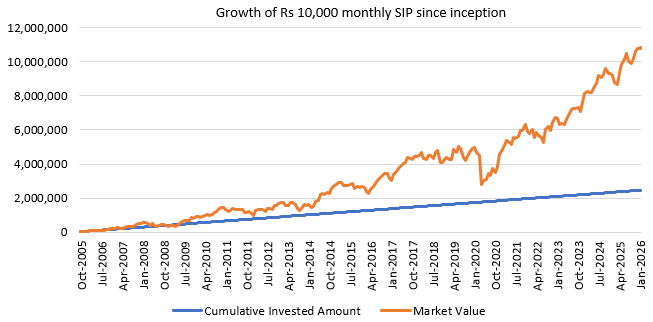
Source: Advisorkhoj Research as on 31st January 2026
Investment process
UTI's proprietary equity research methodology -Score Alpha, is designed to identify high-potential investment opportunities and focuses on Operating Cash Flow (OCF) and Return on Capital Employed (RoCE). Companies get OCF & RoCE ratings based on their previous 5 years financials. The process focusses on identifying good stocks, while avoiding poor stocks. The key to stock picking is the consistency of performance over time.
- OCF is assessed over the previous five years, with companies classified into three tiers based on their cash flow consistency.
- RoCE is evaluated similarly, with companies categorized into three tiers based on their average returns over five years.
Portfolio Composition
The fund's portfolio consists of a around 30 stocks at the end of January 2025. The portfolio is primarily composed of large-cap stocks (74%), followed by mid cap and small cap stocks comprising 14% and 12% respectively.
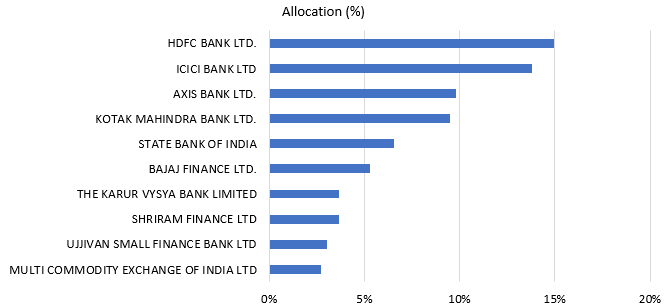
Source: Scheme Factsheet as on January 31st, 2026
Why should you invest in the UTI Banking and Financial Services Fund?
- The Fund has overweight position in Insurance capitalizing on structural trends of under-protection and private sector outperformance.
- The chart below shows the 1 year rolling returns of UTI Banking and Financial Services Fund versus the benchmark index over the last 5 years. You can see that the fund consistently outperformed the benchmark index.
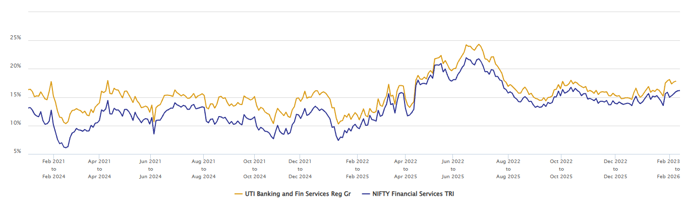
Source: Advisorkhoj Research, as on 12th February 2026
- The fund has outperformed benchmark 4 times in the last 6 calendar years, including current year on a YTD basis.
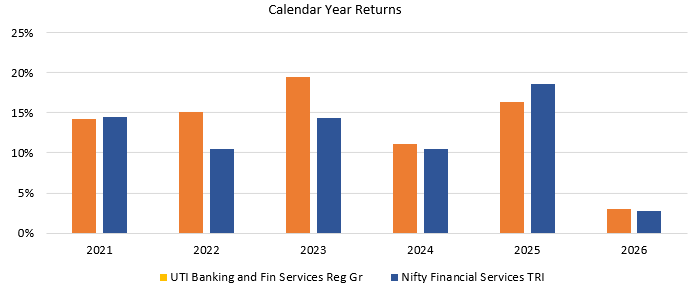
Source: Advisorkhoj Research, as on 12th February 2026
Why invest in the UTI Banking and Financial Services Fund now?
- The BFSI Sector is trading at a discount compared to the Nifty 50.
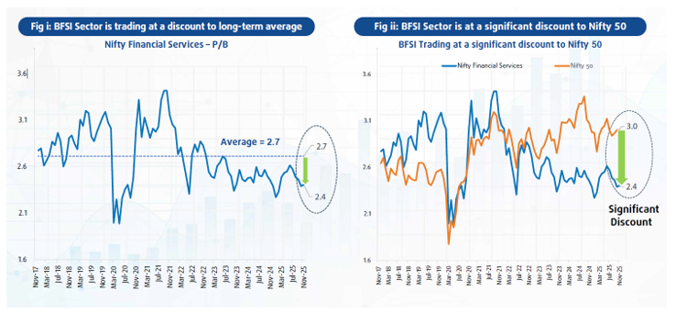
Source: Bloomberg, Elara Equity Research. Data as on 30th Nov 2025. Above data is P/B for respective index. BFSI Sector- Nifty Financial Services TRI, Nifty 50 TRI.
- Significant growth in financial services sector is needed for India to catch up with the developed markets, in terms of the sector's penetration.
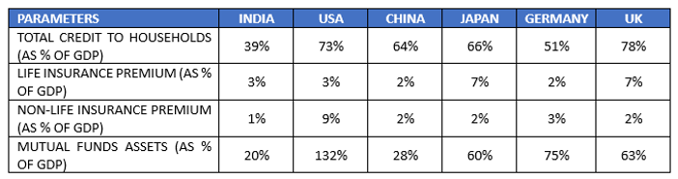
Source: IRDAI, AMFI, World Bank Data as on CY 2024
- Fintech in India shows significant potential to expand in next 10 Years. UPI payment volume is expected to increase by 3.5X in next 10 Years (Source: RBI).
Who should invest in UTI Banking and Financial Services Fund?
- Investors who are looking for long-term capital appreciation through thematic investments.
- Investors who are aiming to capitalise on the growth potential within banking, financial services, and related sectors.
- Investors with an investment horizon of minimum 5 years.
- Investors who have a very high-risk appetite.
You should consult your financial advisor or mutual fund distributor, to determine if UTI Banking and Financial Services Fund is suitable for your investment needs.
Mutual Fund Investments are subject to market risk, read all scheme related documents carefully.




Queries
-
What is the benefit of mutual fund STP
Aug 29, 2019
-
How much to invest to meet target amount of Rs 2 Crores
Aug 26, 2019
-
Can I achieve my financial goals with my current mutual fund investments
Aug 24, 2019
-
Can you tell me return of various indices
Aug 19, 2019
-
What would be the post tax return on different investments
Aug 18, 2019
-
Which Principal Mutual Fund scheme will be suitable for my retirement corpus
Aug 16, 2019
-
What is the minimum holding period for availing NCD interest
Aug 4, 2019
Top Performing Mutual Funds

Recommended Reading



Fund News
-
AlphaGrep Mutual Fund SIF launches Eminence Hybrid Long Short Fund
Oct 15, 2026 by Advisorkhoj Team
-
SBI Mutual Fund launches SBI BSE India Defence ETF
Oct 13, 2026 by Advisorkhoj Team
-
Invesco Mutual Fund SIF launches Summit Active Asset Allocator Long Short Fund
Oct 12, 2026 by Advisorkhoj Team
-
Zerodha Mutual Fund launches Zerodha BSE Top 10 Banks ETF
Oct 12, 2026 by Advisorkhoj Team
-
quant Mutual Fund launches quant Nifty Midcap 150 Index Fund
Oct 12, 2026 by Advisorkhoj Team




