Why large cap funds should be part of your core portfolio?

Though the market is back to near its record highs, it is facing selling pressures / profit booking at higher levels. Continued FII selling is dragging the market down. Pressure on the INR and the uncertainty about Indo US trade deal are the headwinds confronting the market. On the other hand, strong GDP growth, fiscal consolidation and consumer demand revival can provide the base for the next bull run for the market. Though the market is near its all time high, valuations are more reasonable compared to Q2 FY 2024-25.
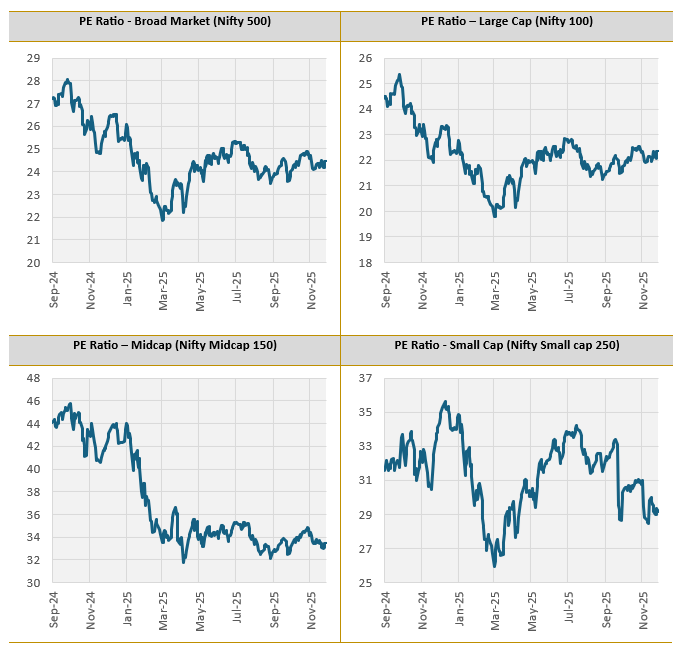
Source: NSE, Advisorkhoj Research, as on 30th November 2025
You can see large cap valuations are at a significant discount to midcap and small cap valuations. In current environment, you can add large cap funds to your equity portfolio with a long-term investment horizon.
What are large cap funds?
As per SEBI, the top 100 companies by market capitalization are classified as large caps. These companies are not only larger than mid and small cap companies, but most large cap companies are also household names with strong brands. These companies are market share leaders in their respective industry sectors with strong balance sheets. Large cap funds, as per SEBI’s mandate must invest minimum 80% of their assets in large cap stocks. Large cap funds have always been very popular with retail investors with nearly Rs 4.2 trillion of assets under management on an aggregate basis across all mutual funds.
Growth story of large cap
The chart below shows the growth of Rs 10,000 investment in Nifty 100 TRI, the benchmark index of the Top 100 stocks (comprising the large cap universe). In the last 20 years, the market went through several investment cycles, crises and deep correction. Despite market upheavals, your investment in Nifty 100 TRI would have multiplied more than 13X to Rs 1.31 lakhs in the last 20 years.
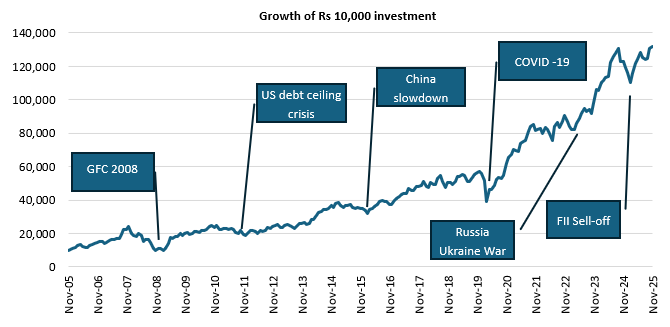
Source: NSE, Advisorkhoj Research, as on 30th November 2025
More stable investment experience compared to smaller companies
The chart below shows the three year rolling returns of the large cap, midcap and small cap indices of over the last 20 years. You can see that large caps were able to provide a more stable investment / lesser volatility.
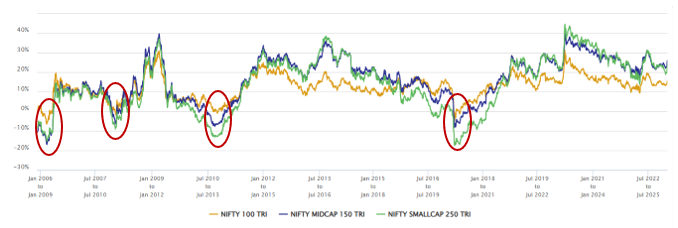
Source: Advisorkhoj Research, as on 30th November 2025
Though median returns of large caps was slightly lower, the minimum returns were higher than midcaps and small caps (see the table below).
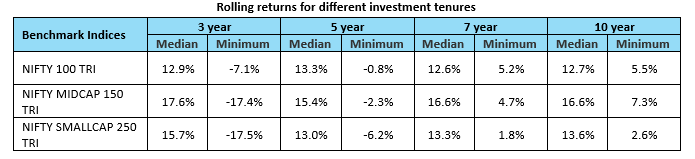
Source: Advisorkhoj Research, as on 30th November 2025
Risk / return trade-off
The table below shows the rolling returns distribution of large cap, midcap and small cap benchmark indices for different investment tenures. You can see that percentage instances of large cap was significantly lower than mid and small caps. On the other hand, the percentage instances of 12%+ CAGR returns for large cap was similar to that of small caps. In other words, large caps provided better risk / return trade off to investors.
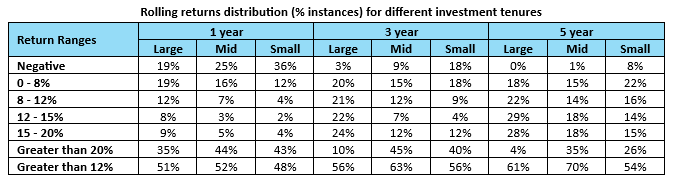
Source: Advisorkhoj Research, as on 30th November 2025. Large cap is represented by Nifty 100 TRI, Midcap by Nifty Midcap 150 TRI and Small cap by Nifty Small Cap 250 TRI
Smaller drawdowns
The table below shows the biggest market corrections in the last 20 years. You can see that large caps (represented by Nifty 100 TRI), experienced small drawdowns in most corrections.
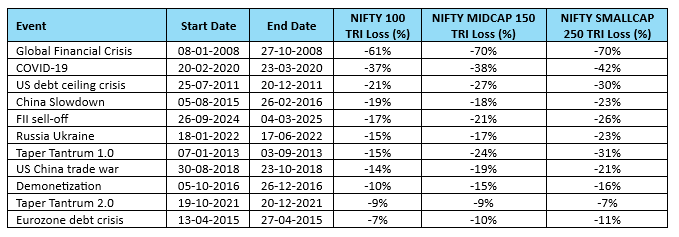
Source: NSE, Advisorkhoj Research, as on 30th November 2025
Diversification beyond Nifty 50
Many tend to think of Nifty 50 as the proxy for large caps. However, the large cap universe comprises of 100 stocks including the Nifty 50 stocks. The large cap benchmark Nifty 100 provides greater diversification compared to Nifty (see the table below).
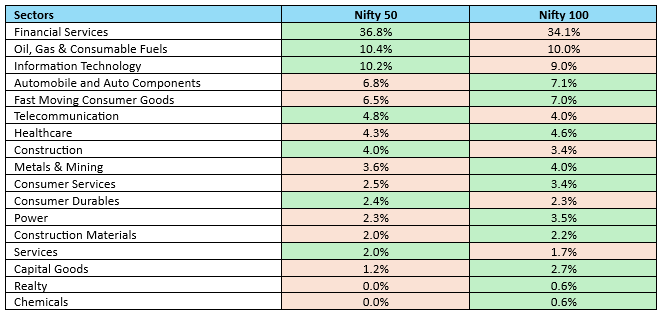
Source: NSE, Advisorkhoj Research, as on 30th November 2025
Potential of outperforming Nifty 50
The table below shows that Nifty 100 TRI (the benchmark for large cap stocks) has given higher median and minimum returns across most investment tenures. This shows that the large cap universe has the potential of outperforming Nifty 50, which is only a subset of the large cap universe.
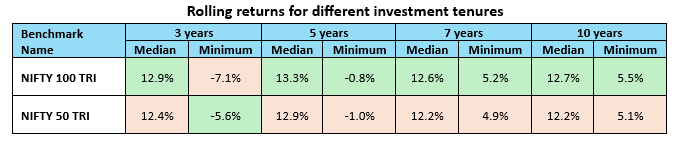
Source: NSE, Advisorkhoj Research, as on 30th November 2025
Wealth creation through SIP
The chart below shows the growth of Rs 10,000 monthly SIP in Nifty 100 TRI, the benchmark index of large cap stocks. You can see with a cumulative investment of Rs 24 lakhs, you could have accumulated a corpus of Rs 1.07 crores in the last 20 years.
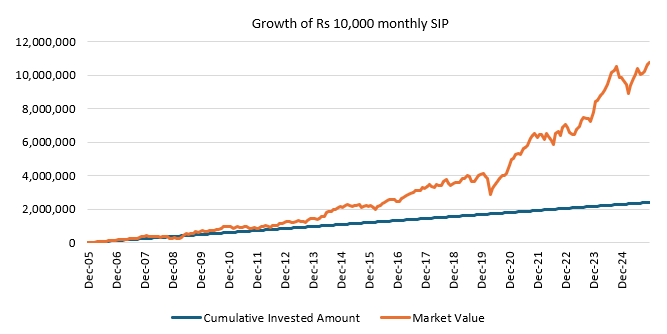
Source: NSE, Advisorkhoj Research, as on 30th November 2025
Why do you need to have long investment tenures for SIP?
The table below shows the distribution of rolling SIP XIRR for different investment tenures over the last 20 years. You can see that the percentage instances of 12%+ SIP XIRR is nearly 70% or higher over 10 year plus SIP tenures. Longer the SIP, higher is the probability of getting 12%+ SIP XIRR.
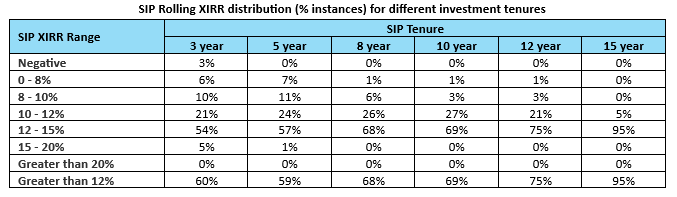
Source: NSE, Advisorkhoj Research, as on 30th November 2025
Who should invest in large cap funds?
- Investors seeking capital appreciation over long investment tenures.
- Investors saving and investing for long term goals like retirement planning, children’s education, house purchase etc.
- Investors who do not have appetite for very high volatility.
- Large cap funds can be suitable for first time investors.
- Investors with minimum 5 year investment horizon.
- Investors should consult with their financial advisors or mutual fund distributors if large cap funds are suitable for their investment needs.
Mutual Fund Investments are subject to market risk, read all scheme related documents carefully.
RECOMMENDED READS
LATEST ARTICLES
- Nippon India Vision Large and Midcap Fund: 145X wealth multiplier since inception
- Role of index funds in portfolio construction
- Large and Midcap Funds: Mix of growth and stability
- Why is this a time for gold How much to take exposure to Gold especially amidst the global uncertainties
- Diversification: Why is it very important in the volatile markets

The information being provided under this section 'Investor Education' is for the sole purpose of creating awareness about Mutual Funds and for their understanding, in general. The views being expressed only constitute opinions and therefore cannot be considered as guidelines, recommendations or as a professional guide for the readers. Before making any investments, the readers are advised to seek independent professional advice, verify the contents in order to arrive at an informed investment decision.
Mutual Fund investments are subject to market risks, read all scheme related documents carefully.
Quick Links
Follow Nippon India MF
More About Nippon India MF
POST A QUERY