Motilal Oswal BSE Clean Environment Index Fund NFO: Investment in the Future of Clean Energy

The Motilal Oswal Wealth Company has launched its NFO, the Motilal Oswal BSE Clean Environment Index Fund NFO. Clean energy is an important theme in current global climate and geo-political scenario. It is also an increasingly important investment theme. The NFO has opened for subscription in 5th June 2026 and will close on 19th June 2026. In this article, we will review this NFO.
The Case for Clean Energy Sector: India’s Environmental and Energy Challenge
- High Fossil Fuel Dependence: Fossil fuels are the single largest driver of India's merchandise trade deficit. India's net crude import bill rose from $116.4 bn in FY25 to $123.1 bn in FY26, despite no major rise in volumes. Coal and oil account for over 20% of India’s import bill, causing a significant current account deficit (CAD) of $ 30 bn and fiscal stress.
- Major Polluter: India's fossil fuel dependency has made it one of the world's most significant polluters, with consequences visible in every city, river, and lung in the country. India is the world’s 3rd largest CO? emitter and has 13 of the world’s 20 most polluted cities, according to a 2024 World Air Quality Report. Delhi emerged as the No.1 polluted capital in the world for six consecutive years, with air quality 10x above WHO safe limits.
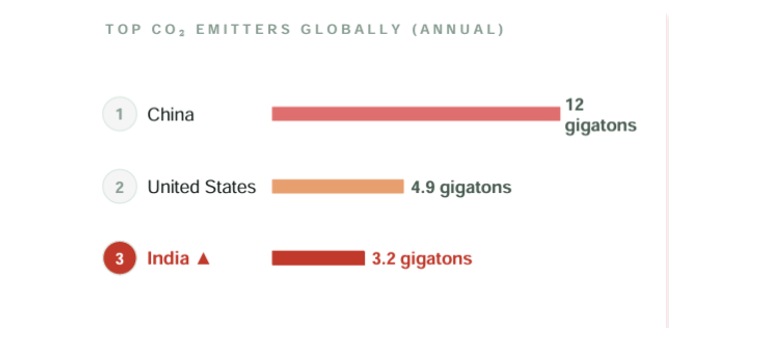
Source: IEA Global Energy Review 2025 | IQAir World Air Quality Report 2024 | Yale Environmental Performance Index 2024 | Economic Survey 2024-25
Global and National Clean Energy Commitments
Global leaders, governments, and institutions have set clear, binding targets backed by policy and capital to transform the world’s energy and economy.
- Global Targets: 195 countries committed to net zero by 2050 (Paris Agreement). By 2030, targets include 50% of new cars being electric and tripling renewable energy capacity.
- Investment Needs: Clean energy investments reached a record $ 2.2 trillion in 2025 alone, taking cumulative investments to ~$17 trillion since 2015, supported by record renewable additions, strong EV sales and rapid battery deployment. By 2030, $4.5 trillion per year in clean energy investment is required globally.
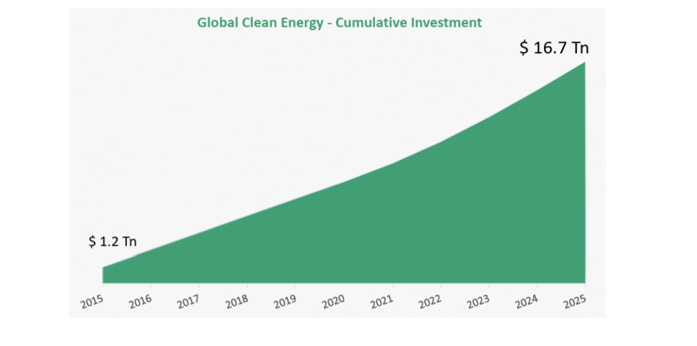
Source: IEA World Energy Investment 2025. The above graph is to explain the cumulative investment done in Global Clean Energy. It shouldn’t be used for the development or implementation of an investment strategy.
India’s Clean Energy Progress
- Installed Capacity: Non-fossil sources now exceed 50% of India’s installed power capacity, though actual generation is lower (29.2%), reflecting the structural gap between capacity and actual output.
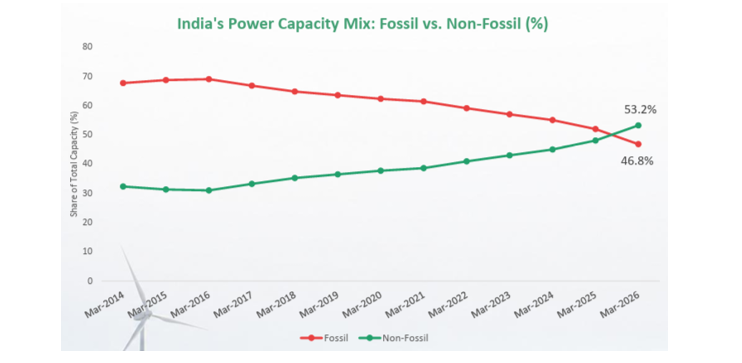
Source: Ministry of New and Renewable Energy (MNRE), Government of India. Data as of March 30, 2026.
- Diverse Portfolio: From solar and wind to hydro, biomass, nuclear and waste-to-energy, India's clean portfolio is spread across technology types - reducing single-source risk. India can now manufacture solar modules domestically to meet its own demand and export as well, making this growth structurally self-sustaining. The graphic below represents India’s clean energy mix.
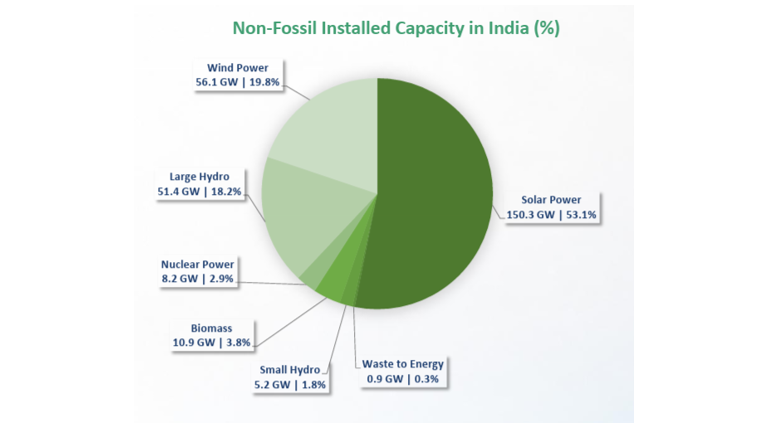
Source: Ministry of New and Renewable Energy (MNRE), Government of India. Data as of March 30, 2026
- Solar Economics: Once installed, solar generates power at near-zero marginal cost. Coal plants incur fuel costs every hour they run. The economic gap is widening. Even solar with battery storage is cheaper than new coal plants discovered in 2025 auctions. Solar tariffs have dropped ~83% since 2010-11, making solar cheaper than coal.
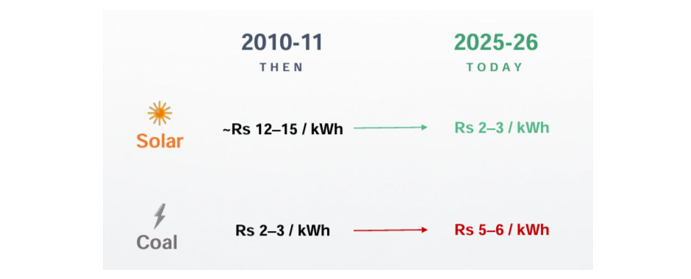
Source: Solar tariff – SECI auction results, October 2025 | Ministry of Power | SECI ISTS-XX auction, October 2025
Investment Opportunities in the Indian Clean Energy Sector: Market Drivers & Policies
- Government Push: Comprehensive policies support manufacturing, wind, storage, hydrogen, transmission, and demand for renewables.
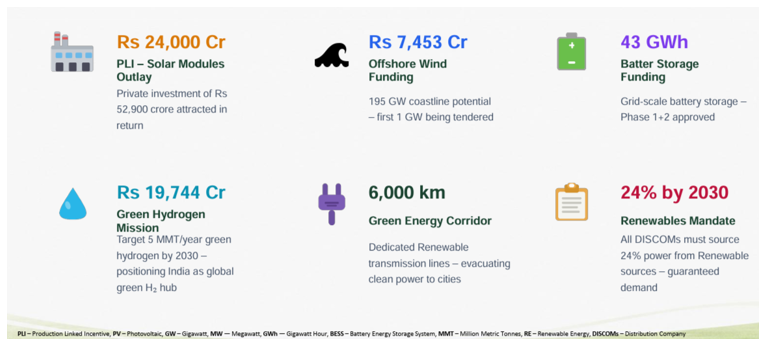
Source: MNRE | Ministry of Power | PIB Press Releases 2025-26 | Union Budget 2025-26 | CERC (RPO targets)
- EV Growth: EV registrations have grown 1000x in a decade from 2.4k in FY15 to over 24L in FY26– driven by falling battery costs and policy push. India’s EV penetration is still low (4.5%), compared to that of other major countries in the world, but accelerating rapidly. The EV30@2030 mandate targets 80% of 2W/3W, 30% of cars and 70% of CVs to be electric, implying 8-10x growth from today's levels.
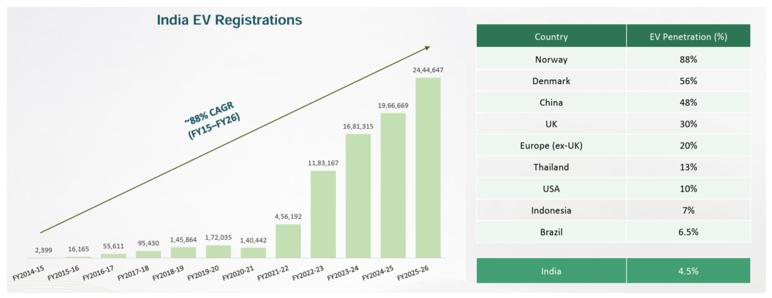
Source: VAHAN Dashboard | CEEW. This graph explains India's EV Transition and does not indicate any recommendations to be used for the development or implementation of an investment strategy. India figure is as per FY 2025-26 (VAHAN Dashboard / EVreporter Intelligence). All other countries are as per IEA Global EV Outlook 2025 (Calendar Year 2024). All figures are for new passenger car (4-wheeler) sales.
- Battery and Recycling: Battery demand is surging, but domestic manufacturing and recycling infrastructure are still developing. Electric cars drive 85%+ of demand today, but electric trucks are the fastest-growing segment; battery demand from trucks is set to triple by 2030. India's commissioned battery cell capacity stands at just 1.4 GWh against a PLI ACC scheme target of 50 GWh, domestic manufacturing is still in its earliest innings.
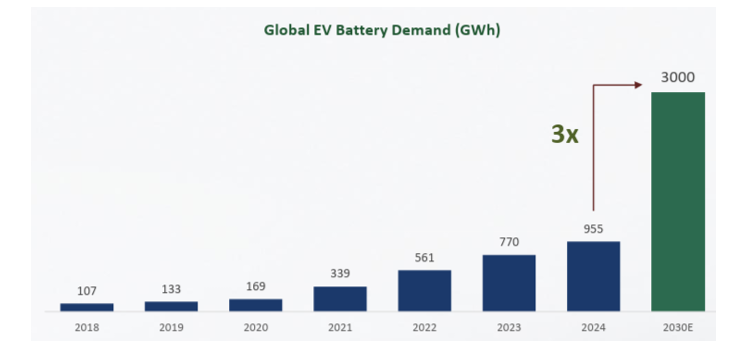
Source: IEA Global EV Outlook 2025
- Solid/Water Waste: Solid waste and wastewater generation are rising, with treatment gaps widening. India's waste is growing at 4% CAGR– by 2030, it will hit 165 MT annually. The treatment gap is not shrinking. It is widening. India has 1,000+ rivers– yet 296 river stretches across 32 states are critically polluted, almost entirely due to untreated sewage discharge. The government has responded with multi-billion-dollar mandates. The government is investing heavily in treatment infrastructure, and the private market is only beginning to catch up.
- E-Waste: India is the 4th largest e-waste generator but recycles only 10% formally. India's transition to clean energy is driving unprecedented growth in end-of-life batteries and electronics.
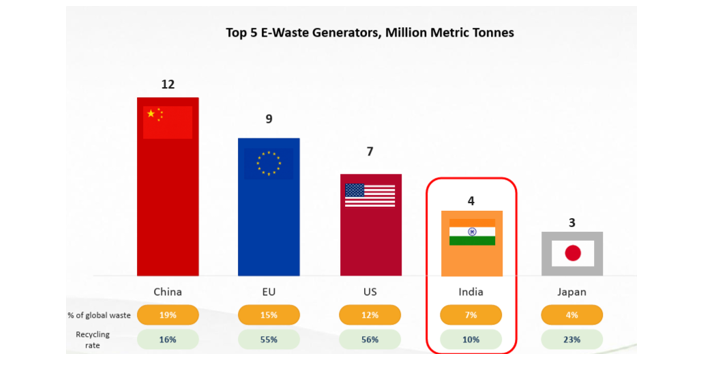
Source: NITI Aayog Report on Advancing Circular Economy of Waste Electronic and Electrical Equipment (E-waste) and Lithium-Ion Batteries in India – January 2026
BSE Clean Environment Index: Different from the index and ESG/Energy Indices
- The BSE Clean Environment Index offers targeted exposure to India’s clean economy megatrend with a track record of strong returns but higher volatility. The BSE Clean Environment Index invests in businesses built around clean activities rather than just companies that score well on ESG parameters. The Clean Environment Index focuses solely on companies with significant clean revenue, excluding fossil fuels and unrelated sectors. The broader indices like the ESG/Energy Indices may include banks, IT, and fossil fuel companies. The selection is based on ESG scores or sector classification, not revenue purity.
- Index Structure: BSE Clean Environment Index focuses on companies deriving >25% revenue from clean environment activities (renewables, EVs, water, recycling, waste).
- Constituent Breakdown: 85.9% renewables, 9% EVs, 3.1% water, 1.8% recycling, 0.2% waste.
- Methodology: Float-adjusted market cap weighting, semi-annual rebalancing, strict revenue and liquidity filters.
- Constituents: Clean Environment owns solar plants and wind farms, whereas ESG owns banks and IT.
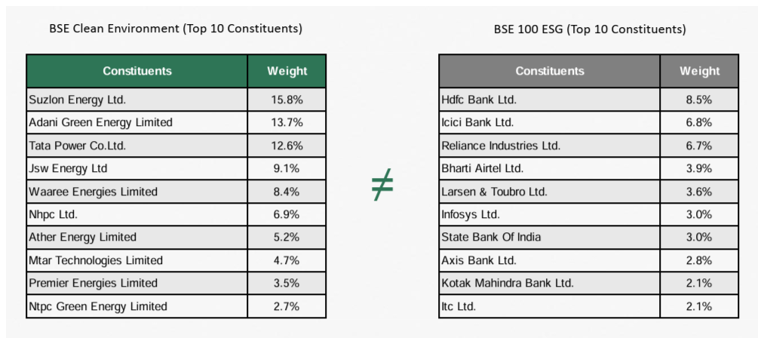
Source: MO AMC | BSE. Data as on 29-May-26. The stocks mentioned above are used to explain the concept and is for illustration purpose only and should not be used for the development or implementation of an investment strategy. The stock may or may not be part of our portfolio/strategy/ schemes. It should not be construed as investment advice to any party. Past performance may or may not be sustained in future and is not a guarantee of any future returns.
Performance of the BSE Clean Environment Index compared to the ESG and Energy Indices
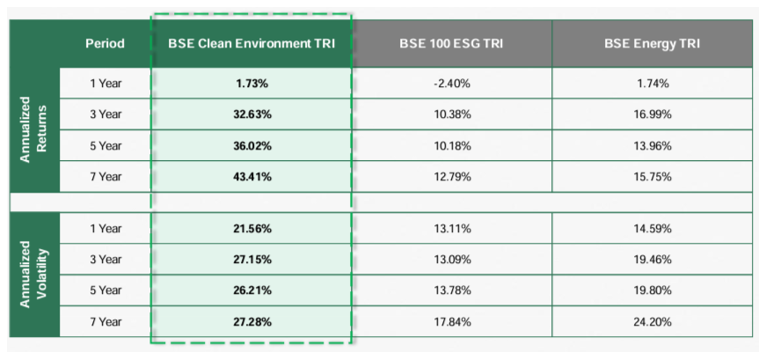
The table below shows the performance of the BSE Clean Environment Index vs the BSE 100 ESG TRI and BSE Energy TRI Indices. The index has outperformed the BSE 1000, ESG, and Energy indices over 1, 3, 5, and 7-year periods, though with higher volatility and drawdowns.
Why invest in the BSE Clean Environment Index?
Historical Outperformance: BSE Clean Environment has outperformed BSE 1000 over the long term
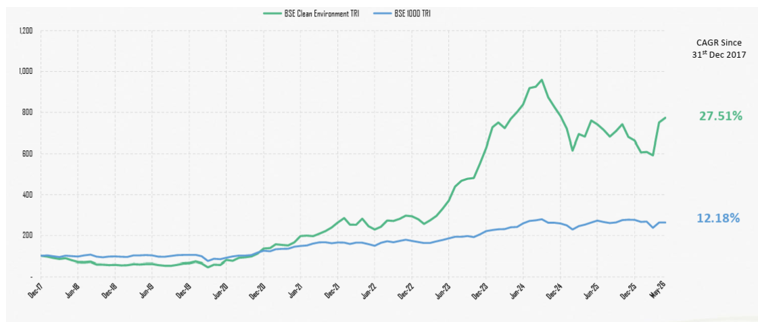
Source/Disclaimer: BSE. Performance as on 29-May-26. The performance is based on historical data and may vary in the future depending on market conditions and economic factors. Performance results have many inherent limitations and no representation is being made that any investor will, or is likely to achieve. Past performance may or may not be sustained in future and is not a guarantee of any future returns. The above graph is used to explain the concept and is for illustration purpose only and should not used for development or implementation of an investment strategy
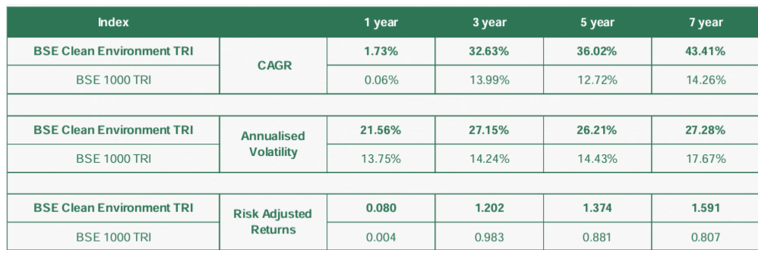
Source/Disclaimer: BSE. Performance as on 29-May-26. Performance results have many inherent limitations and no representation is being made that any investor will, or is likely to achieve. The above table is used to explain the concept and is for illustration purpose only and should not used for development or implementation of an investment strategy. Past performance may or may not be sustained in future and is not a guarantee of any future returns.
Calendar Year returns: BSE Clean Environment TRI has outperformed BSE 1000 TRI 6 times in last 8 calendar years
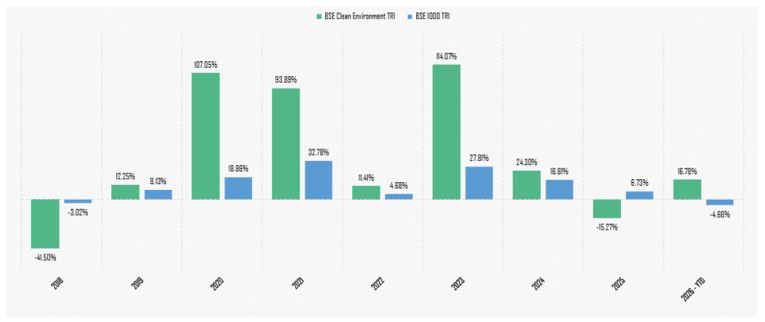
Source/Disclaimer: BSE. Performance as on 29-May-26. Performance results have many inherent limitations and no representation is being made that any investor will, or is likely to achieve. The above graph is used to explain the concept and is for illustration purpose only and should not used for development or implementation of an investment strategy.
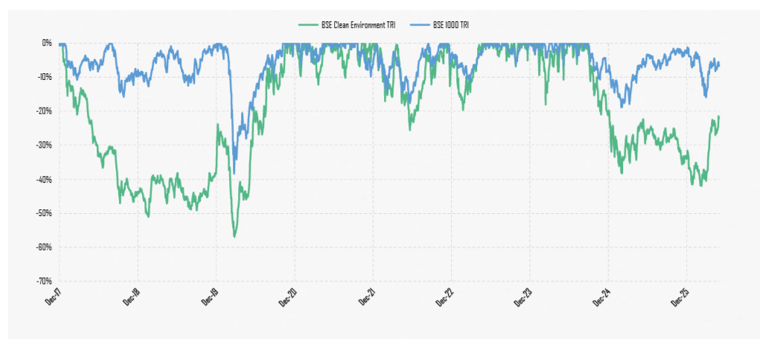
Smaller drawdowns: BSE Clean Environment TRI has historically exhibited higher drawdowns than BSE 1000
Why invest in the BSE Clean Environment Index now?
- Valuation Reset: BSE Clean Environment Index PE has fallen from a peak of 71.54 to 56.32– a 21% correction from the top. This offers attractive entry points for investors.
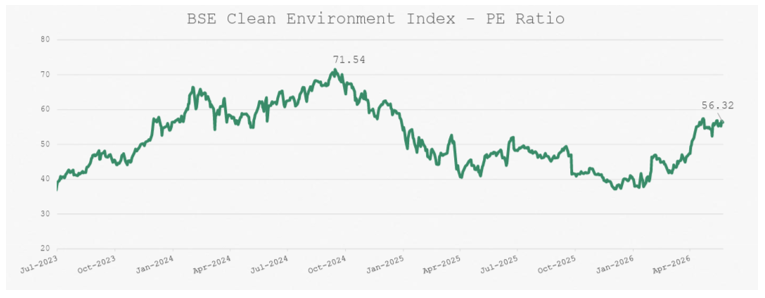
Source/Disclaimer: BSE. Data as of 29-May-2026.The information/data herein alone is not sufficient and should not be used for the implementation of an investment strategy. The table/charts mentioned above are used to explain the concept and is for illustration purposes only It should not be construed as investment advice to any party.
- Stock level valuations have reset sharply: 12 of 18 companies have seen PE contraction of over 25% from the market's peak in Sep-2024 – with 7 stocks down more than 60%
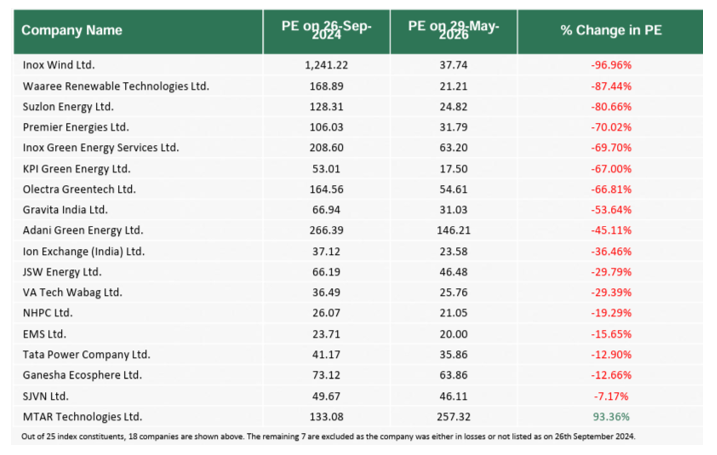
Source/Disclaimer: Factsheet. BSE. Data as of 29-May-2026.The information/data herein alone is not sufficient and should not be used for the implementation of an investment strategy. The table/charts mentioned above are used to explain the concept and is for illustration purposes only It should not be construed as investment advice to any party.
- Earnings Growth Remains Strong: 18 of 25 companies reported positive EPS growth in FY2026, with 12 companies growing earnings by more than 25%. Earnings momentum remains broad-based across renewables, EVs, water and recycling – confirming that the theme's fundamentals are intact even as valuations have reset.
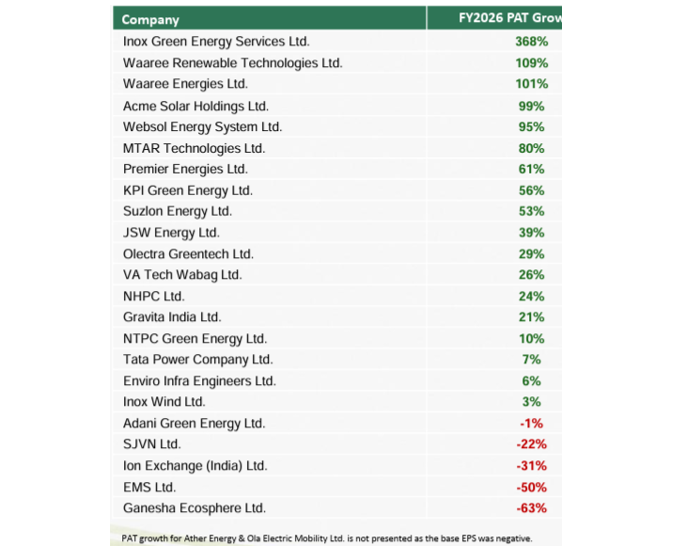
Source/Disclaimer: Factset. BSE. Data as of 29-May-2026.The information/data herein alone is not sufficient and should not be used for the implementation of an investment strategy. The table/charts mentioned above are used to explain the concept and is for illustration purposes only It should not be construed as investment advice to any party. The stocks referred above should not be construed as recommendations or It should not be construed as investment advice to any party.
About Motilal Oswal BSE Clean Environment Index Fund NFO:
The Motilal Oswal BSE Clean Environment Index Fund is an open-ended fund tracking the BSE Clean Environment Index. The investment objective of the scheme is to provide returns that, before expenses, correspond to the total returns of the securities as represented by BSE Clean Environment Index, subject to tracking error. The NFO will remain open between 5th June and 19th June 2026. The fund managers for the Equity Component are Mr. Swapnil Mayekar and Mr. Dishant Mehta (Associate Fund Manager). The debt component of the fund is managed by Mr. Rakesh Shetty.
Taxation of the fund: Long-term Capital Gains– 12.5% on gains above Rs 1.25 lakh (on units held for more than 12 months) Short-term Capital Gains @ 20% (for units held for less than 12 months).
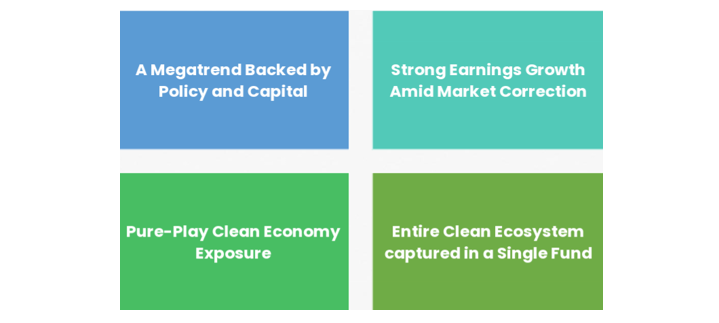
Why should you invest in the Motilal Oswal BSE Clean Environment Index Fund NFO?
Who should invest in the Motilal Oswal BSE Clean Environment Index Fund NFO?
The fund is suitable for investors who are
- looking for long-term capital appreciation
- Have a high to very high-risk appetite
- Seeking returns that correspond to the BSE Clean Environment Index, subject to tracking error
Consult your mutual fund distributor or financial planner to determine if the fund is suitable for your investment goals, risk appetite, and investment horizon.
Mutual Fund Investments are subject to market risk, read all scheme related documents carefully.
RECOMMENDED READS
- Motilal Oswal Midcap Fund: 7 point 4X in 10 years
- Motilal Oswal Multi Factor Passive FOF: Navigate market cycles with multi factor strategy
- Look beyond Nifty 50: Explore the Benefits of Investing in the Nifty 500 Index
- Why index funds make a good investment choice
- Motilal Oswal Consumption Fund: Potential for long term growth from consumption story
LATEST ARTICLES
- Motilal Oswal Small Cap Fund: Outperforming benchmark and peers
- Motilal Oswal BSE Midcap 150 Momentum 30 Index Fund Review 2026: NFO Benefits Returns and Should You Invest
- Motilal Oswal Contra Fund NFO: Contrarian Strategy for long term wealth creation amidst volatility
- Motilal Oswal Large and Midcap Fund: Growth stability and high quality
- Motilal Oswal Multi Factor Passive FOF: Navigate market cycles with multi factor strategy

Motilal Oswal Asset Management Company Ltd. (MOAMC) is a public limited company incorporated under the Companies Act, 1956 on November 14, 2008, having its Registered Office at 10th Floor, Motilal Oswal Tower, Rahimtullah Sayani Road, Opposite Parel ST Depot, Prabhadevi, Mumbai - 400025. Motilal Oswal Asset Management Company Ltd. has been appointed as the Investment Manager to Motilal Oswal Mutual Fund by the Trustee vide Investment Management Agreement (IMA) dated May 21, 2009, executed between Motilal Oswal Trustee Company Ltd. and Motilal Oswal Asset Management Company Ltd.
Investor Centre
Follow Motilal Oswal MF
More About Motilal Oswal MF
POST A QUERY