Role of index funds in portfolio construction

Index funds have become very popular in India over the last few years. As per AMFI data, assets under management (AUM) in index funds have grown from Rs 20,426 crores in April 2021 to Rs 3.31 lakh cores in April 2026, multiplying nearly 16 times at a CAGR of nearly 75% (source: AMFI, as on 30th April 2026). In this article, how index funds play a key role in portfolio constructions.
What are index funds?
Index funds are passive mutual fund schemes which invest in a basket of stocks that replicate a market benchmark index like Nifty 50, Sensex etc. Unlike actively managed mutual fund schemes, passive funds do not aim to outperform the market index – they simply aim to track the market index as closely as possible.
Benefits of index funds
- Low cost: The Total Expense Ratios (TERs) of index funds are much lower than actively managed mutual fund schemes. Unless an active fund can create significant alphas, index funds have the advantage of lower expenses.
- No unsystematic risk: Actively managed funds they need to be overweight / underweight on some stocks / sectors to beat the market benchmark index. This gives rise to unsystematic risk i.e. stock or sector specific risk in actively managed funds. There is no unsystematic risk in index funds because they are not overweight / underweight on any stock / sector relative to the benchmark. Index funds simply track the benchmark.
- No fund manager bias: Unlike active funds, there is no fund manager bias in index funds. The fund manager does not select stocks for the portfolio. The portfolio replicates the benchmark index with same weights as the index constituents have in the benchmark indices.
Let us now discuss how index funds can play a role in your portfolio construction.
- Core portfolio: This is the largest part of your portfolio and form the foundation of your overall investment portfolio. Your core portfolio should be aligned with your long-term financial goals. The core should be well diversified and have long term investment horizon. Index funds enable you to get true diversification because you invest in the entire universe of securities that constitute a broad market benchmark index. For example, if you invest in an active diversified equity mutual fund, you will get exposure to 60 – 80 stocks. On the other hand, if you invest in a Nifty 500 index fund, you can get exposure to 500 stocks. Through index funds you can get diversification at a low cost without any unsystematic risk.
SIP is a systematic plan to build long term wealth by investing regularly from your monthly savings and can be highly suitable for investing in your core portfolio. You can invest in in index funds through SIP and accumulate corpus for your long-term financial goals through the power of compounding.
- Satellite portfolio: This is the tactical part of your portfolio, which can enhance portfolio returns by investing in themes or sectors that are outperforming or expected to outperform. Index funds offers low-cost investment opportunities in different industry sectors e.g. Banks, IT, Auto, Realty etc. Index funds can also help you get exposure to investment themes like manufacturing or consumption. Index funds offer variety of investment options for your satellite portfolio. You can invest either in lump sum or through SIP depending on your investment needs and goals.
- Exposure to different investment strategies or factors: Factors are investment strategies which historically driven portfolio returns and risk. Factor or smart beta indices are constructed based on quantitative, rule-based investment strategies based on factors like momentum, value, quality, low volatility etc. Active fund managers may use the same factors in stock selection and portfolio construction, but the advantage of smart beta index funds is that you can get exposure to these factors at a much lower cost and no unsystematic risk, compared to an actively managed fund. Smart beta index funds can be a based on a single factor benchmark e.g. momentum, low volatility, quality etc, or multi-factor models combining Quality, Value, Alpha and Low Volatility.
Smart beta index funds can be part of your core or satellite portfolio depending on your risk appetite and investment needs. You should consult with your financial advisor or mutual fund distributor to understand how smart beta index funds can fit in your investment portfolio.
- Asset allocation: Asset allocation is a strategy to diversify your investment across different asset classes. Different asset classes like equity, debt, international equity etc have different risk / return characteristics. There is low correlation between returns of different asset classes in different market conditions (see the chart below). By investing across different asset classes, you can balance risk and return.
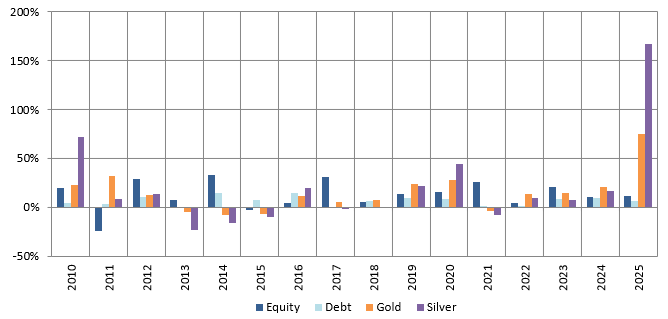
Source: NSE, Yahoo Finance, Bloomberg, Advisorkhoj Research. Equity is represented by Nifty 50 TRI, Debt is represented Nifty 10 year Benchmark G-Sec Index and commodities by MCX spot prices (gold and silver (as on 31st December 2025). Disclaimer: Past performance may or may not be sustained in the future.
Asset allocation will reduce your portfolio risk and keep you disciplined in your investments. Index funds or funds of funds (FOFs) can provide you exposure to multiple asset classes like equity, fixed income, commodities (gold, silver) etc. Investing in a mix of index funds from different asset classes can provide asset allocation solutions. Your allocation to different asset classes will depend on your financial goals, risk appetite and investment horizon. You should consult with your financial advisor or mutual fund distributor to understand what asset allocation may be suitable for your investment needs and select funds accordingly.
Index funds and ETFs
Both index funds and ETFs provide highly effective passive investment solutions for a wide variety of investment needs. You need demat accounts to invest in ETFs. Furthermore, ETF transactions, unless in lot sizes (creation units), need to be done through trading accounts at prevailing market prices. Depending on liquidity (volumes traded), market prices of ETFs may diverge from the NAVs. Index funds, on the other hand, offer simplicity and ease of transactions for average retail investors. You can invest in index funds or redeem index funds with the Asset Management Company, either directly or through mutual fund distributors at applicable NAVs. If you are investing in ETFs, you should check with your broker if they provide SIP like facility. You can invest in index funds though SIP just like any other mutual fund scheme.
Summary
Both active funds and index funds can play important roles in your portfolio. Your core portfolio can comprise of both active and index funds. Index funds can be cost effective and convenient investments to provide diversification to your investment portfolio. Many investors still associate index investing with Nifty and Sensex. However, the index fund space has evolved tremendously over the last few years. Index funds can provide you exposure to different market segments, industry sectors, investment strategies or factors, fixed income benchmarks and commodities. You should consult with your financial advisor or mutual fund distributor, which index funds are suitable for your risk appetite and investment needs.
Mutual Fund Investments are subject to market risk, read all scheme related documents carefully.
RECOMMENDED READS
LATEST ARTICLES
- Why you need to focus on asset allocation in current market conditions
- How a fund of funds with 65 percentage allocation to debt can be of use for risk averse investors
- Role of asset allocation in achieving your financial goals
- Why having large and midcap funds in the portfolio matters now
- Large and Midcap Funds: Mix of growth and stability

The information being provided under this section 'Investor Education' is for the sole purpose of creating awareness about Mutual Funds and for their understanding, in general. The views being expressed only constitute opinions and therefore cannot be considered as guidelines, recommendations or as a professional guide for the readers. Before making any investments, the readers are advised to seek independent professional advice, verify the contents in order to arrive at an informed investment decision.
Mutual Fund investments are subject to market risks, read all scheme related documents carefully.
Quick Links
Follow Nippon India MF
More About Nippon India MF
POST A QUERY