Large and Midcap Funds: Mix of growth and stability

What are large and midcap funds?
Large and midcap fund is one of the most popular mutual fund categories, especially among retail investors. As per AMFI's March 2026 data the total assets under management (AUM) in large and midcap funds is more than 2 lakh crores (as on 31st March 2024) with more than 90 lakh folios. Large and midcap funds are diversified equity funds which invest minimum 35% in large cap stocks (top 100 stocks by market capitalization) and minimum 35% in midcap stocks (101st to 250th stocks by market capitalization). In this article we will discuss about large and midcap funds.
Why invest in large and midcap funds?
- Winners rotate across market cap segments: The chart below shows the annual returns of large cap (Nifty 100 TRI), midcap (Nifty Midcap 150 TRI) and small cap (Nifty Small Cap 250 TRI) indices. A diversified portfolio of large cap and midcap stocks can produce superior long-term returns, while reducing downside risks in volatile markets.
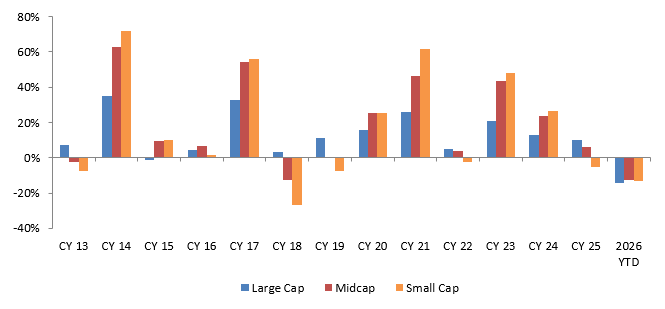
Source: National Stock Exchange, Advisorkhoj Research; as on 31st March 2026. Large cap is represented by Nifty 100 TRI, midcap by Nifty Midcap 150 TRI and small cap by Nifty Small Cap 250 TRI. Disclaimer: Past performance may or may be sustained in the future
- Large and midcaps outperformed the broad market index: The chart below shows the calendar year returns of large and midcap index (Nifty Large Midcap Index 250 TRI) and the broad market index (Nifty 500 TRI) over the last 10 years. You can see that Nifty Large and Midcap 250 TRI outperformed Nifty 500 TRI, 8 times in the last 10 years.
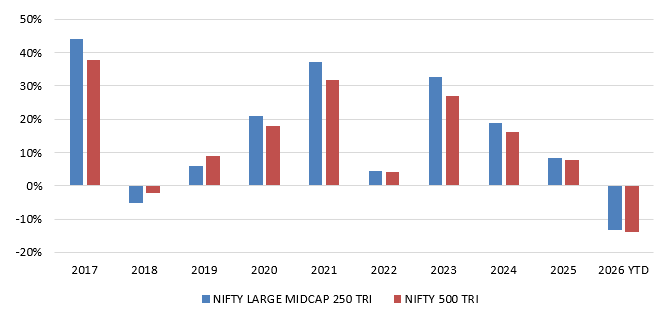
Source: National Stock Exchange, Advisorkhoj Research; as on 31st March 2026. Disclaimer: Past performance may or may be sustained in the future
- Lower downside risks compared to midcaps and small caps: The chart shows the major drawdowns of the market over the last 20 years. You can see that large and midcaps experienced smaller drawdowns compared to midcaps and small caps.
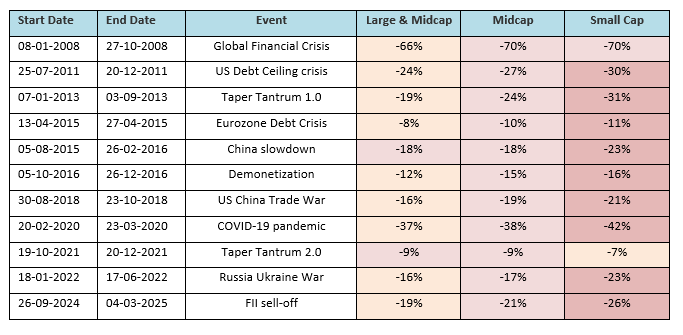
Source: NSE, Advisorkhoj Research Data as on 31st March 2026. Large & Midcap is represented by Nifty Large Midcap 250 TRI, midcap by Nifty Midcap 150 TRI and small cap by Nifty Small Cap 250 TRI. Disclaimer: Past performance may or may be sustained in the future
- Mix of growth and stability: The table below shows the median rolling returns and standard deviation of the rolling returns over different investment tenures (1 year, 3 year and 5 year) for different market cap segments over the last 20 years. You can see that large and midcaps were able to give returns than large caps over different investment tenures. At the same time, the volatility of large and midcaps was lower than midcaps and small caps across investment tenures.
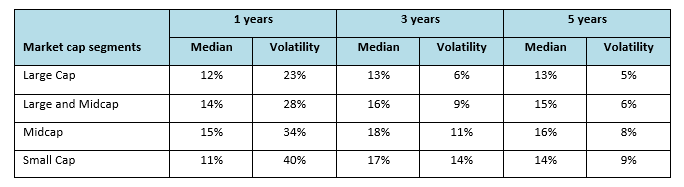
Source: Advisorkhoj Research, as on 31st March 2026. Large cap is represented by Nifty 100 TRI, Large and Midcaps by Nifty Large Midcap 250 TRI, Midcap by Nifty Midcap 150 TRI and Small cap by Nifty Small Cap 250 TRI. Disclaimer: Past performance may or may be sustained in the future
- Diversified industry sector exposure: Large cap indices like Nifty 100 has a heavier tilt towards certain sectors like BFSI, IT, Oil & Gas and FMCG. Large and midcaps provide exposure to sectors where large caps have no presence e.g. textiles, media and entertainment etc. Furthermore, Large and midcaps provide more balanced exposure to sectors like Healthcare, Capital Goods, Consumer Durables, Consumer Services, Realty, Chemicals, Textiles etc where large cap exposure is low. These sectors can benefit from India's consumption driven economic growth, rising per capita income, changing global trade dynamics, Government's policies e.g. import substitution (Make in India), digitization, infrastructure spending, shift from unorganized to organized sectors etc.
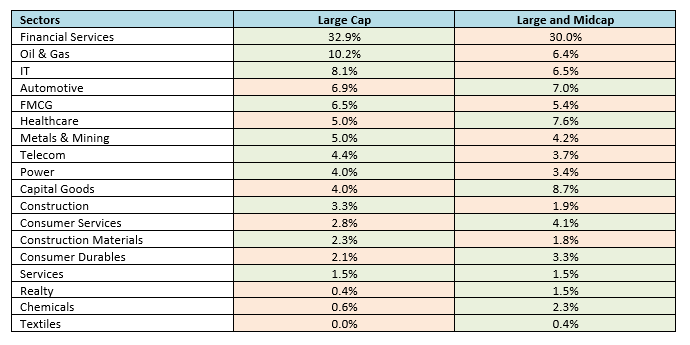
Source: NSE, as on 31st March 2026. Large cap is represented by Nifty 100 and large & midcap by Nifty Large Midcap 250 indices. Disclaimer: Past performance may or may be sustained in the future
- Valuations have moderated: Market has been volatile for past 18 months. FII sell-offs, relatively high valuations, US trade policies, armed conflicts in the Middle East (e.g. 12 day Israel Iran War in June 2025 and 40 day US Iran War in 2026) and surging crude oil prices have been driving volatility. Ongoing volatility have brought down valuations to reasonable in the large and midcap segments.
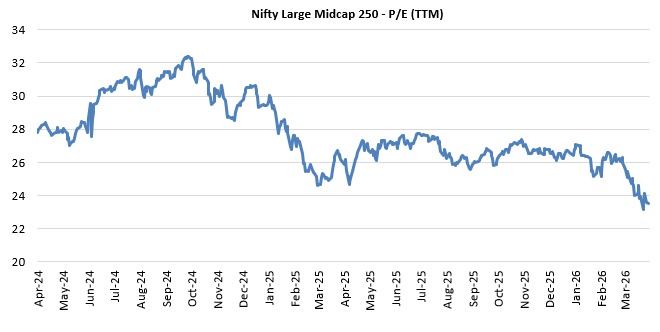
Source: National Stock Exchange, Advisorkhoj Research; as on 31st March 2026. Disclaimer: Past performance may or may be sustained in the future
Long Term Outlook
The Indian economy has strong resilience amidst slowdown in other major economies. As per Ministry of Finance's estimates India's FY 2025-26 GDP growth rate to be 7.4%. India became the 4th largest economy of the world in 2025 (source: Press Information Bureau, Government of India). Though India's rank in GDP USD terms slipped from 4th to 6th as per IMF's World Economic Outlook in April 2026, it was driven mainly by currency movements due to changing trade dynamics and geo-political turmoil. The long-term outlook of Indian equities remains bullish. Stable macros, strong growth in consumption demand driven by per capita income growth, rising affluence, demographic advantages and shifting consumption patterns. In the long term, both large and midcap Indian companies are likely to benefit from the structural reforms made by the Government e.g. e.g. Atmanirbhar Bharat, Make in India, Digital India, Atal Innovation Mission, Defence sector reforms, labour law reforms etc.
Who should invest in Large and Midcap Funds?
- Investors looking for capital appreciation and wealth creation.
- Investors having a 5 year plus investment horizon in this scheme.
- This fund can be suitable for new or first time investors.
- Investors with very high risk appetite.
- Investors can invest in large and midcap funds through SIP depending on your investment needs.
Investors should consult with their financial advisors or mutual fund distributors if large and midcap funds will be suitable for their investment needs.
Mutual Fund Investments are subject to market risk, read all scheme related documents carefully.
RECOMMENDED READS
LATEST ARTICLES
- Why you need to focus on asset allocation in current market conditions
- How a fund of funds with 65 percentage allocation to debt can be of use for risk averse investors
- Role of asset allocation in achieving your financial goals
- Why having large and midcap funds in the portfolio matters now
- Role of index funds in portfolio construction

The information being provided under this section 'Investor Education' is for the sole purpose of creating awareness about Mutual Funds and for their understanding, in general. The views being expressed only constitute opinions and therefore cannot be considered as guidelines, recommendations or as a professional guide for the readers. Before making any investments, the readers are advised to seek independent professional advice, verify the contents in order to arrive at an informed investment decision.
Mutual Fund investments are subject to market risks, read all scheme related documents carefully.
Quick Links
Follow Nippon India MF
More About Nippon India MF
POST A QUERY