SBI Quality Fund: Invest in the long-term growth potential of Quality Stocks

SBI Mutual Fund has launched the SBI Quality Fund. The New Fund Offer (NFO) opened on 28th January 2026 and will close on 11th February 2026. In this article we will explore the reasons why this fund can be an important addition to your portfolio.
What is Quality Investing?
Whether you are investing in large cap, multi-cap, midcap or small cap funds, at the end of the day, you are investing in an underlying portfolio of stocks. Whether the stocks are picked directly by the investors or professional fund managers, in equity investments, we often face the dilemma of identifying the right stock that is expected to perform well in most market phases. Some stocks outperform well in bull runs, while others underperform in bear markets. Picking quality stocks in such a dilemma may turn out to be a better investment strategy, especially in the long run. Quality Investing focuses on discipline, sound processes, and long-term viability over short-term results, guided by the belief that lasting value is defined by quality, not quantity. Quality Investing emphasises substance over scale, focusing on discipline, sound processes, and long-term business viability rather than short-term outcomes. This approach reflects the belief that, enduring value is shaped not by quantity alone, but by the quality of what is built.
Why Invest in an Actively Managed Quality Fund?
The benchmark for the SBI Quality Fund is the Nifty 200 Quality 30 Index. Understanding the underlying index of the SBI Quality Fund will help in understanding the risk / return characteristics of the fund. The Nifty 200 Quality 30 Index is a smart beta index which filters out stocks from the Nifty – 200 Index (index of 200 largest companies by market cap) based on some quantitative factors to identify quality stocks and selects 30 highest quality stocks based on the quantitative factors. The index ignores earning growth potential of companies and filters them based on 3 factors: ROE, Debt to Equity and Historical Earnings Volatility. The benchmark is purely number focused and backward looking.
Nifty 200 Quality 30 Index uses a set of pre-defined quantitative rules for selecting highest quality stocks. For quant-based stock selection certain quantitative parameters (metrics) must be applied to select stocks. Jeremy Grantham (co-founder and chief investment strategist of Grantham, Mayo & van Otterloo) in his whitepaper (2004) has defined quality companies as those which meet the following criteria:
- Low Leverage:
Leverage is the ratio of debt to equity in the capital structure of a company, and is indicative of the risk of the business model. Higher the leverage, higher is the financial risk. Low leverage is a characteristic of a quality stock. - High Profitability:
Profitability measure of ability and efficiency of a company to generate earnings. There are various profitability measures, the most common ones being Return on Capital Employed (ROCE), Return on Assets (ROA) and Return on Equity (ROE) etc. Return on Equity is one of the best measures of shareholder value created by the management. If you go through our Interview Section, you will see that many fund managers favor using ROE or ROCE in their active stock selection process. - Earning Quality:
Earnings quality implies persistence in earnings growth measured by low variability in Earnings per Share (EPS) growth. Steady EPS growth is a testimony to the stability and robustness of the business model of the company. It is one of the strong characteristics of high-quality companies.
Each of these parameters are given equal (one third) weight in the screening process of Nifty 200 Quality 30 Index. The Quality Score for each company in the Nifty – 200 Index is determined based on Return on Equity, Financial Leverage and Earnings. The weights of the stocks are derived from their quality scores and square root of free float M-Cap. The stock weight is capped at 5%. The Nifty 200 Quality 30 Index is rebalanced semi-annually.
Nifty 200 Quality 30 Index
- Strong Returns
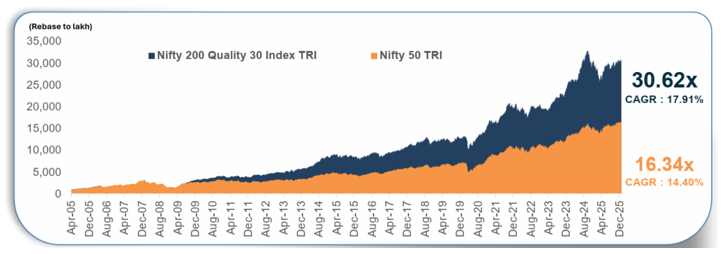
93% More Profit than Nifty over last 20 Yrs. An investment of Rs 1 Lakh in Apr 2005 would have grown to Rs 16.34 Lakhs in the Nifty 50, achieving a CAGR of 14.40%. The same Rs 1 Lakh invested in the Nifty200 Quality 30 Index would have grown to Rs 30.62 Lakhs, delivering a higher CAGR of 17.91%.
Source: MFI explorer, Data for the period Apr 2005 – Dec 2025.
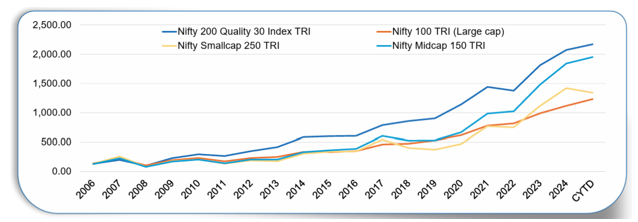
- Beaten Broader Market Cap Benchmarks: Quality investing philosophy has outperformed the Broader market cap indices in the long run
Source: MFI Explorer, Data for the period Jan 2005 – Dec 2025.
Lower Drawdown
The Nifty 200 Quality 30 Index has weathered every major crisis better than broad market indices, aiming to safeguard investor wealth through volatility.
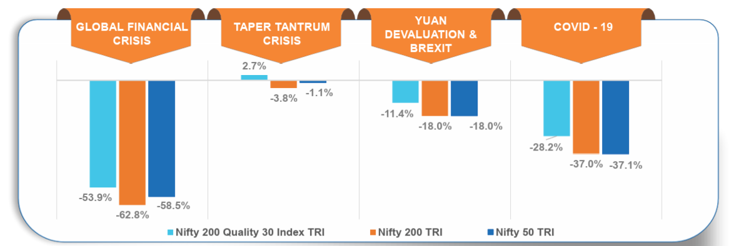
Source MFI Explorer, NSE India, BSE Limited. GFC (01/01/2008 to 27/10/2008), Taper Tantrum Crisis (1/01/2013 to 28/06/2013), Yuan Devaluation & Brexit (03/08/2015 to 29/02/2016) and Covid (19/02/2020 to 23/03/2020).
Lower Volatility
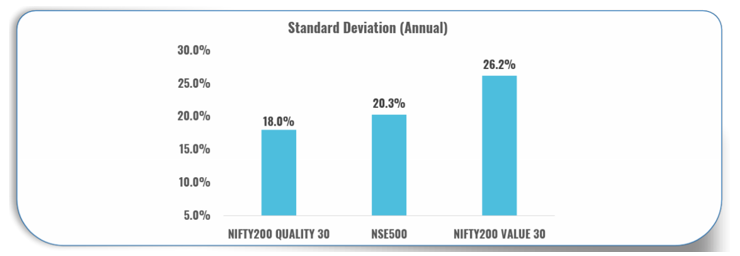
Source: www.niftyindices.com
SBI Quality Fund NFO
The SBI Quality Fund NFO is an open- ended equity scheme following Quality factor theme. The investment objective of the scheme is to generate long-term capital appreciation by investing in Equity & Equity related instruments of companies identified based on the Quality Factor. SBI Quality Fund is taxed as an equity-oriented mutual fund: short-term capital gains (units held ?12 months) are taxed at 20%, and long-term capital gains (units held > 12 months) are taxed at 12.5%, with an annual exemption of up to Rs 1.25 lakh on LTCG.
Portfolio Construction Process
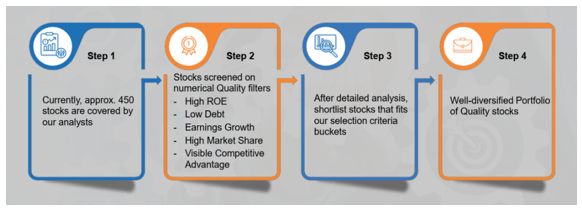
Source: SBI Product presentation
Portfolio Selection Process
The stock selection for the fund follows a disciplined framework built on multiple high-conviction parameters:
- Widening Moat: Companies widening their economic moat through greater scale, improving brand equity, technological innovation etc.
- Quality at reasonable price: Companies operating in large markets that offer faster earnings growth than the broader economy, available at reasonable valuation.
- Caterpillars: Companies that have the makings of a future high-quality enterprise. The marks of a Future Quality Business (caterpillars) are:
- Consistently high R&D investment in a promising product family
- Platform Business, high network effect
- Large scale build-up in a business with scale advantage/high fixed cost
- Owner of a good brand, gaining share & launching more
- Mean Reversion: Companies that have seen temporary deterioration in operating metrics or valuation multiples.
The fund managers also deploy a quality lens to identify companies:
- Return on Equity (ROE): Measures the profitability of a company relative to its shareholders' equity, indicating effective capital utilization.
- Return on Invested Capital (ROIC): Evaluates how efficiently a company uses its capital to generate profits, indicating effective resource allocation.
- Debt-to-Equity Ratio: Analysis financial leverage to understand the company’s risk profile, with a lower ratio indicating stability.
- Management Quality: A qualitative assessment of leadership credibility, strategic vision, governance standards, and management's track record in navigating complex business environments.
- Earnings Stability: Reviews consistency in earnings over time, indicating a stable income generation model that’s less vulnerable to market fluctuations.
- Industry Position and Market Share: Evaluates a company’s competitive positioning within its sector, looking at market share, brand strength, and ability to sustain competitive advantages.
- Capital Allocation Discipline: Examines management’s approach to reinvestment and capital deployment, favouring companies that invest prudently in growth while maintaining healthy balance sheets.
Portfolio Construct
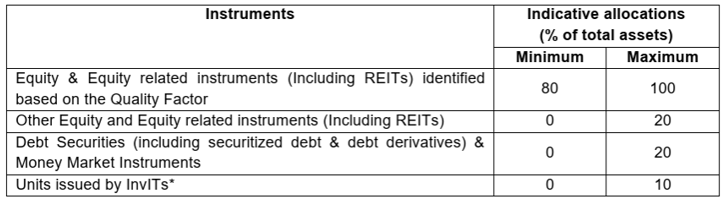
Why should you invest in the SBI Quality Fund?
SBI Quality Fund may be a suitable choice for investors seeking sustainable long-term growth.
- By subscribing to this NFO you will be able to invest in some of the quality companies in India, with a small capital outlay as SIP.
- SBI Mutual Funds is one the largest AMCs in India, as also one of the most respected AMCs in the country, with assets under management of over Rs. 12 lakh crore. The fund is managed by Mr. Anup Upadhyay.
- The Quality Investing approach of this fund emphasises substance over scale by prioritising disciplined management, sound processes, robust governance, and sustainable business models instead of short-term market outcomes.
- By focusing on companies with proven resilience and long-term viability, the fund aims to participate in consistent wealth creation across market cycles. This approach reflects the conviction that enduring value is shaped not merely by expansion or speed, but by the quality of what is built over time.
Why invest in Quality Funds now?
Historically extended phases of 3-year rolling performance of Quality compared to Value have been followed by strong rebounds. This could be an indication that quality may stage a comeback and investors can take advantage of the current valuation to earn alphas in the long run.
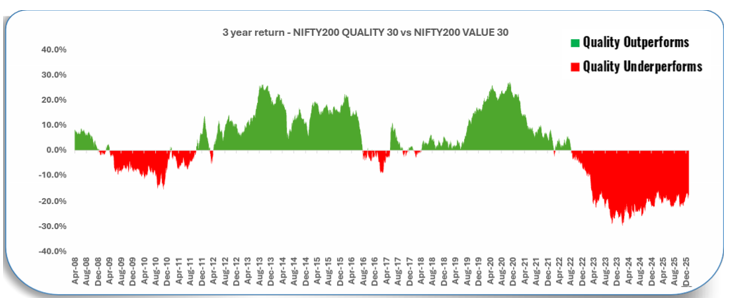
Source: MFI explorer, Data for the period April 2005 – Dec 2025.
Who should invest in the fund?
Quality stocks tend to deliver consistent financial performance irrespective of investment cycles. Hence it is important to remain invested in these stocks over several investment cycles to benefit from the power of compounding across different conditions. As such, quality investing may be a good strategy to invest for your long-term financial goals
Investors should consult with their mutual fund distributors or financial advisors to know if the SBI Quality Fund NFO will suit their investment needs.
Mutual Fund Investments are subject to market risk, read all scheme related documents carefully.
RECOMMENDED READS
- Demystifying debt mutual funds
- Why Balanced Funds may be the best investments for new mutual fund investors
- How do you know if you have good funds in your mutual funds portfolio: part 1
- Know your mutual fund tax obligations to manage your investments effectively
- Asset Allocation is much more important than fund selection
LATEST ARTICLES
- SBI Balanced Hybrid Fund NFO: Benefit of Equity and Debt in a Single Portfolio
- Magnum Equity Ex Top 100 Long Short Fund: Navigating market movements in mid and small cap space
- SBI Nifty Midcap 150 Momentum 50 ETF FOF: Catch the midcap growth opportunity as market recovers
- SBI Large and Midcap fund: Potential for Long Term Wealth Accumulation
- SBI Focused Fund: On a strong performance upturn
Quick Links
Follow SBI MF
More About SBI MF
POST A QUERY