Why Nippon India Multi Asset Allocation Fund a top performing Hybrid Fund in current market conditions

Current market context
Equity market bounced back after ceasefire between US and Iran. However, the ceasefire did not hold with both sides launching strikes and the Strait of Hormuz, volatility has returned to the market. The broad market benchmark, Nifty 50 TRI is down almost 7% on a YTD basis (source: NSE, as on 17th June 2027). The 10-year G-Sec yield rose from 6.6% to 7.1% but has now declined to 6.8% (source: Bloomberg, as on 17th June 2027). Though commodities have been volatile, gold is up 6% on a YTD basis (source: MCX spot prices, as on 17th June 2027). The US market rallied and S&P 500 has given 19% return in INR terms on a YTD basis (source: MCX spot prices, as on 17th June 2027).
Why Multi Asset Allocation?
Equity and debt are the two most popular asset classes for asset allocation. However, other asset classes like commodities and international equities can add richer diversification to your portfolio. There is low correlation of returns between different asset classes (see the chart below). Adding multiple classes to your asset allocation can provide stability to your portfolio and get potential risk adjusted returns.
You may like to read more about Multi Asset Allocation funds - Role of asset allocation in achieving your financial goals
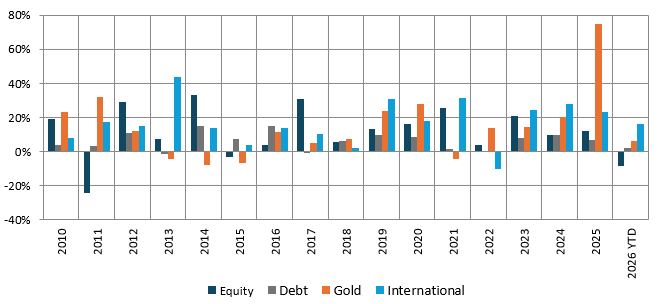
Source: NSE, MCX, Bloomberg, Advisorkhoj Research, as on 30th June 2026. Equity is represented by Nifty 50 TRI, debt by Nifty 10 year benchmark G-Sec Index, Gold by MCX Spot Prices and International by S&P 500 in INR. Disclaimer: Past performance may or may not be sustained in the future
Multi asset allocation funds have been gaining popularity with investors, especially in the current geo-political and economic environment. In the last three years assets of multi asset allocation funds have increased by 6X from Rs 31,149 crores to Rs 1.96 lakh crores (source: AMFI, as on 30th June 2026). In this article, we will review Nippon India Multi Asset Allocation Fund, one of the top performing funds in its category.
Nippon India Multi Asset Allocation Fund - Consistent outperformance
Nippon India Multi Asset Allocation Fund is one of the most consistent performers in Multi Asset Allocation Fund category. The graphic below shows the quartile rankings of Nippon India Multi Asset Allocation Fund for the last 12 quarters (last 3 years, as on 31st March 2026). The fund was in top 2 quartiles, 10 times in the last 12 quartiles.
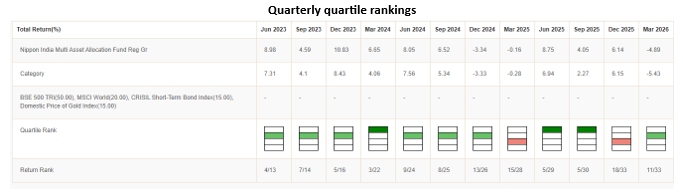
Source: Advisorkhoj Research, as on 31st December 2025
Superior risk adjusted return to broad equity market index
The chart below shows the median and minimum rolling returns of Nippon India Multi Asset Allocation Fund versus the broad market index, Nifty 50 TRI for different investment tenures since the inception scheme. You can see that the fund gave higher median returns than Nifty 50 TRI across all tenures. At the same time, the minimum returns than Nifty 50 TRI, across investment tenures. In other words, the fund gave superior risk adjusted returns relative to Nifty 50 TRI.
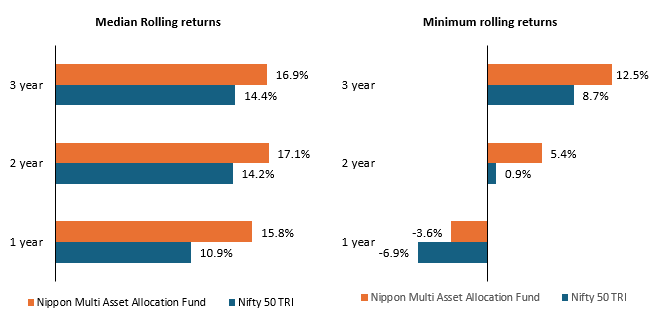
Source: Advisorkhoj Research, as on 17th July 2026
Limited downside risks for investors
The chart below shows the drawdowns of the Nippon India Multi Asset Allocation Fund versus the broad market index, Nifty 50 TRI since the inception of the scheme. You can see that Nippon India Multi Asset Allocation Fund experienced smaller drawdowns compared to Nifty 50 TRI.
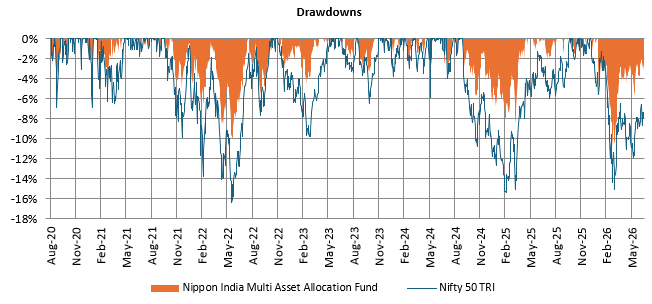
Source: NSE, Advisorkhoj Research, as on 17th July 2026
Consistently outperformed peer average
The chart below shows the 3-year rolling returns of Nippon India Multi Asset Allocation Fund versus the category average returns. You can see that, after an initial brief period of underperformance, the fund outperformed the category average across different market conditions.
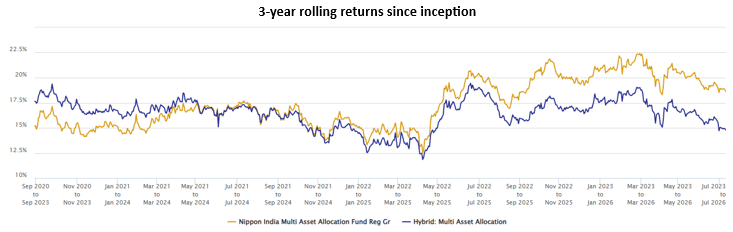
Source: NSE, Advisorkhoj Research, as on 17th July 2026
The chart below shows the rolling returns distribution of Nippon India Multi Asset Allocation Fund versus the category average for different investment tenures. You can see that the fund gave higher instances of 12%+ CAGR returns compared to the category average. At the same time % instances of negative returns were same for both, fund and the category.
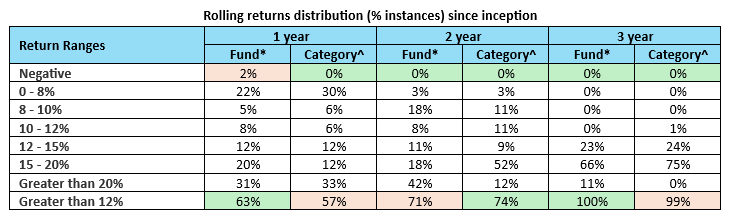
Source: NSE, Advisorkhoj Research, as on 9th January 2026. *Fund - Nippon India Multi Asset Allocation Fund. ^Category - Hybrid Multi Asset Allocation Fund category average
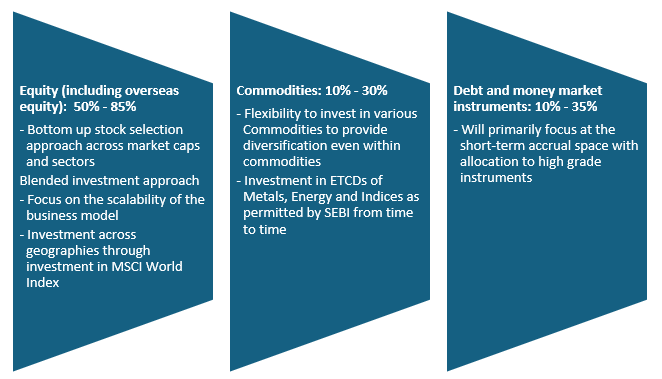
Investment strategy
Current Portfolio Positioning
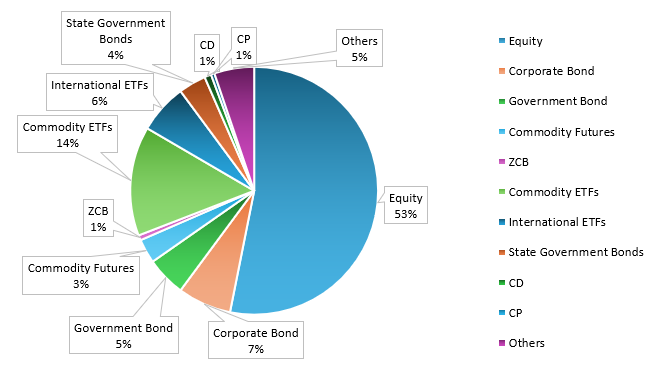
Source: Nippon India MF, Advisorkhoj Research, as on 31st December 2025
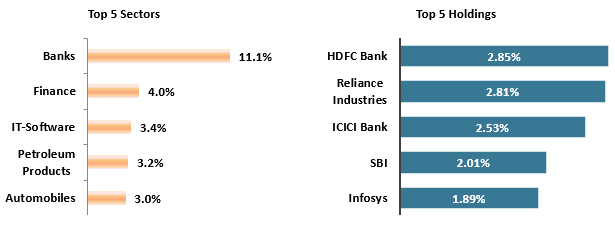
Source: Nippon India MF, Advisorkhoj Research, as on 31st December 2025
Note on taxation
Minimum holding period for long term capital gains taxation for Nippon India Multi Asset Allocation Fund is 24 months. Short term capital gains will be taxed as per the income tax rate of the investor. Long term capital gains will be taxed at 12.5%.
Why invest in Nippon India Multi Asset Allocation Fund?
- Nippon India Multi Asset Allocation Fund seeks to provide diversification across asset classes with an aim to provide better risk adjusted returns.
- Nippon India Multi Asset Allocation Fund also offers diversification under respective asset classes.
- The fund aims to benefit from Tax efficiency through rebalancing within the fund.
- Nippon India Multi Asset Allocation Fund is a one stop solution which may help to reap benefit of Growth of Equity, Stability of Debt & Diversification from Commodities.
Who can find Nippon India Multi Asset Allocation Fund suitable?
- Investors looking for capital appreciation over long investment horizons.
- Investors who want to reduce portfolio volatility by diversifying across multiple asset classes.
- Investors with minimum 3 - 5 years investment tenure.
- Investors with moderately high to high-risk appetites.
- You can invest either in lump sum or SIP based on your investment needs.
Investors should consult their financial advisors or mutual fund distributors if Nippon India Multi Asset Fund is suitable for their investment needs.
Mutual Fund Investments are subject to market risk, read all scheme related documents carefully.





Queries
-
What is the benefit of mutual fund STP
Aug 29, 2019
-
How much to invest to meet target amount of Rs 2 Crores
Aug 26, 2019
-
Can I achieve my financial goals with my current mutual fund investments
Aug 24, 2019
-
Can you tell me return of various indices
Aug 19, 2019
-
What would be the post tax return on different investments
Aug 18, 2019
-
Which Principal Mutual Fund scheme will be suitable for my retirement corpus
Aug 16, 2019
-
What is the minimum holding period for availing NCD interest
Aug 4, 2019
Top Performing Mutual Funds

Recommended Reading




Fund News
-
RBI MPC Hikes Repo Rate by 25 bps, Changes Policy Stance to 'Calibrated Tightening'
Oct 8, 2026 by 360 ONE Asset
-
Aditya Birla Sun Life Mutual Fund launches Aditya Birla Sun Life Financial Services Sectoral Debt Fund
Oct 8, 2026 by Advisorkhoj Team
-
Kotak Mahindra Mutual Fund launches Kotak Nifty 500 Index Fund
Oct 5, 2026 by Advisorkhoj Team
-
Jio BlackRock Mutual Fund launches JioBlackRock Income Plus Arbitrage Omni FOF
Oct 5, 2026 by Advisorkhoj Team
-
HDFC Mutual Fund launches HDFC Nifty LargeMidcap250 Plus 8 13 yr G sec 70:30 Index Fund
Oct 5, 2026 by Advisorkhoj Team