How a fund of funds with 65% allocation to debt can be of use for risk-averse investors

Many conservative or risk averse investors still prefer traditional fixed income investments like Bank FDs, Government Small Savings Schemes etc for the bulk of their savings / investments. However, interest from traditional fixed income investments are taxed as per the income tax slab rate of the investors. With interest rates coming down secularly in the long term, the post-tax income from traditional fixed income investments is a cause of concern for many conservative investors e.g. senior citizens.
Can mutual funds offer a more tax efficient investment option for risk averse investors?
Capital gains of debt mutual fund schemes are also taxed at the income tax rate, irrespective of the holding period. In case of bank FDs, incidence of taxation arises when interest is accrued or paid out, but in case of mutual funds incidence of taxation arises only for realized gains (i.e. units are redeemed) or for IDCW. However, irrespective of when incidence of taxation arises, both Bank FD interest and debt mutual fund gains are taxed as per the income tax rate of the investor. Are there mutual fund schemes which provide more efficient taxation and also limit downside risks for investors? The answer is yes.
Taxation of FOFs with 35% to 65% allocation to equity
In Union Budget 2024-25, the taxation of mutual fund schemes with 35% to 65% equity allocation was changed. The holding period for long term capital gains for such schemes is 2 years. Short term capital gains (holding period less than 2 years) are taxed as per the income tax rate of the investors. Long term capital gains are taxed at 12.5%. For investment tenures of 2 years or longer, these schemes are much more tax efficient than traditional fixed income investments like Bank FDs, especially for investors in the higher tax bracket.
What is the impact of minimum 35% equity allocation on scheme volatility?
It depends on the nature on the nature of the equity allocation and the balance asset allocation. Some multi asset allocation funds have between 35 – 65% equity allocation, and the balance asset allocation is to fixed income and commodities. While fixed income has low volatility, commodities can be volatile (as evidenced in January – February of 2026). Furthermore, volatility of a hybrid scheme or FOFs depends on the nature of equity allocation. From a taxation standpoint, gross equity and net equity are both treated as equity for purpose of long term capital gains. However, hedging or arbitrage can reduce net equity exposure and volatility while ensuring efficient taxation.
What is Income Plus Arbitrage FOF?
These funds of funds usually invest up to 65% into fixed income (debt) and the remaining amount into arbitrage strategies, which entail capturing price differentials between cash and futures markets in order to nail down risk-free profits. The volatility of Income Plus Arbitrage Fund of Funds is comparable to volatility of shorter duration debt funds. The payoff? A portfolio that seeks to provide stable, accrual-type returns with a lot less volatility than pure equity funds, and with improved tax efficiency than traditional fixed income investments (e.g. Bank FDs) or debt mutual funds. The concept is to combine the stability and fixed income of debt with the market-neutral, low-risk returns of arbitrage while keeping tax efficiency in mind.
Tax Advantage: Income Plus Arbitrage FOF versus Debt Fund + Arbitrage Fund
The main benefit here is again the taxation. Suppose your portfolio has a mix of 60% in debt and 40% in arbitrage, long term capital gains from 60% will be taxed as per income tax slab, while the long-term capital gains 40% would be taxed at 12.5% (after allowing exemption of up to Rs 1.25 lakhs). In Income plus Arbitrage FOFs, the entire long term capital gains are taxed at 12.5%.
Let us assume you want to invest Rs 50 lakhs, with 60% allocation to debt and 40% allocation to arbitrage. Your investment tenure is 2 years, and your income tax slab rate is 30% (excluding surcharge and cess). Assume debt fund return, arbitrage and income plus arbitrage run is the 2 year rolling returns of the CRISIL Short Term Bond Fund Index, Nifty 50 Arbitrage Index and 60% CRISIL Short Term Bond Index + 40% Nifty 50 Arbitrage Index respectively from 1st April 2016 to March 31st March 2026. The table below shows the long-term capital gains tax calculations
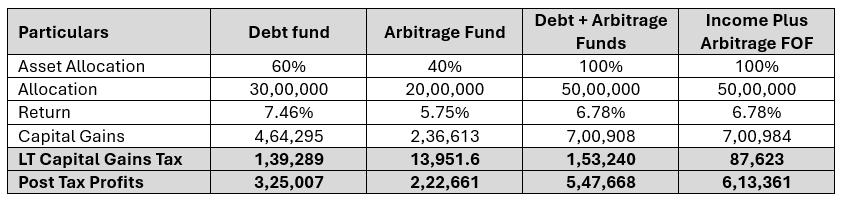
Source: ICRA, AMFI, Period: 1st April 2016 to March 31st March 2026. Above illustration is purely for investors education purposes and not indicative of actual taxation. Consult with your tax advisor to understand tax consequences of your investments.
Furthermore, there is no incidence of taxation for investors when there is switching between schemes / rebalancing in the FOF.
Conclusion
FOFs with up to 65% debt allocation e.g. Income Plus Arbitrage Funds can be good investment options for investors seeking capital safety, reasonable returns, and tax effectiveness. You should have reasonable returns expectation and minimum 2 years investment horizon in order to get taxation benefits. Investors should consult with their mutual fund distributors or financial advisors Income Plus Arbitrage FOF can be part of their investment portfolios.
Mutual Fund Investments are subject to market risk, read all scheme related documents carefully.
RECOMMENDED READS
LATEST ARTICLES

The information being provided under this section 'Investor Education' is for the sole purpose of creating awareness about Mutual Funds and for their understanding, in general. The views being expressed only constitute opinions and therefore cannot be considered as guidelines, recommendations or as a professional guide for the readers. Before making any investments, the readers are advised to seek independent professional advice, verify the contents in order to arrive at an informed investment decision.
Mutual Fund investments are subject to market risks, read all scheme related documents carefully.
Quick Links
Follow Nippon India MF
More About Nippon India MF
POST A QUERY