Why you should have Mid Cap Funds in your portfolio in current market conditions

Current market context
The market has turned highly volatile since the outbreak of the US - Iran War earlier this year. The closure of Strait of Hormuz has impacted global energy flows and caused a surge in commodity prices, especially crude oil. High commodity prices has an impact on inflation, interest rates and bond yields. Rising bond yields have impacted global risk sentiments, especially towards emerging markets like India. On a year to date basis, Foreign Institutional Investors have pulled out Rs 296,466 crores from Indian equities (see the chart below).
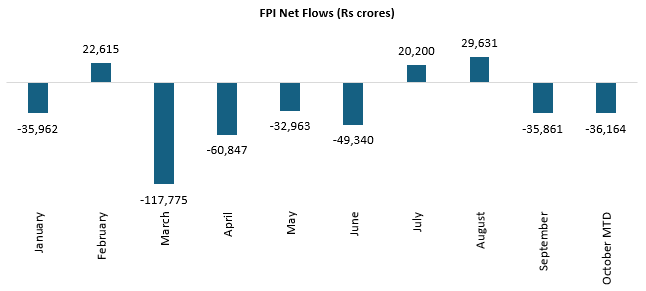
Source: NSDL, Advisorkhoj Research, as on 27th October 2026
Since FIIs mostly invest in large cap stocks, large cap stock prices have been affected more by FII sell-off compared to midcap and small cap stocks. While the stock market has been highly volatile and geo-political uncertainty sustains well into 3rd quarter of FY 2026-27, the macros of Indian economy remain strong. India's Q1 FY 27 GDP growth rate was 7.8% beating estimates, while the Q2 GDP growth rate forecasted by the RBI is 7.2% (source: RBI MPC meeting). At the same time, the valuations of the midcap stocks have moderated significantly to much more reasonable levels than seen in past. In current market conditions, midcap funds may provide attractive investment opportunities to investors with long investment horizons.
Wealth creation potential of midcap stocks
Midcap funds have always been popular with retail investors. Midcap funds have second highest assets under management (AUM) among diversified equity funds. The reason midcap funds are popular with investors, is their wealth creation potential. The chart below shows the growth of Rs 1 lakh investment in the midcap index, Nifty Midcap 150 TRI versus the broad market index, Nifty 50 TRI over the last 20 years. Your investment would have multiplied 15.5X in the midcaps (versus 7.8X in Nifty 50).
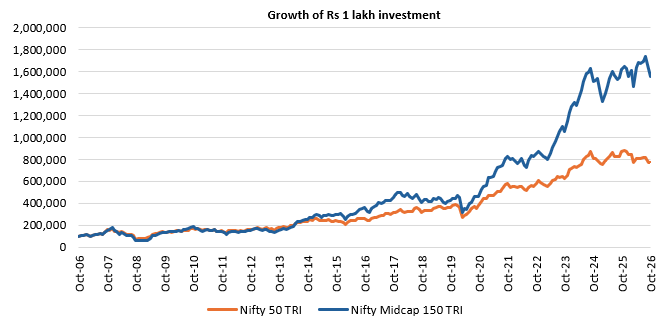
Source: National Stock Exchange, Advisorkhoj Research, as on 27th October 2026
Midcaps outperformed large caps and broad market over longer investment tenures
The chart below shows the 5 year rolling returns of the midcap index, Nifty Midcap 150 TRI versus the large cap index, Nifty 100 TRI and the broad market index, Nifty 50 TRI over the last 20 years. You can see that Nifty Midcap 150 TRI outperformed the other two indices most of the time.
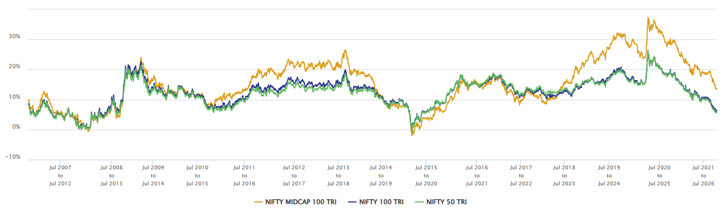
Source: National Stock Exchange, Advisorkhoj Research, as on 27th Oct 2026
Let us now see how the midcap index performed versus the large cap index and the broad market index over 10 year investment tenure. You can see that the midcap consistently outperformed the other two indices.
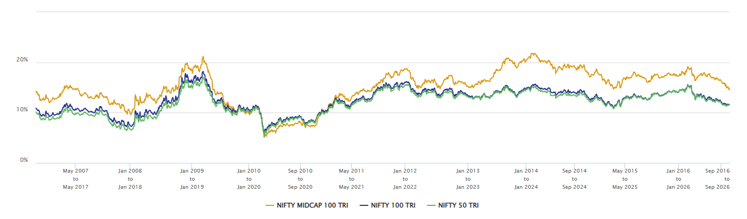
Source: National Stock Exchange, Advisorkhoj Research, as on 27th October 2026
The below shows the returns distribution of the midcap index versus the large cap index for different investment tenures. You can see that over 7 years plus investment tenures, Midcap always gave positive returns. At the same time the percentage instances of 15%+ CAGR returns (marked in red) is significantly higher for Midcap across investment tenures.
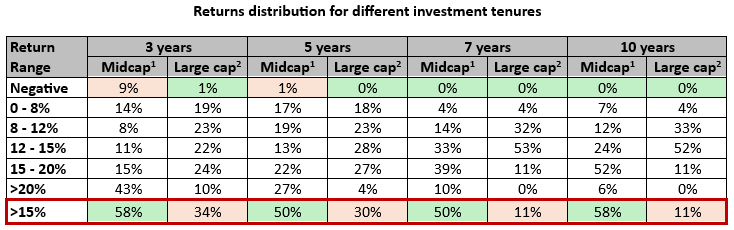
Source: National Stock Exchange, Advisorkhoj Research, as on 27th October 2026. 1. Nifty Midcap 150 TRI, 2. Nifty 100 TRI
Suitable for SIPs
Systematic investment plans (SIPs) are popular investment avenues for retail investors, especially for investing in midcap funds. Midcap funds are best suited for long investment tenures (see table above). Through SIP you can keep investing relatively small amounts and remain invested over long investment tenures. The relatively high volatility of these funds also make them suitable for SIPs. SIPs take advantage of volatility through Rupee Cost Averaging. The chart below shows the growth of Rs 10,000 SIP in the midcap index (Nifty Midcap 150 TRI) versus the large cap index (Nifty 100 TRI) over the last 20 years. With a cumulative investment of just Rs 24 lakhs, you could have accumulated a corpus of ~ Rs 1.6 crores in midcap (versus ~Rs 86 lakhs in large cap index.
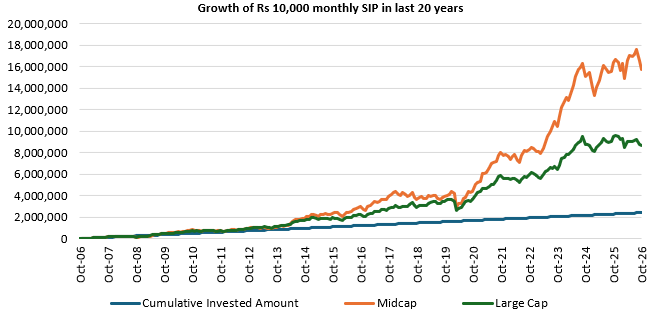
Source: National Stock Exchange, Advisorkhoj Research, as on 27th October 2026. Midcap is represented by Nifty Midcap 150 TRI while large cap is represented by Nifty 100 TRI
The below shows the SIP rolling XIRR distribution of the midcap index (Nifty Midcap 150 TRI) for different investment tenures over the last 20 years. You can see that the midcap index never gave negative returns over 3 years plus investment tenure over the last 20 years. For 8 years plus SIP tenures, you can see that the midcaps gave 12+ XIRR returns in at least 95% of instances. The table below shows the importance of having long SIP tenures for your midcap funds.
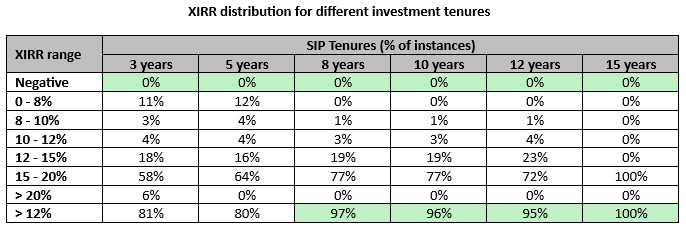
Source: National Stock Exchange, Advisorkhoj Research, as on 27th October 2026
Broader sector exposure
The universe of midcap stocks (150 stocks) is broader than large caps. Midcaps provide broader sector exposure than large cap stocks. There are several sectors dominated by midcap stocks, which are under-represented in large caps or where large caps have no presence e.g. consumer durables, consumer services, realty, chemicals, textiles. These sectors can play an important role in the consumption driven India Growth Story.
Lower downside risks compared to small caps
Though small cap space may have more potential multi bagger stocks, midcap stocks while generating alphas for your portfolio can limit drawdowns relative to small caps (see the chart below). Midcap stocks have proven business models, stronger balance sheets and many market leaders in industry niches. As such midcaps are better positioned to weather economic slowdowns / recessions and tend to be less volatile than small cap stocks.
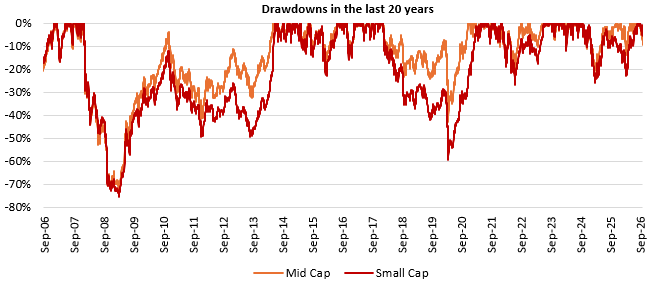
Source: National Stock Exchange, Advisorkhoj Research, as on 27th October 2026. Mid Cap is represented by Nifty Midcap 150 TRI and Small Cap by Nifty Small Cap 250 TRI
Why invest in midcap stocks now?
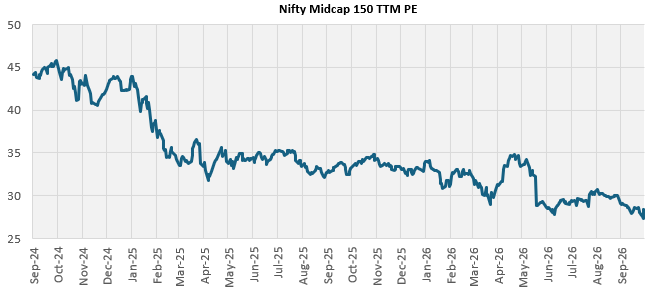
The market correction beginning in September 2024 has moderated midcap valuations to reasonable levels (see the chart below). Though the midcap index has remain flat to slightly positive in the last one year (ending 30th September 2026), you can see that the PE ratio is significantly lower than what it is was one year back. This clearly shows that earnings are catching up with valuation. The strong earnings growth and reasonable valuations can provide attractive investment opportunities to investors at current levels.
Source: National Stock Exchange, Advisorkhoj Research, as on 30th September 2026
Stock selection is important
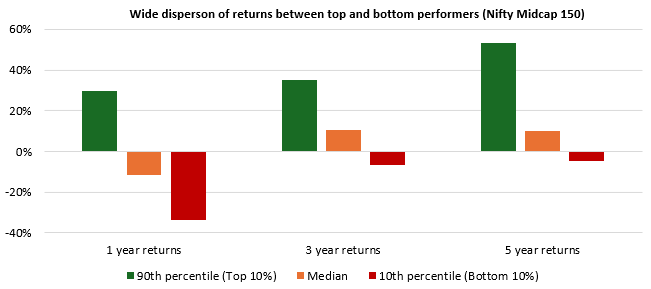
The universe of midcap stocks is significantly bigger than large caps (150 versus 100 stocks). The cross-sectional dispersion of returns i.e. difference in returns between top and bottom performers is quite large in midcap segment (see the chart below). Stock selection plays a very important role in midcap funds and top performing funds can generate significant alphas for investors.
Source: Advisorkhoj Research, NSE, as on 27th October 2026
You should always invest in funds that have long track record of consistent outperformance relative to the benchmark index. You should also look at the performance of other funds managed by the fund manager and the track record of the asset management company (AMC). You should consult with your financial advisor or mutual fund distributor if you need help in selecting funds for your investment portfolio.
Who should invest in midcap funds?
- Investors seeking capital appreciation or wealth creation over long investment tenures.
- Investors who are comfortable with high short-term volatility.
- Investors who have minimum 5-year investment tenures.
- Investors with very high-risk appetites.
- SIP can be highly effective for midcap funds.
- Lump sum investments on dips can also be suitable provided investors have long investment tenures.
Investors should consult with their financial advisors or mutual fund distributors how they can add midcap funds (if suitable) to their investment portfolios.
Mutual Fund Investments are subject to market risk, read all scheme related documents carefully.
RECOMMENDED READS
LATEST ARTICLES
- Why you need to focus on asset allocation in current market conditions
- How a fund of funds with 65 percentage allocation to debt can be of use for risk averse investors
- Role of asset allocation in achieving your financial goals
- Why having large and midcap funds in the portfolio matters now
- Role of index funds in portfolio construction

The information being provided under this section 'Investor Education' is for the sole purpose of creating awareness about Mutual Funds and for their understanding, in general. The views being expressed only constitute opinions and therefore cannot be considered as guidelines, recommendations or as a professional guide for the readers. Before making any investments, the readers are advised to seek independent professional advice, verify the contents in order to arrive at an informed investment decision.
Mutual Fund investments are subject to market risks, read all scheme related documents carefully.
Quick Links
Follow Nippon India MF
More About Nippon India MF
POST A QUERY