Why is this a time for gold? How much to take exposure to Gold especially amidst the global uncertainties

We are living in times of elevated geo-political uncertainties. After a volatile 2025 due to global trade uncertainties, US and Israeli air strikes on Iran followed by Iran's counter strikes on Israel and US military bases in the Gulf region, again threw global financial markets into turmoil. The war has severely disrupted global crude oil and LNG shipments from the Persian Gulf region. Oil tanker traffic through Strait of Hormuz has virtually halted. Crude oil prices surged to over $100 barrel. Qatar, the world's largest producer of LNG, has declared force majeure on LNG exports and this can cause severe LNG crisis globally.
Developed markets ex US (e.g., Japan, UK, Germany, France, South Korea etc) are down 5 - 11% since the war broke out in the Middle East. The Dow Jones was down 3%, while China fared slightly better, with the Shanghai composite down 1% (source: Bloomberg, as on 6th March 2026). The Nifty 50 broke down below the 24,000 level in intraday trade on 9th March and closed just above 24,000 by close of 9th March (source: NSE). Gold meanwhile surged to Rs 1.67 lakhs per 10 grams and is holding strong at Rs 1.59 lakhs per 10 grams (source: MCX, as on 9th March 2026). In a circular dated 26th February 2026, SEBI has allowed equity funds, to invest the residual part of their assets (after meeting the core allocation mandate) in gold and silver. This will provide more flexibility to fund managers to invest the residual portion beyond the usual overnight, liquid and money market instruments.
Why invest in Gold in times of uncertainty?
Gold is considered to be safe haven asset because its value is not impacted by wars, geo-political or economic turmoil. If we look at long term price history of gold, we can see that price of gold usually rises in times of economic slowdown or recession since the demand for gold goes up during such periods.
Gold as a hedge against inflation
While the purchasing power of currency declines over time due to inflation, gold retains its purchasing power over time, as gold is a store of value. In the last 15 years, gold failed to beat inflation only 4 times (see the chart below). Over sufficiently long investment tenures gold is a very hedge against inflation.
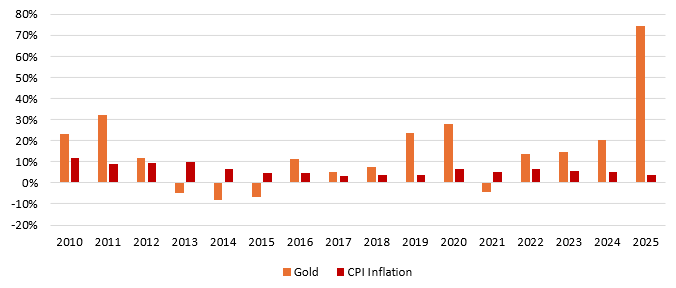
Source: MCX, World Bank, CBDT as on 31st December 2025
Gold as hedge against currency depreciation
Historical data shows that gold acts as hedge against currency. When dollar or rupee depreciates, the price of gold increases. Furthermore, globally gold is priced in US dollars. When the INR depreciates against dollars, the price of gold in INR increases. Therefore, gold can be an effective hedge against INR depreciation.
Gold for asset allocation
Gold is counter-cyclical to equities. Gold outperforms when equity underperforms and vice versa. Adding gold in your asset allocation helps to balance risk and return and provide greater stability to your portfolio.
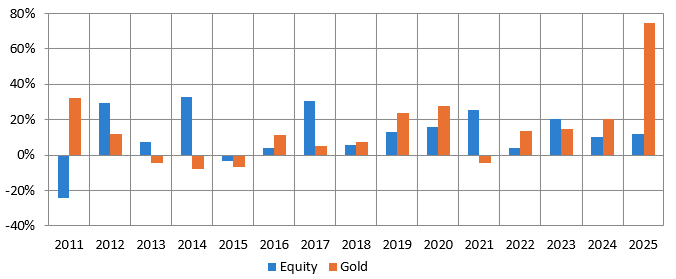
Source: MCX, NSE, as on 31st December 2025. Equity is represented by Nifty 50 TRI and Gold by MCX spot prices
How Gold performed in major Market Drawdowns?
The table below shows how equity and gold performed in major market drawdowns over the past 20 years. You can see that gold gave positive returns in almost all major drawdowns, limiting downside risks and providing stability to investors portfolios in major market corrections or bear markets.
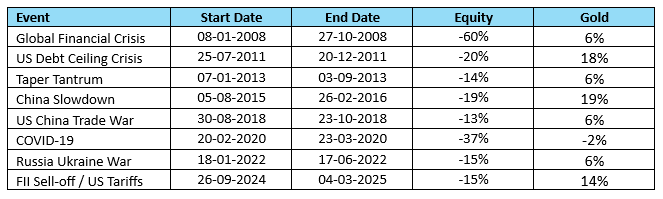
Source: MCX, NSE, as on 31st December 2025. Equity is represented by Nifty 50 TRI and Gold by MCX spot prices
Why you need to have long investment tenures for gold?
Gold can underperform versus other asset classes for extended period (see the chart below) especially in periods when the US dollar is strengthening. Therefore, you need to have long investment horizons for gold.
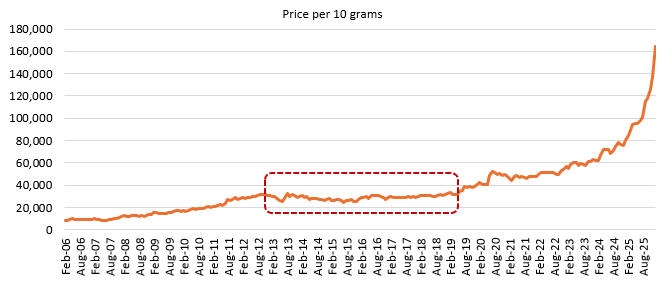
Source: MCX, as on 28th February 2026
How much gold should you have in your asset allocation?
Your gold allocation will depend on risk appetite and investment needs. Financial advisors usually recommend 10 - 15% allocation to gold. In times of extreme prolonged economic uncertainty or economic downturns you can increase your gold allocations to 30 - 35%. However, you need to have long investment horizons and not make speculative investments. Also, if you are planning to gift gold to your children at the time of their wedding, you can invest in gold systematically according to your investment goal. You can accumulate gold over long investment horizons, by investing in gold fund of funds through SIP. You should consult with your financial advisor or mutual fund distributor to discuss how much gold you should have in your asset allocation.
How to invest in Gold?
Traditionally, jewellery is the most popular type of gold investment in India. However gold jewellery may have impurities, which are deducted from the weight of gold if you want to sell your gold jewellery for cash. Furthermore, gold jewellery often comes with additional expenses like making charges and storage charges e.g., bank locker charges. Gold ETFs and FOF, on the other hand, does not have impurities. The price of gold ETFs / FOF reflect the price of physical gold (of 99.5% purity). Gold ETF / FOF investors do not have to incur expenses like making or storage charges. Furthermore, the minimum investment required to invest in physical gold is much higher than gold ETF / FOF. Your investment in Gold ETF/ FOF investments are much more cost efficient compared to investing in physical gold.
Should you invest in Gold ETF or Gold FOF?
Expense ratios (TERs) of gold ETFs are lower than gold FOFs - gold ETFs are more cost efficient. However, you need demat and trading account to invest in Gold ETFs. If you do not have demat or trading account, then you can invest in gold FOF. Another advantage of gold FOF is that you can invest in them from your regular savings through systematic investment plans (SIP) over long investment horizon.
Conclusion
Last 12 months have been very difficult times for investors. Geopolitical uncertainty seems to be intensifying, and high volatility seems to be the new normal. In this article, we have discussed how gold can bring stability to your portfolio. Investors should consult with their financial advisors or mutual fund distributors on how to add gold ETFs or gold Fund of Funds to their asset allocation.
Mutual Fund Investments are subject to market risk, read all scheme related documents carefully.
RECOMMENDED READS
LATEST ARTICLES
- Why you need to focus on asset allocation in current market conditions
- How a fund of funds with 65 percentage allocation to debt can be of use for risk averse investors
- Role of asset allocation in achieving your financial goals
- Why having large and midcap funds in the portfolio matters now
- Role of index funds in portfolio construction

The information being provided under this section 'Investor Education' is for the sole purpose of creating awareness about Mutual Funds and for their understanding, in general. The views being expressed only constitute opinions and therefore cannot be considered as guidelines, recommendations or as a professional guide for the readers. Before making any investments, the readers are advised to seek independent professional advice, verify the contents in order to arrive at an informed investment decision.
Mutual Fund investments are subject to market risks, read all scheme related documents carefully.
Quick Links
Follow Nippon India MF
More About Nippon India MF
POST A QUERY